
Will you chip in to support our nonprofit newsroom with a donation today?
Yes, I want to support My MLTnews!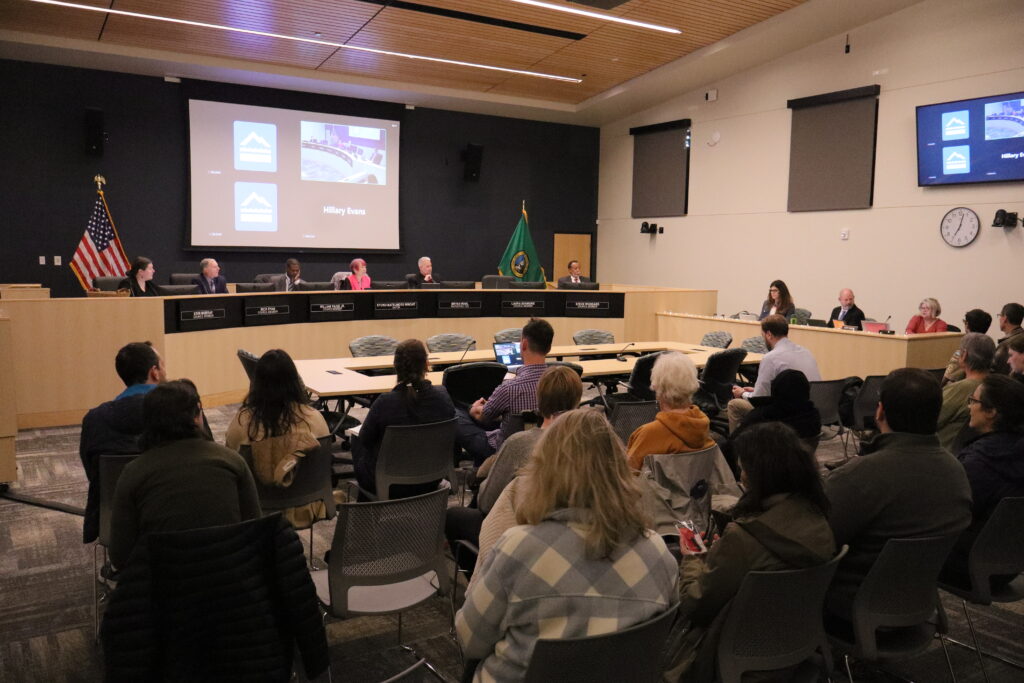
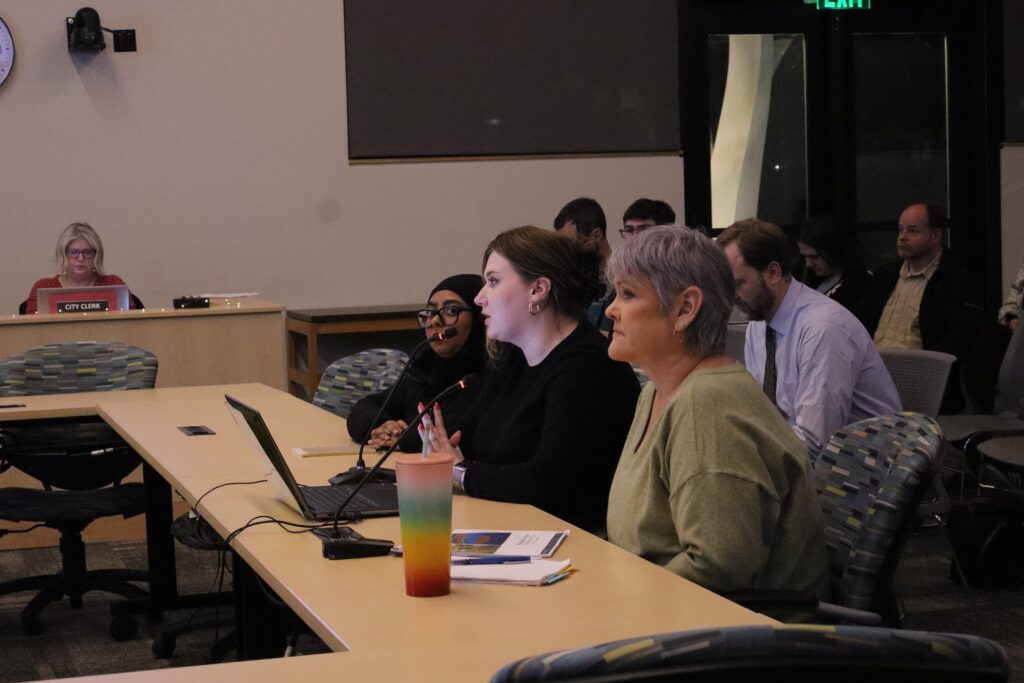
Board members of the Mountlake Terrace Community Foundation (MLTCF) presented a food forest and community garden proposal to the Mountlake Terrace City Council during its Thursday meeting. The council also voted 6-0 to cancel the Flock Safety contract (see related story here).
MLTCF board member Audrey Meyer described a food forest as where edible plants are organized to mimic the ecosystems and patterns found in nature.
“A food forest has many benefits, many more than just an orchard because there is biodiversity, which has resiliency,” Meyer said. “There’s less likelihood of pests from having monocultures. When you have biodiversity, there’s more wildlife habitat. With increased resiliency, you can have greater abundance of food production, and you have a variety of food that you can produce.”
Meyer added that having a food forest increases carbon sequestration and tree canopy, which aligns with the City’s Urban Forest Management Plan of increasing tree canopy to 37% by 2050.
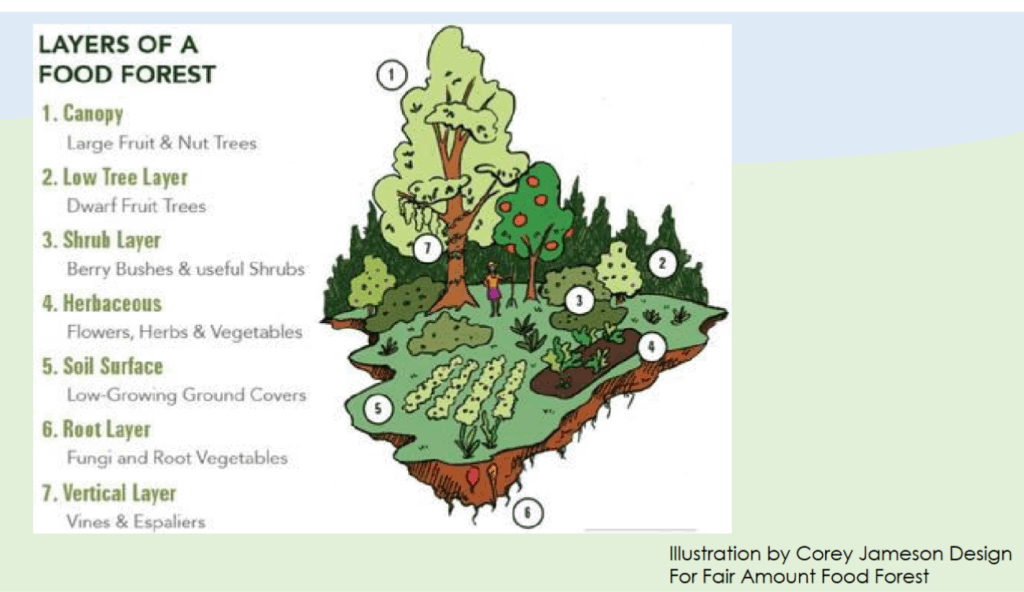 She described seven layers (and a bonus layer) of a food forest including:
- Canopy layer (walnut, dogwood)
- Understory (apple, cherry, pear)
- Shrub layer (variety of berries)
- Herbaceous layer (rhubarb, asparagus, thyme, lavender)
- Ground cover (oregano, strawberry, kinnickinick)
- Root layer (onions, potatoes, garlic)
- Vine (grapes, figs, kiwis)
- Bonus layer: Fungi
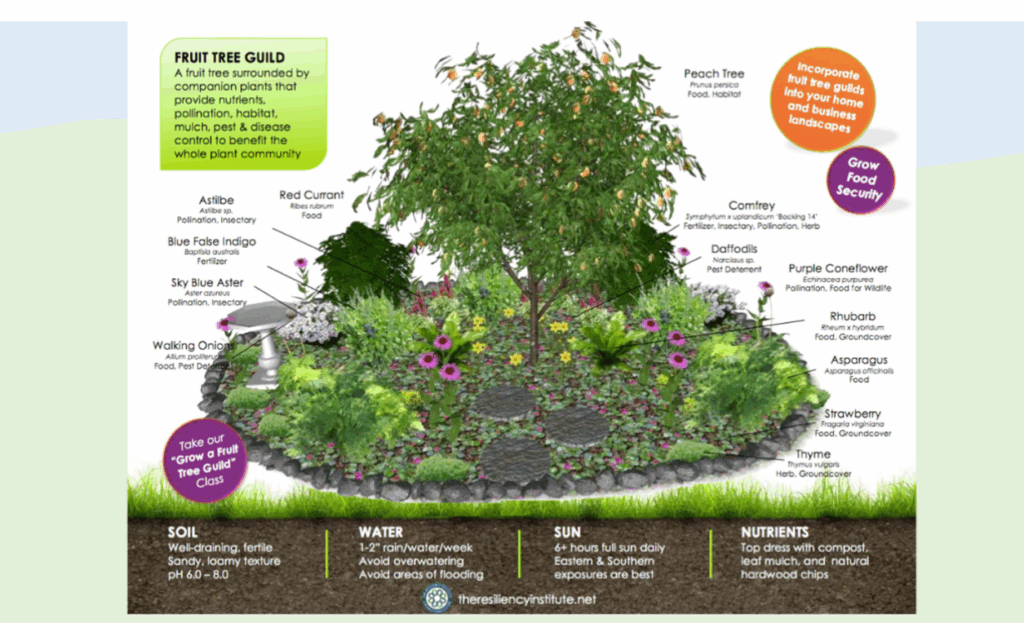
She also described a forest guild, which serves as the “building blocks” of the food forest. “In a guild, the plants together produce more than they would alone because they provide different services,” Meyer said. “Again, this is great because it’s less work for the gardeners.”
She highlighted several roles a forest guild offers, including:
- Provides nitrogen fixers, which extract nitrogen from the air for a variety of plants to use
- Attracts pollinating insects while repelling harmful ones
- Builds mulch and adds nutrients to soil
Meyer said the Ballinger food forest would create a vibrant sanctuary where the community cultivates a diverse range of perennial food plants, using education, collaboration and sustainable practices.
“We empower everyone to grow, share and celebrate the abundance of our shared resources. Here, we inspire lasting stewardship of the environment, develop meaningful relationships and ignite a passion for growing food that expands possibilities for a healthier, more resilient future,” she said. “It’s a really great ice breaker, great way to meet your neighbors, bring different people together that you might not have met otherwise and definitely made friends.”
Meyer told My MLT News that the food forest will be an “open harvest,” meaning that anyone can harvest freely from a site “with the understanding that they will take what they need and leave some for others.”
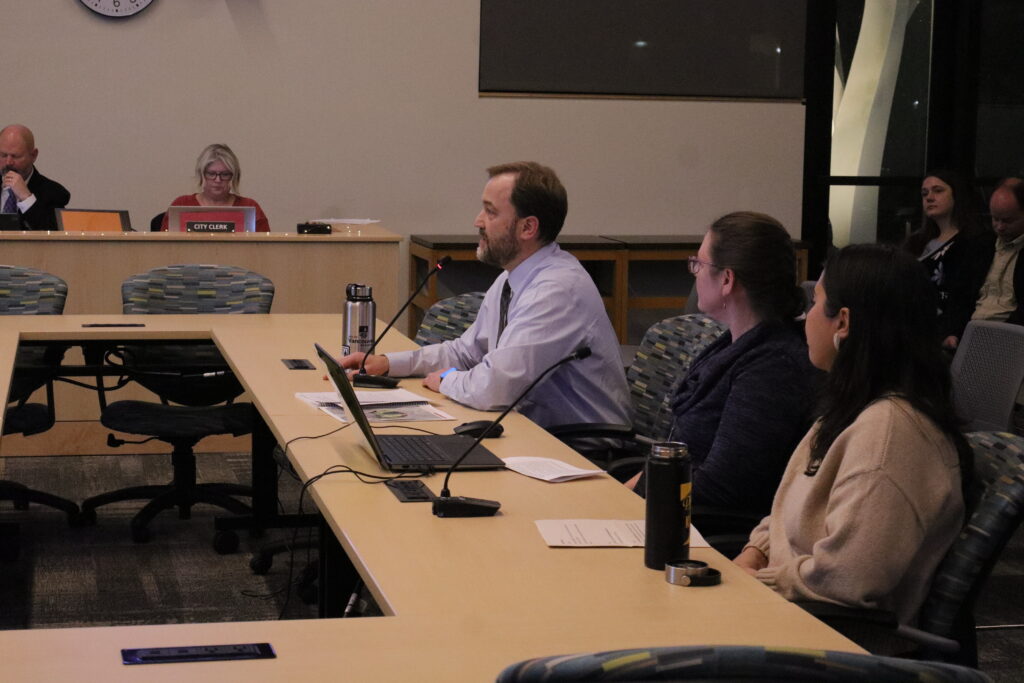
The Foundation is also proposing a community garden, which MLTCF board member Robyn Rice said has a different purpose from a food forest. She said a garden focuses on perennial crops grown in individual plots that gardeners rent each spring, which they plant, maintain and harvest themselves.
“This is becoming more and more important with the rising cost of groceries at the store, and allows people to grow things that might not be available in the market,” Rice said. “And it also allows people to have access to areas to grow food when they might not have them at home, such as people living in apartments, condos and townhouses.”
The food forest and community garden will be located near the northeast slope of Ballinger Park by Lakeview Drive. Councilmember Steve Woodard pointed out car pollutants that likely contaminate the garden.
“When I drive down and I see a blackberry [bush] on the side of the road, I don’t think I’m going to pick that,” he said.
Meyer said the sidewalk and the slope would act as a buffer zone between Lakeview Drive and the garden
“We did meet with a couple of staff of Snohomish Conservation District, and they thought that the site was great. They didn’t have any concerns with that,” Meyer said. She added that the soil will also be tested for its quality.
Cost and expenses
The cost of building a food forest is $14,200, which includes the plants, irrigation, compost, signage and public art, according to Rice. Meanwhile, the community garden would cost $29,300, which includes raised bed, irrigation, signage and cedar chips.
Rice said when the Ballinger Master Plan was published in 2015, the cost estimates for installing the garden and food forest was about $230,000. In 2025, the cost has increased to about $315,000.
“Our estimate of $60,000 [for the garden] is only 20% of that. We’re pretty confident that we can get these in the ground with what we’ve estimated because they’ve been itemized costs based on what we’ve seen in the stores,” Rice said. “We also feel like this is a really great value for getting over half an acre of growing space in Ballinger park for food.” She added that “$60,000 is still a very large expense, though, and the Community Foundation is actively looking into sources for funding and donations.”
Garden safety, crop protection
Rice also told My MLT News that higher participation in the community garden can reduce the risk of equipment theft and vandalism in the public areas. “There is significant benefit to having these food growing spaces in Ballinger Park, which has a very high use rate, and there is then minimized opportunity for vandalism,” she said. “We also are hoping to include murals on the shed; public art has been shown to limit graffiti. All tools would be secured with limited access from day to day, and opened during work parties.”
To deter animals from eating or damaging crops, Rice said the community garden would have raised beds that elevate crops to limit access by smaller animals, such as rabbits and dogs. “Other protections would be up to the individual gardener who could install crop covers as they see fit. For the food forest, the design of individual guilds help with integrated pest management, in that the different plants actively help protect each other more than in a standard orchard. Many plants in the herb layer contribute to deterring pests and attracting beneficial insects.
“For example, plants that have umbrella-like flowers, such as dill and fennel, attract parasitic wasps that attack some undesirable insects while also providing pollination. Planting a variety of trees, rather than a single species monocrop, can help prevent pest infestations.”
“One aspect of a food forest is that you are working with the ecosystem,” Rice continued. “There is enough food for all, and some food loss to animals is expected, but there is still enough for folks to harvest.”
Rice and Meyer said MLTFC is looking into grants, community donations, fundraisers and sponsorships of an individual tree or plant.
MLTFC will host a volunteer meeting Monday, Dec. 8, at 6 p.m. at the MLT Library for community members who are interested in volunteering. Email Robyn Rice at [email protected] or Audrey Meyer at [email protected] for details.
Details of the presentation can be found on the City’s website.
Housing Action Plan
The City Council voted 6-0 to adopt the Mountlake Terrace Housing Action Plan. (Councilmember Laura Sonmore was absent from the meeting.)
Community and Economics Development Director Christy Osborne, ECOnorthwest Project Manager Mackenzie Visser and Associate Planner Mirna Ali highlighted updates, including ongoing engagement with developers, mitigating junk fees, regional coordination and inviting community land trusts.
The plan also outlines five housing policy priorities: Supporting housing production, investing in mixed-use areas, incentivizing affordable units, increasing housing diversity and preventing displacement.
Councilmember Rick Ryan asked how would the action plan reduce the risk of displacement for those living in mobile home parks.
While Osborne said her department doesn’t have “anything on the books right now,” she and her colleagues are working on various strategies and protections that other communities are using.
“One of the things that we’re required to do under the Growth Management Act [is] to address displacement in some of our existing housing stock,” she said. “Some of our older multi-family accommodations where we might tear down something and could have a negative impact – for our mobile home parks in particular. That would be something that we again would work through with the planning commission and bring forth to council members as far as some of the actions that Council could potentially take to modify displacement of current residents in those situations.”
Ryan asked if Mountlake Terrace already has protected zoning for mobile homes.
“We do,” Osborne said. “One of the things that we are seeing that I would like to address is that if you have to replace the current mobile home in one of those parks, it can be very difficult due to the current regulations that we have in those parks.
“So we want to take a fresh look at that and see maybe if we can minimize some of those setback standards, or some of those requirements. When some of that housing stock is beyond its useful life, that somebody could then replace one of those units in existing space in those mobile home parks, which is somewhat difficult to do right now,” she added.
The Housing Action Plan presentation can be viewed on the City’s website.
In other business:
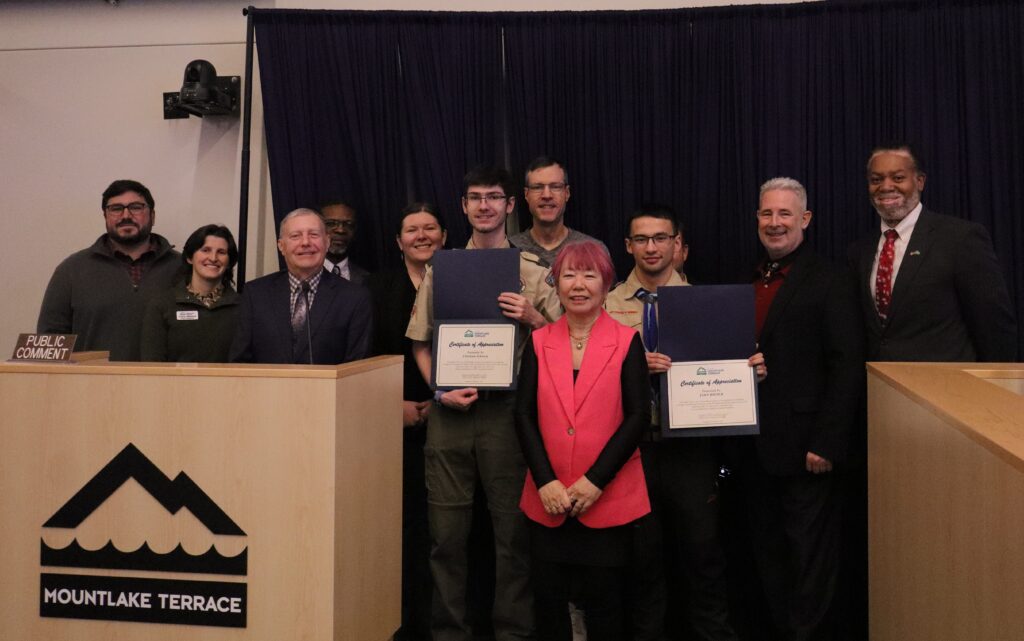
- Eagle Scouts Eoin Ritter and Christian Johnson were recognized for their work in the restoration of Terrace Creek and Terrace Creek Overlook, respectively.
- Councilmembers approved the extension of the City’s contract with the federal lobbyist The Johnson Group to the consent agenda on Dec. 18. City Manager Jeff Niten said there will be a 3% annual increase starting from a $4,961 monthly retainer. That means a two-year extension with a 3% increase in each year would result in a monthly retainer of $5,110 in 2026 and $5,265 in 2027.
Since 2007, The Johnston Group has secured more than $10 million in federal funds for various city projects. Niten said the City is continuing to pursue federal funding for replacing the roofs of MLT Library and the Lake Ballinger Center.
The full meeting can be viewed on the City’s YouTube channel.


Real first and last names — as well as city of residence — are required for all commenters.
This is so we can verify your identity before approving your comment.
By commenting here you agree to abide by our Code of Conduct. Please read our code at the bottom of this page before commenting.