
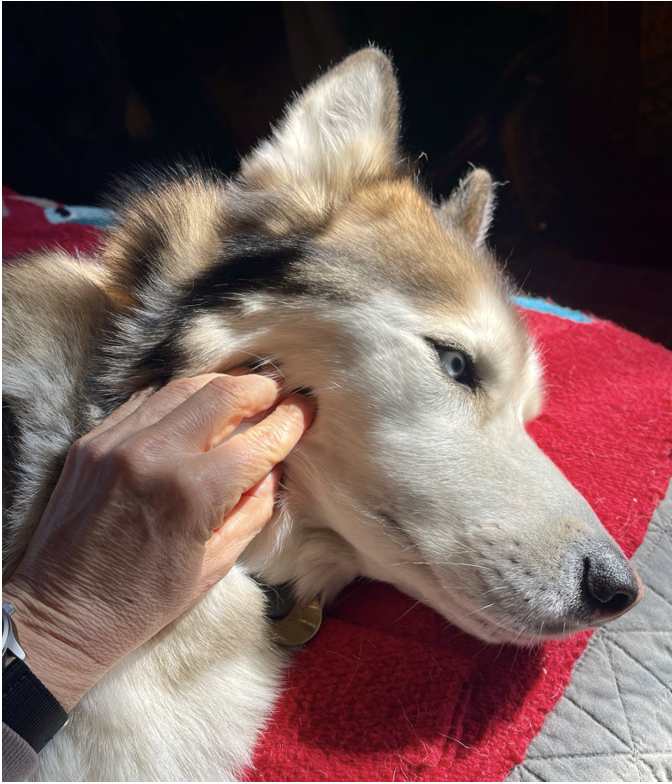
You know that tightness in your hip that you’re hoping will go away on its own? The one that doesn’t hurt that bad, so it’s fine? But you’ve been walking differently. Your opposite knee works harder. Your back compensates. You’re dealing with pain in places that seem unrelated to that hip. Not only are they related — they are connected. By fascia.
What Is Fascia (And Why You Should Know)
My name is Kristin Schwartz of Standing Strong Animal Massage, and I’m a licensed animal massage therapist, serving South Snohomish and North King counties. One of the things I love most about this work is helping people understand fascia — because once you know what it does, so much about your dog’s movement and comfort starts to make sense.
Think of fascia as one continuous sheet of plastic wrap (connective tissue). It wraps around every muscle fiber, organ, nerve and blood vessel. When fascia is healthy and hydrated, it allows muscles to slide and glide smoothly against each other with every movement. Your dog jumps, runs, plays and moves with ease because everything underneath their skin is working like a well-oiled machine.
Fascia is living tissue that responds to stress, repetition, injury, surgery and normal daily activity. Over time, adhesions can form — spots where the fascia gets “stuck” to itself or to the muscle beneath it. In humans, we might notice this as that stubborn knot between our shoulder blades. Our pets experience the exact same thing, even healthy and active animals — except they can’t tell us “my shoulder feels weird.” And when those stuck spots go untreated, they will eventually affect other parts of the body. We don’t notice until they’re limping and by then, the root cause has been developing for a lot longer than we realize.
What Restricted Fascia Looks and Feels Like
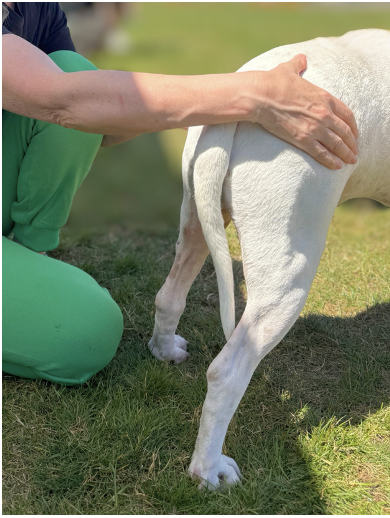
Here’s what most people don’t realize: You can actually see and feel fascial restrictions in your dog.
With mildly restricted fascia, you might notice their skin doesn’t bounce back immediately after you gently lift it up with your fingertips. As that fascial restriction progresses, it gets increasingly difficult to lift the skin until you can’t lift it at all. Sometimes the skin might even feel hard. This is local fascial dehydration — the tissue itself becoming less pliable. This is not to be confused with your dog needing more water.
The Before and After Never Gets Old
Something happens regularly in sessions regarding fascial restriction: When I first put my hands on an animal to assess, there’s often an area they don’t want me to touch. I notice it right away — they’ll shift, tense up, move an ear or give me side eye — sometimes their guardian isn’t even sure there is discomfort. I continue with my assessment and eventually make my way back to that uncomfortable spot. The dog is usually more intentional with signals the second time around because ”I already told you I don’t like that.” All along, I’ve been creating a massage plan for that animal on that day.
By the end of the session? I can touch those same areas, pick up the skin easily and get zero reaction in mild and moderate cases. I have helped make room in their body to release that restriction and the discomfort is gone. That before and after transformation gets me every single time.
Prevention Matters
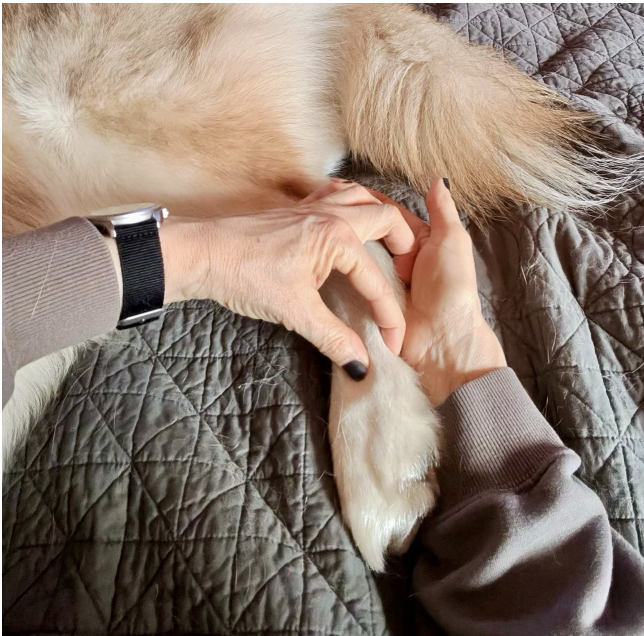
Many of my clients are older dogs living with arthritis or mobility issues, or recovering from injury (I also see cats). Increasingly, I’m seeing younger, healthy dogs carrying fascial restrictions their owners didn’t know were there.
Not working dogs or canine athletes. Regular family dogs who play, go for walks and chase balls. Normal, active lives — and normal, gradual buildup of tension in their bodies.
Bodywork isn’t just for animals who are already struggling. It’s also for maintaining the health and function of animals who seem perfectly fine — because that’s when we can actually prevent the compensation patterns, gait changes and long-term mobility issues.
Sometimes your pet’s fascia is being affected simply because they weren’t born with a perfectly aligned body — of course that’s most of us on the planet, humans and animals alike! I’ll talk more about that next month.
If you’re curious whether your pet might benefit from bodywork, I’d love to answer any questions you might have. Learn more at StandingStrongMassage.com, call/text 425-561-9156 or email [email protected]. Because the best time to address fascial restrictions isn’t when your dog is limping. It’s before their bodies ever have to compensate.


Real first and last names — as well as city of residence — are required for all commenters.
This is so we can verify your identity before approving your comment.
By commenting here you agree to abide by our Code of Conduct. Please read our code at the bottom of this page before commenting.