
Will you chip in to support our nonprofit newsroom with a donation today?
Yes, I want to support My MLTnews!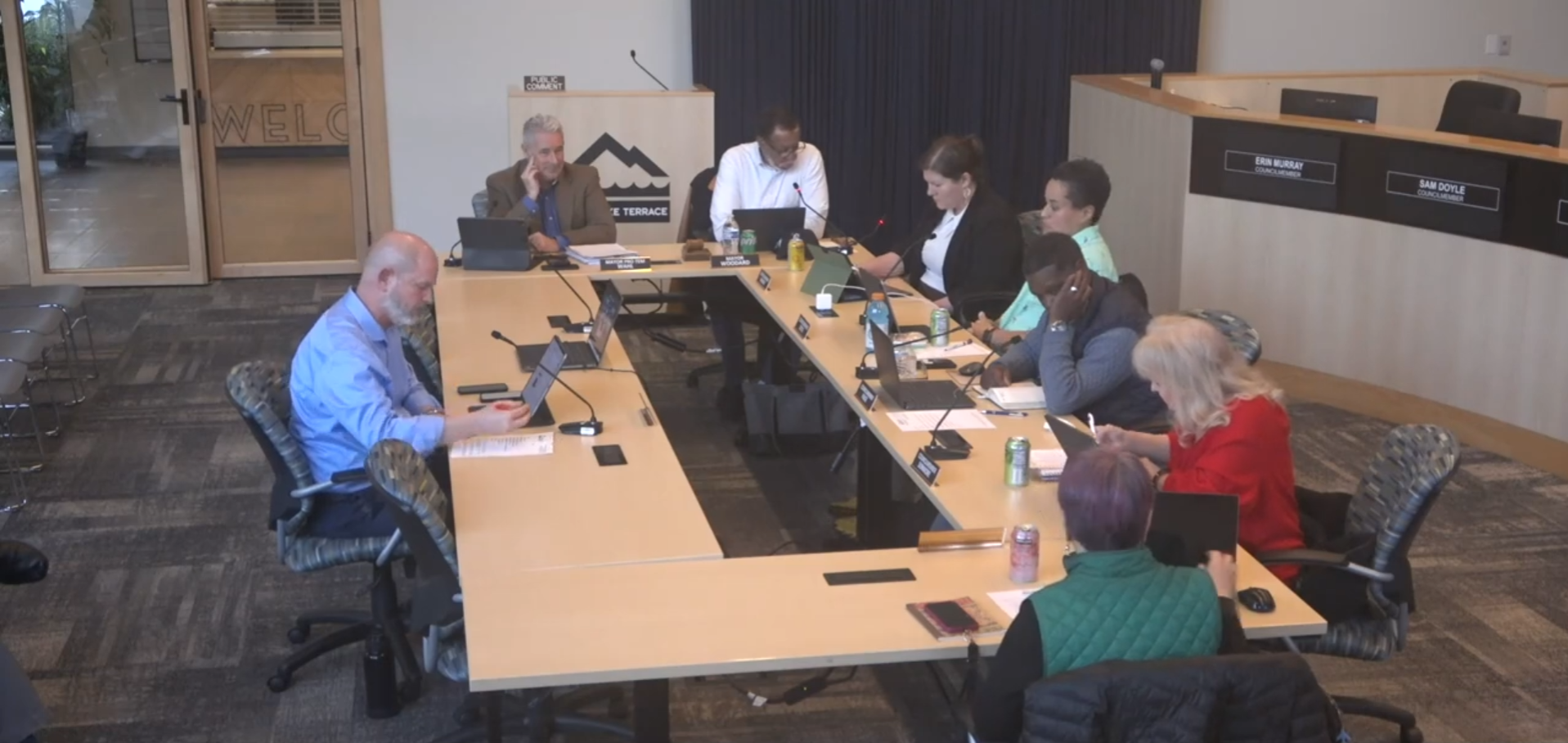
Key takeaways
- The Council reviewed the City’s fourth quarter budget. While some revenue is below expectations, the City is $2.26 million ahead of its budget projections.
- Events Coordinator Andrew Appelwick summarized 2025 City events and previewed what is planned for 2026.
- Recreation and Parks Director Jeff Betz requested approval of a contract with MUSCO Lighting to upgrade the lighting at the Evergreen Playfield tennis courts.
- Public Works Director Gary Schimek asked the Council to adopt the updated interlocal agreement with the City of Lynnwood for wastewater management.
The Mountlake Terrace City Council reviewed the City’s fourth-quarter 2025 budget report with Finance Director Sirke Salminen and Senior Accountant Artus Nemati, who detailed each fund’s performance.
General fund
Nemati said the City spent about $2.26 million below what was approved in the 2025 general fund because of cost‑cutting measures and conservative budgeting.
As a result, the City’s main operating fund ended the year with a smaller‑than‑expected drawdown. The general fund balance was reduced by $845,738, compared to a forecasted reduction of $3.1 million, leaving the City about $2.26 million ahead of its budget projections for 2025.
Nemati said the sales tax revenue is “a little bit lower than what was actually received.” According to the presentation, the City is about $700,000 short of its expected revenue of $4.97 million. However, Nemati said that utility tax is slightly over budget, collecting nearly $5.18 million in revenue compared to the adopted budget of $4.21 million.
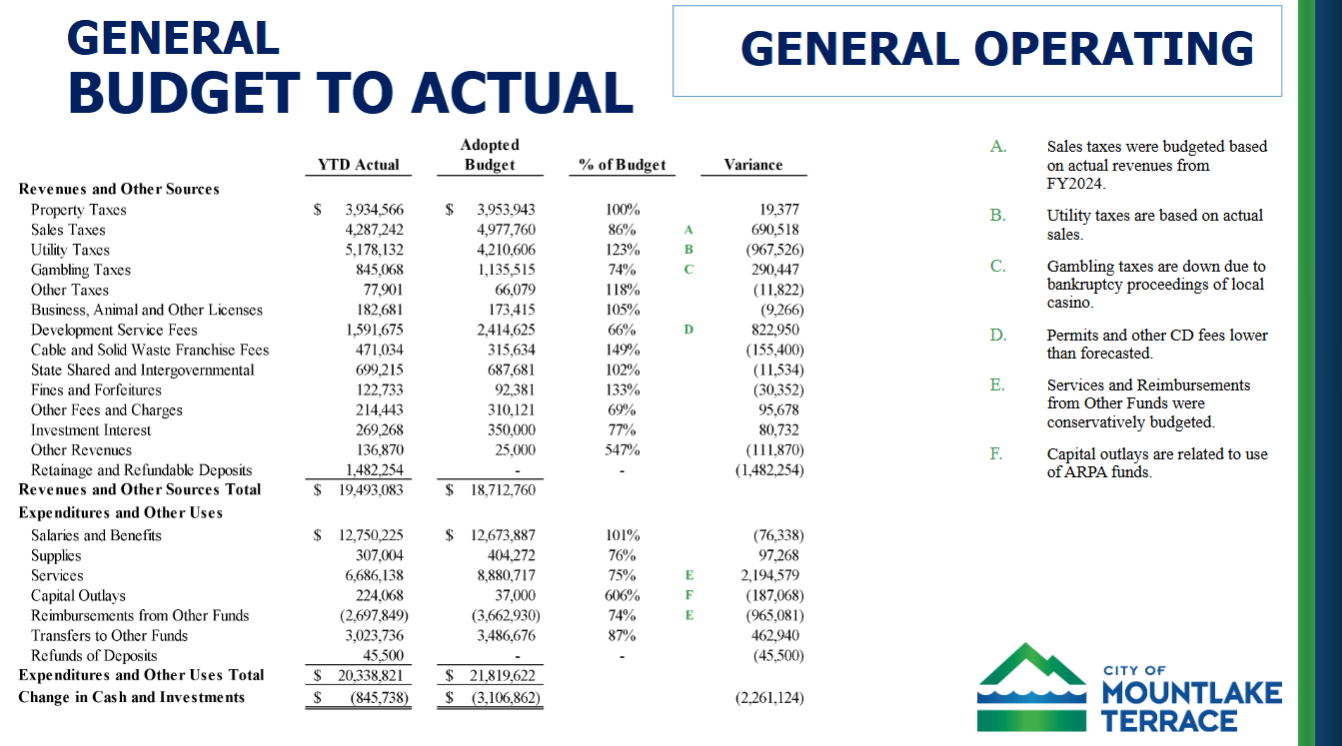
He said gambling taxes are down because Dragon Tiger Casino filed for bankruptcy in 2025, resulting in a $290,000 shortfall. Development services and permit revenues remained lower than the forecast because of slower development activity, he said.
Regarding the overestimated sales tax revenue, Mayor Pro Tem Bryan Wahl said the Council “thought the economy was going to continue in full force, and it just didn’t.” He also asked why the utility tax revenue was high.
Salminen said utility taxes include revenues from water, sewer and storm services, electricity and gas. She said the City may consider budgeting higher in the future, “at least up to that $5 million, instead of $4.2 million.” She said the City may have budgeted conservatively and would need to review previous budget assumptions more closely.
Specialty funds
Salminen and Nemati reviewed how the specialty funds are spent.
- Housing needs fund: About $3,500 was spent for membership in and work with the Housing Authority of Snohomish County (HASCO) There was some interest earnings, with the larger balance being held for future housing-related uses.
- Strategic reserve and accumulated leave reserve: Very little to nothing was spent from these two funds, Nemati said. The funds had earned some interest, and the amounts were transferred to other funds. He added that the accumulated leave reserve is money aside for people retiring if the other funds aren’t able to pay for them.
- Recreation fund: Nemati said the aquatics revenues underperformed because of a planned pool maintenance closure, leaving that program around 71% of its revenue budget.
- Solid waste service fund: This fund had a revenue of about $50,000, which comes from mainly the utility tax. However, the expenditure was about $74,500.
- Street operating fund: Netami said the revenue is lower than expected, but operating expenditures on supplies and services were kept under budget.
- Art fund: About $27,000 was transferred into this fund but had no qualifying expenditures in 2025, Netami said.
- Tree planting fund: There was no revenue or expenditures for this fund. Nemati said it is intended to collect fees in lieu of taxes to support tree-planting efforts, adding that the fund remains in place to accept future fees if they are collected.
- American Rescue Plan Act (ARPA) fund: Nemati said the final ARPA dollars ($105,175) were transferred into the operating or capital funds. With those transfers completed, the ARPA fund will close.
- Opioid settlement fund: About $330,000 was transferred into this fund for drug prevention services.
- Hotel/motel tax fund: This fund – which is allocated to organizations that draw tourism to the city – had revenue of about $69,200, which is about $11,000 more than forecasted. Nemati said the $20,000 expenditure was for Wag Fest.
- General debt service fund: This is primarily a pass-through account for paying debt obligations, according to Nemati. It mainly acts as a holding and payment channel rather than a place where money accumulates or is used for ongoing operations. It had revenue of about $405,000 with expenses of about $711,400. The revenue is about $270,000 short of its forecast.
Nemati said that in prior years the fund accumulated a relatively large balance because transfers exceeded annual debt‑service requirements. In 2025, the City transferred about $450,000 versus a budgeted $711,000. He said the City will align future transfers more closely with actual scheduled debt payments so the fund doesn’t carry an unnecessary surplus.
- Fleet fund: Because of delays in vehicle purchases and long delivery times, Nemati said vehicles ordered in 2025 will not be paid for until they arrive in 2026, shifting those expenses into this year. He added the City is also holding off on some purchases while evaluating needs and potential cost savings. The fleet fund had revenue of $2.6 million and expenses of nearly $1.6 million.
- Information technology fund: Nemati said this fund was recently separated from the general fund and is supported by internal reimbursements from other city funds. As it is the first year the fund is operating independently, he said some budget figures are lower than originally planned and will be adjusted in the next budget cycle to better reflect actual costs and future plans.
- Sewage, water, stormwater funds: Nemati said utility revenues came in slightly above budget due to higher usage, while capital facility charges were lower than expected because of reduced development activity. He said those trends were consistent with earlier projections, noting “there was no major change” since the third quarter.
- For the water utility fund, Nemati said service revenues similarly reflect actual usage, while capital facility charges depend on development levels. On the expenditure side, spending for services came in at about 86% of the budget. He attributed part of that to water purchases still being billed at prior rates, explaining that “water is still being purchased at 2024 rates” while negotiations on updated pricing continue.
- The stormwater fund performed largely as expected, with expenditures “roughly on target” and service revenues slightly higher due to actual usage, Nemati said.
- He added that the fund now also serves as a centralized account for utility-related debt payments. He said that all utility funds transfer money into this account annually to cover their debt, and “that’s all that you’ll see move through here.”
Capital projects
Nemati highlighted several major street construction efforts, including Main Street reconstruction, 66th Avenue West repaving, adaptive signals and school zone signage.
In the parks capital fund, Nemati said impact fee revenues came in significantly below budget due to lower development activity. Despite that, the city funded several major projects, including the Transit Connection Corridor, Ballinger viewing platform and trails, Sound Transit mitigation work, and upgrades to Evergreen Playfields and tennis courts.
Nemati added that real estate excise tax revenues are transferred into other capital funds, where the money is spent on city projects.
Regarding the facilities construction fund, he said this was created to separate projects previously grouped under a single parks capital fund, allowing for clearer tracking of spending. He said the fund is supported by transfers from the parks fund and used for facility-specific projects, including the police roof, HVAC generator, Evergreen replacement buildings and the Lake Ballinger Clubhouse roof, all of which were funded through this account.
Nemati said the enterprise or construction funds — receive transfers and grant funding from other sources. Among the major projects was the Hall Creek biofilter project at 220th Street Southwest and 77th Avenue West.
He said another fund included about $6,000 in actual spending, though the budgeted amount of $750,000 reflects planned work, such as the Cedar Grove waste reduction program and the Northeast sanitary sewer reconstruction.
For the water construction fund, Nemati said major work focused on water main projects, including the Westside Water Main Improvements Project.
Nemati said the City reviewed its outstanding debt balances, including revenue bonds tied to utility funds and Public Works Trust Fund loans. He noted the only new borrowing during the year was “a $141,000 drawdown” on an existing loan, with all other activity consisting of regular payments reducing overall balances.
Regarding the solid waste budget, Wahl asked where that funding appears in the budget report and noted the $25,000 gap between revenues and expenditures.
Salminen said the funding supports a low-income discount program that provides free garbage service. Under the program, Waste Management bills the City directly, and the City covers the cost. She added the Council approved a budget amendment late last year as demand increased, noting “every year, the services have increased, and people have been in need of discount, free garbage.”
City Manager Jeff Niten said current qualification criteria may not fully capture applicants’ income, noting some individuals could appear eligible based on tax documents that “don’t show like all of their retirement income.”
“Somebody could be making $150,000 a year and still qualify,” he said, adding that changes to the requirements are expected to reduce program costs, but they may be “controversial for the folks that have gotten that discount for many years.”
Wahl asked how utility tax revenues are allocated to fund the program, and whether the roughly $49,000 budgeted represents all solid waste utility tax revenues or only a portion. He also suggested future budgets may need to increase that allocation to better match rising costs.
Salminen said the program’s costs historically aligned with available funding, but expenditures have increased in recent years as more residents qualify under current criteria.
Councilmember Laura Sonmore asked how expenditures and fund balances are tracked, and whether there is a cap on annual payouts.
Nemati said the Council approved a budget amendment late last year to increase funding, drawing from the fund’s beginning balance. He said actual spending is based on the number of qualifying applicants and the benefits they receive.
Niten added that if demand exceeds the approved budget – for example, if requests reached $100,000 – staff would need to return to the Council to seek additional funding approval.
Salminen and Nemati will return in May for the first quarter 2026 budget report. Details on the budget can be viewed on the City’s website.
2026 city events
Events Coordinator Andrew Appelwick told the Council that the City’s 19 community events in 2025 cost just over $56,000 to produce, with sponsors contributing more than $48,000. This left a net general fund impact of more than $8,000.
He said the Third of July celebration drew about 10,000 attendees, which was triple the turnout when the City took over the event. Terrace Summer Nights music and movie events had 50% attendance growth from 2024 to 2025, and artist applications for the music series climbed from 16 to 49 for four nights of performances.
Appelwick pointed out two new events in 2025 – a bubble play day at Evergreen Playfield 3 and a first-ever Luminaria Walk at Lake Ballinger – with each drawing 200 to 300 participants. He said the City’s announcement of MLT Pride, scheduled for June 5, generated 140 engagements, 15 shares and 16 comments within four hours of posting.
Appelwick also outlined a new tiered sponsorship structure with gold, silver and community partner levels. The community partner tier targets smaller businesses and residents. He said Chamber members receive a $100 discount and recognition on a banner displayed at all City events.
Regarding the Mountlake Terrace parade, Appelwick said the Mountlake Terrace Chamber of Commerce has taken over operations from MLT Cares, a nonprofit that took over operations from the Tour de Terrace organizers. Chamber representatives Aireal King and Sarah Frost are leading the effort, which has support from Seafair. Appelwick said he will be providing logistical support, including staging, road impacts and route planning.
Lighting the tennis courts
Recreation and Parks Director Jeff Betz discussed the contract with MUSCO Sports Lighting to replace and modernize the lighting at the Evergreen tennis courts. He said the lighting system at the tennis courts is failing and half of the lights don’t work.
Betz said the contract is about $276,570 with a 5% contingency, bringing the total not to exceed $290,400. The new system would include LED fixtures, new poles, a conduit, a control cabinet, and remote and push-button light activation on the courts.
The project is largely funded by a $350,000 Recreation and Conservation Office Youth Athletic Facilities grant, supplemented by capital improvement program dollars. The lighting work is one piece of a broader Evergreen courts renovation that also includes resurfacing, fencing, an ADA pathway and parking improvements, plus converting one tennis court into three pickleball courts, Betz said. Construction is expected to take place this summer.
Council will vote on this proposal as part of its April 2 consent agenda.
Wastewater interlocal agreement
Public Works Director Gary Schimek asked the Council to approve an updated interlocal agreement with the City of Lynnwood that governs emergency and planned maintenance connections to Mountlake Terrace’s wastewater system. He said that Mountlake Terrace has wastewater agreements with four entities: Edmonds, Olympic View, Shoreline and Lynnwood. Aside from fee amount updates, he said the Lynnwood agreement was last revised in 1982.
Under the agreement, a Lynnwood-owned pump station near 16th Avenue and Highway 99 is allowed to discharge into Mountlake Terrace’s system during emergencies or planned maintenance. Schimek said the arrangement “is better for everybody” from a safety and environmental standpoint.
Schimek said the primary change in the updated agreement is the cost formula. The rate Lynnwood pays has been revised from $2 per cubic foot (CCF) to $5 per CCF. He added that improved monitoring in Lynnwood’s system allows staff to track flow volumes more accurately entering Mountlake Terrace’s lines.
The updated agreement also clarified notification procedures, outlining steps Lynnwood must follow before a planned outage. Schimek called this “an approved document in terms of protocol and procedures” that reflects “a fair cost for everybody.”
The Council will vote on this as part of the April 2 consent agenda.
The meeting can be viewed on the City’s YouTube channel.


Thank you, I appreciate the local news reporting.
With pleasure!