
Will you chip in to support our nonprofit newsroom with a donation today?
Yes, I want to support My MLTnews!
We posted the story about the Edmonds School District Prop. 1, a $361 million levy scheduled for a Feb. 10 vote. Ballots have already been sent. The four-year levy replaces the expiring Educational Programs and Operations Levy (EP&O).
Readers posed two relevant questions. We spoke with Curtis Campbell, Edmonds School District director of communications, and Sierra Cornelius, Snohomish County Auditor’s office communications and engagement officer, to get more information.
Consolidate ballot initiatives
Jan. 24, 2026 At 10:14 pm MyEdmondsNews
What I don’t understand is why school levies are separate from general elections. It seems to me that this increases the overhead cost. Which seems like the amount that goes to the schools is less than it would be if the levies were included in a general election. Maybe some knowledgeable person can explain the rationale for separating school levies from general elections. Appears to be an inefficient way to operate.
Yes. It does cost extra. The cost is split among all the districts affected by the levy. In this case, there are 13 districts. The school board anticipates the cost and plugs it into the budget.
Sierra Cornelius, Snohomish County Auditor’s Office communications and public engagement officer, provided more information on the cost question:
“Jurisdictions are responsible for sharing in the cost of administering an election when they have a race or measure on the ballot.
“Each jurisdiction’s cost of an election is based on the total number of jurisdictions with a race or issue on the ballot and the total number of registered voters in each of those jurisdictions. In most cases, the greater the number of jurisdictions participating in an election, the lower the cost will be per jurisdiction because the expenses are divided.”
She explains the math this way: The proportion for each district is calculated by adding up the total number of registered voters in each participating district and then dividing the number of registered voters in a specific district by the total number of registered voters eligible to vote in the election.
Here is an example of what that looks like for, say, an election with three jurisdictions.
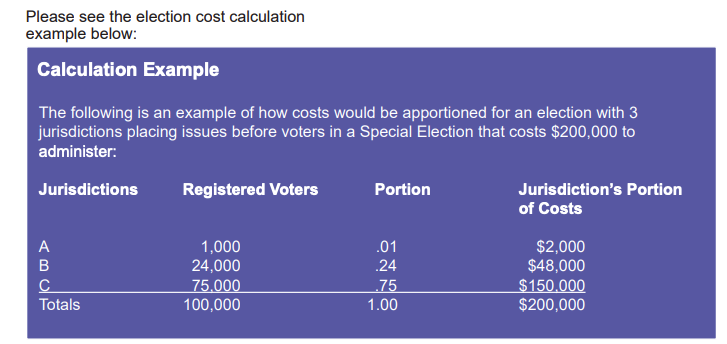
For the Feb.10 special election, 12 Snohomish County school districts are participating plus one fire district so the cost is shared by 13 districts.
Final cost for the election is determined when the election is certified Feb. 20, 2026 because it is directly tied to voter turnout.
Cornelius provided a really easy to understand, step-by-step election guide about how ideas get to the ballot. [Not as catchy as this video, but it does a good job of explaining.]
You can find more information about how election costs are calculated in our 2025 District Guide.
Why is the district running this ballot now?
Campbell explained the reasoning from the district’s perspective.
“Most school districts do levies in special elections earlier in the calendar year because if we waited until November and the levy failed, there would be no options to rerun before the tax collections for the following year,” Campbell said.
“For example, if we ran in November and it failed, we would not be able to collect any levy taxes for all of 2027, even if it was rerun and passed in February 2027 because those funds would not be able to be collected until 2028.”
“Running in February gives the option to rerun in April or November if it were to not pass.”
Levy and property tax increases
There were also questions about how a levy increase is calculated. On the face of it, it seems difficult to understand how a $361 million levy package (that replaces an older levy that has expired) could result in a flat or small property tax increase when the money generated is such a large amount.
One reader posed an answer:
Jan.24, 2026 At 7:30 pm My Edmonds News
My understanding is that the tax rate is able to be lower than it otherwise would be if assessed values were growing at a lesser amount. So taxpayers are seeing their taxes increase more because of the increased assessed value of their property than by the increase in tax rate. Is there something incorrect about my understanding?
You are correct. A school district is unique in its levy.
(This is the tricky thing about levies. It depends how how the levy is structured and what it is for. We are digging into that for a future ‘Government and you’ story)
When a school district levy is set, it is set for a dollar amount and it must be stated what the levy money will be used for. In this case, the district levy will be used for extracurriculars, programs, services and staff positions not funded by the state.
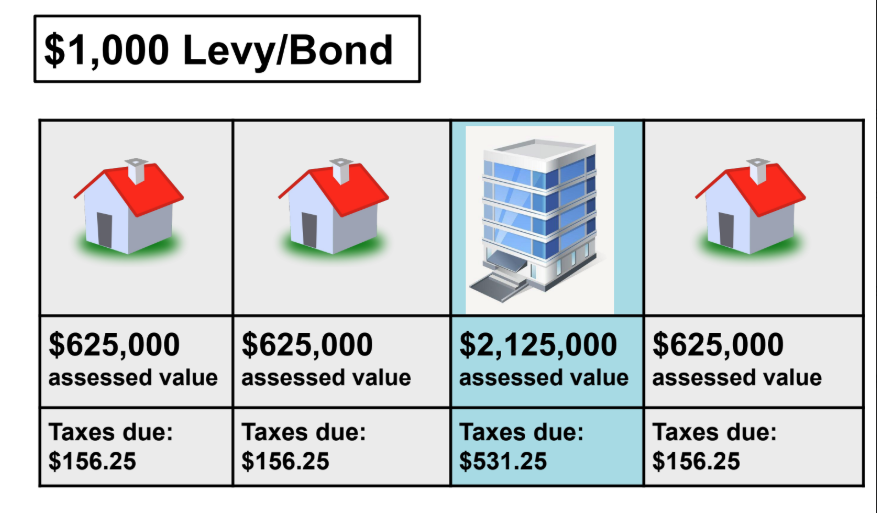
The district is asking for $361 million for this levy. That number doesn’t fluctuate or change. So when the district asks for money, the specific request is divided among all district properties and each individual property owner gets a set levy amount.
In our fictitious situation below, our $625,000 houses pay $156.25 and our $2.125 million office building pays $531.25.
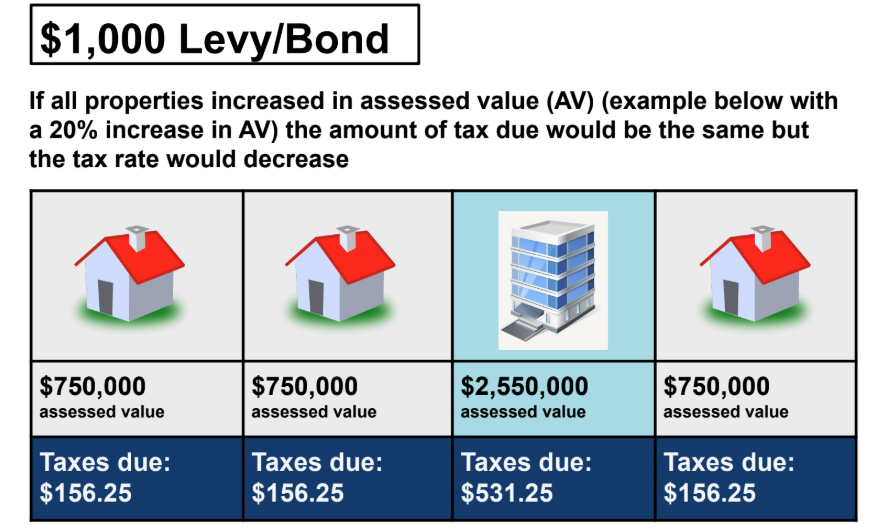
Next year, when these properties increase in value by, say, 20% to $750,000, the amount doesn’t change. The single home property owners still pay $156.25. The district shows that in the slide below. (The word ‘rate’ can be confusing. It means proportionally, dollar-for-dollar, the owner is actually paying less.)
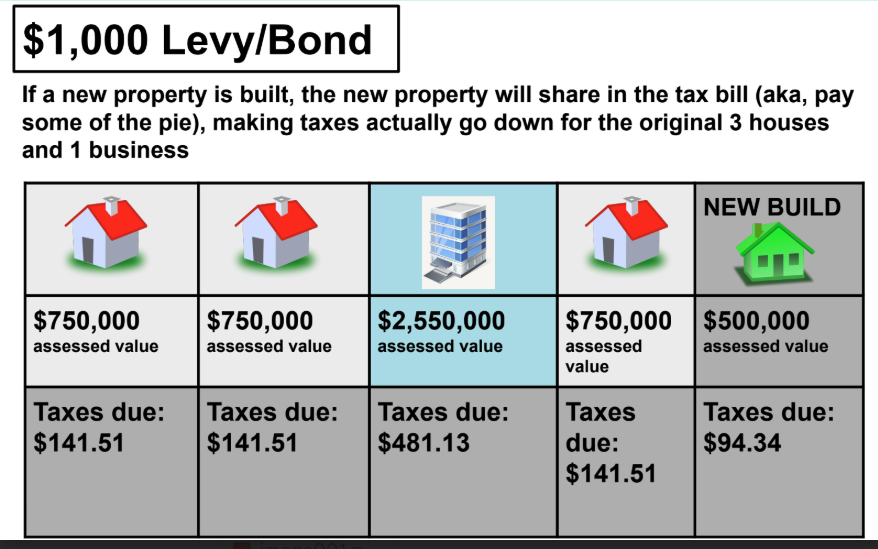
However, when new properties are added to this school district levy pie, like a new house, the amount paid by all properties actually goes down because there are more properties sharing in that $361 million cost (the levy pie).
The slide below is a look at how costs are anticipated to increase each year of the four-year levy. This levy is structured to generate a little bit more each year.
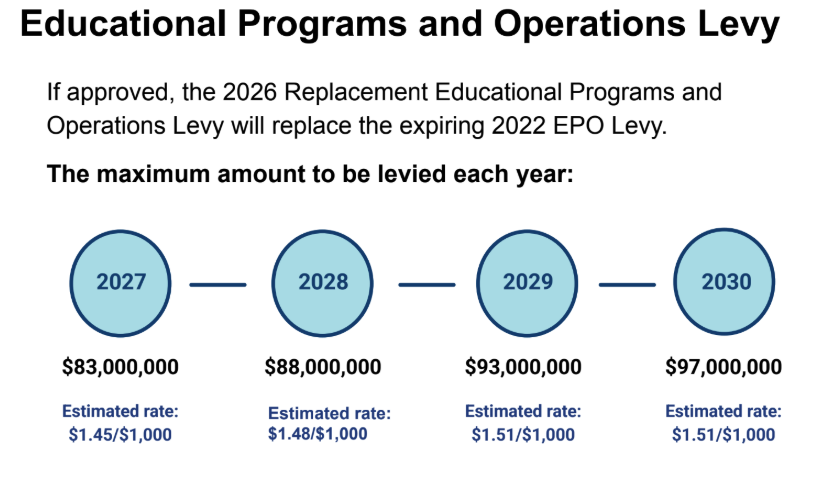
You can always review what you pay the school district on the Snohomish County Assessor’s website. My Neighborhood News Group created a new property tax calculator for this levy to show the real-time impact on your individual property.


Real first and last names — as well as city of residence — are required for all commenters.
This is so we can verify your identity before approving your comment.
By commenting here you agree to abide by our Code of Conduct. Please read our code at the bottom of this page before commenting.