
Will you chip in to support our nonprofit newsroom with a donation today?
Yes, I want to support My MLTnews!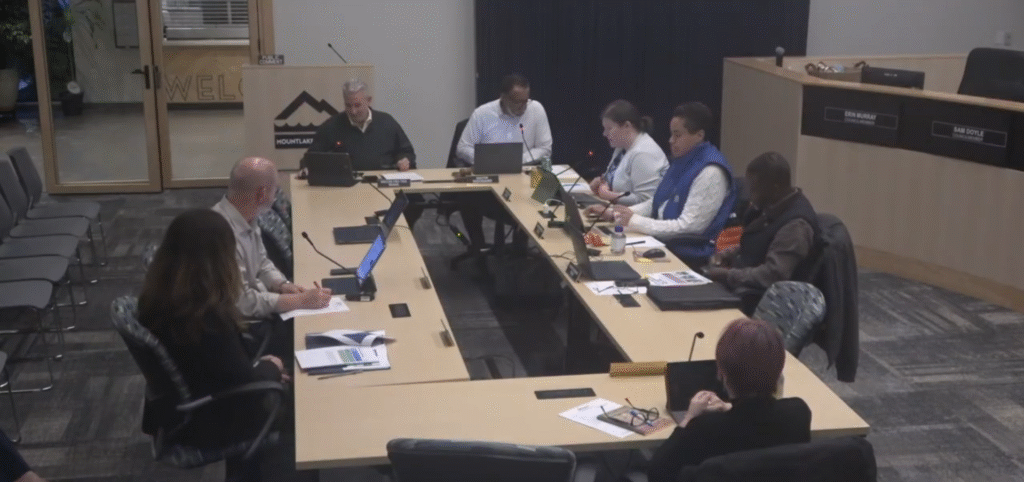
City Manager Jeff Niten and Deputy City Manager Caroline Hope presented several scenarios to the Mountlake Terrace City Council March 12 to address the City’s $4.5 million budget gap. These scenarios were proposed by the City’s Fiscal Sustainability Taskforce. Councilmember Laura Sonmore was absent from the meeting.
Niten highlighted budget strategies, including a reduction of “redundant” business management software subscriptions, a 5% general fund reduction over two years and potential tax measures, such as using the city’s banked property tax capacity or implementing a Transportation Benefit District sales tax.
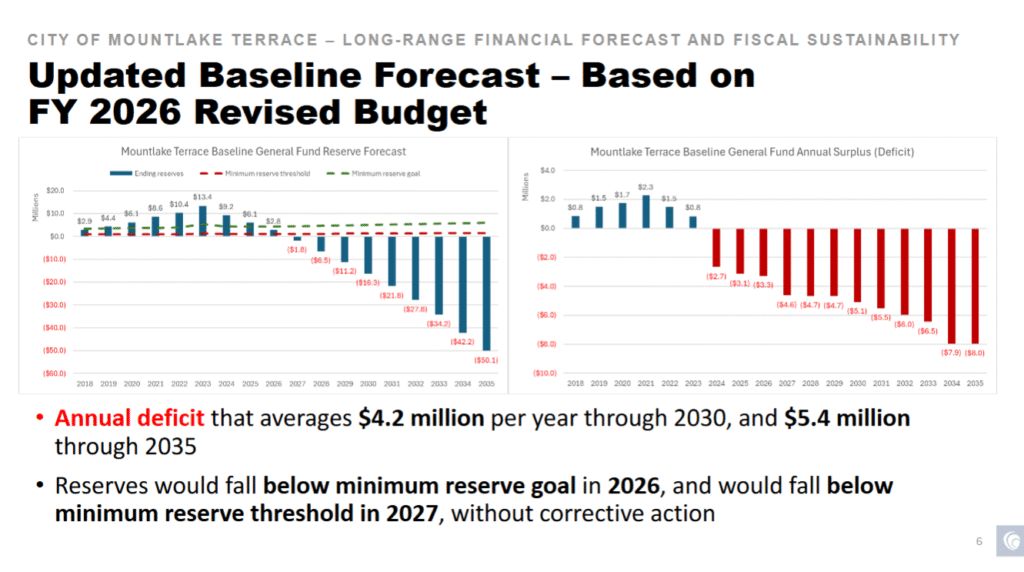
Hope said the task force based its recommendations on the City’s financial forecast from fall 2025, which shows an ongoing annual general fund deficit of about $4.2 million through 2030. This amount grows by about $5.4 million per year by 2035. Without corrective action, she noted the City’s reserves will drop below the minimum required threshold in 2027.
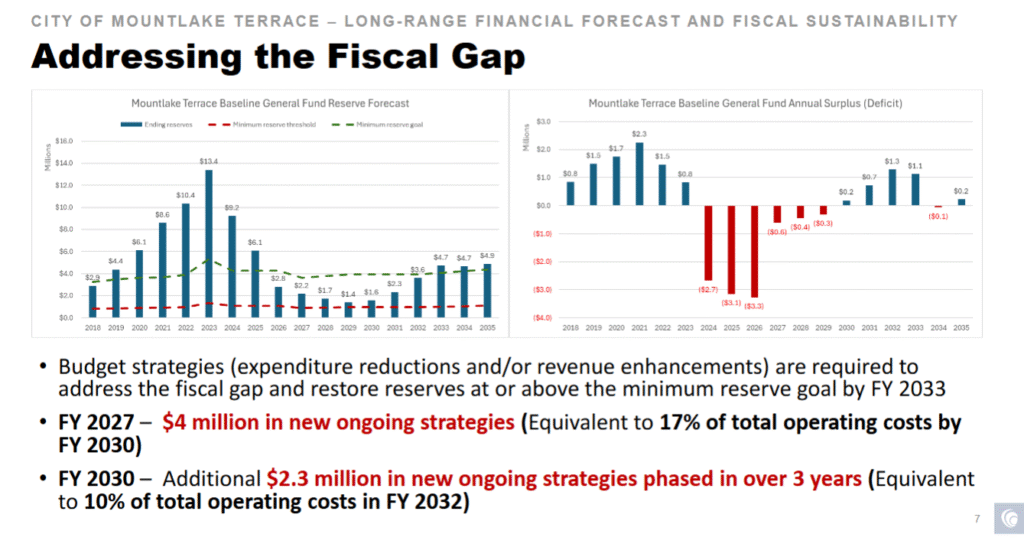
To close the gap and rebuild the reserves toward 20% – instead of their current 5% – the City needs $2 million to $4 million per year in expenditure reductions and/or new revenue. An additional $2.3 million per year is also needed starting in 2030, she added.
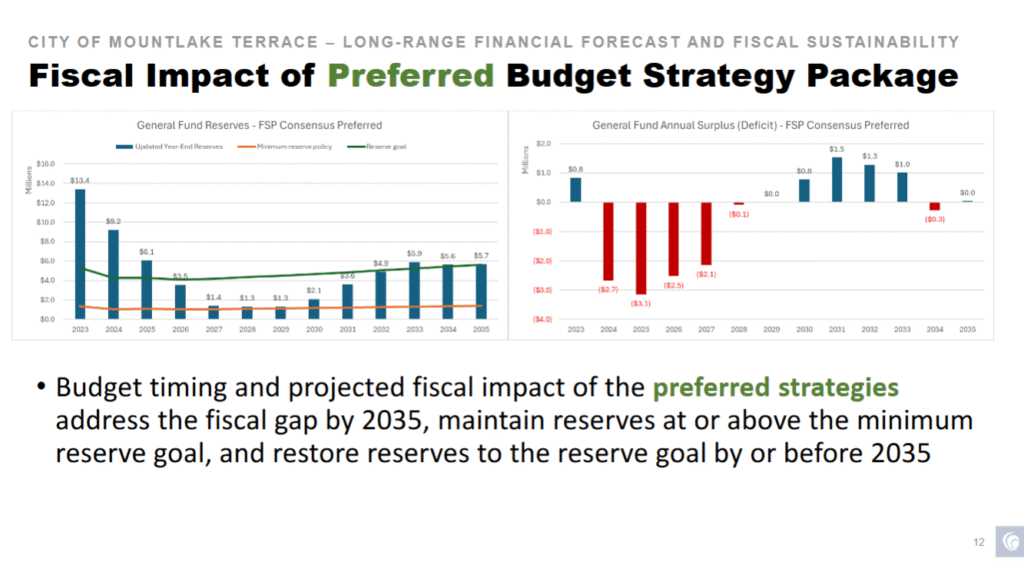
Hope then described the “preferred package” and three contingencies should the preferred package – or phase – is not adopted.
Phase 1
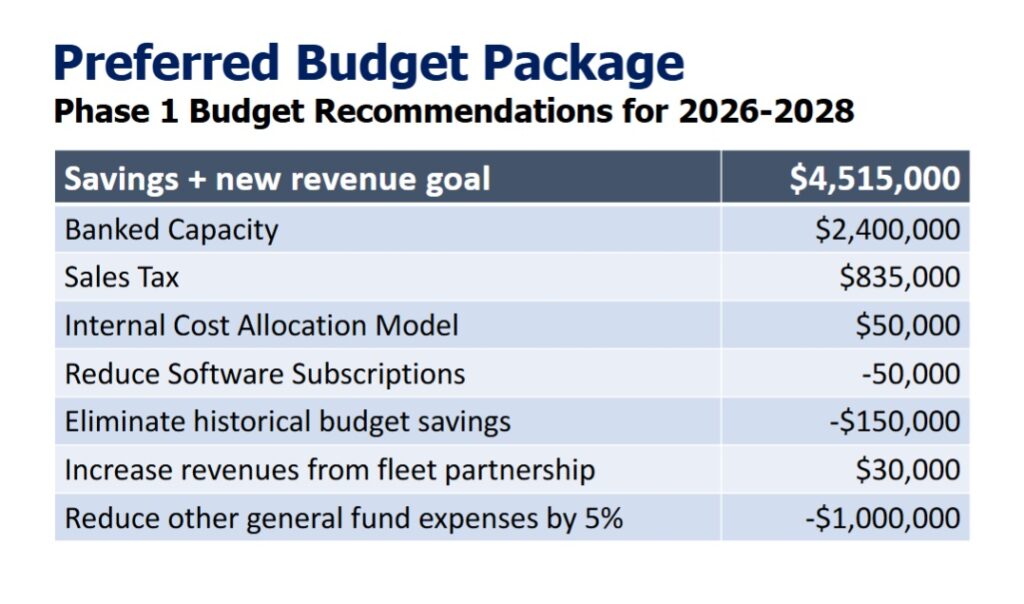
This package includes:
- Eliminating historical budget savings, such as long‑vacant positions, trimming professional services and removing duplicated expenses. This is money budgeted in past years but not spent. The City is now removing that money from the budget and counting it as ongoing savings. Hope said the task force expected to find $150,000 but instead found about $703,000.
- Cutting software and technology costs (about $50,000). Examples include eliminating duplicate Adobe and Bluebeam licenses and removing built-in laptop hotspots.
- Planning for an internal cost allocation adjustment, such as moving $72,000 from the general fund into utilities/enterprise funds.
- Reducing general fund spending by 5% over two years, which was initially a $1 million goal. This amount is reduced because the above savings cover a large portion.
- Modest revenue enhancements, such as permit fee and car tab increase, new rentals for park shelters or use of the City plaza, and shared fleet equipment with other cities.
- Allowing a limited use of real estate excise tax (REET) to reduce the street subsidy. The City’s general fund is subsidizing streets by about $690,000 a year.
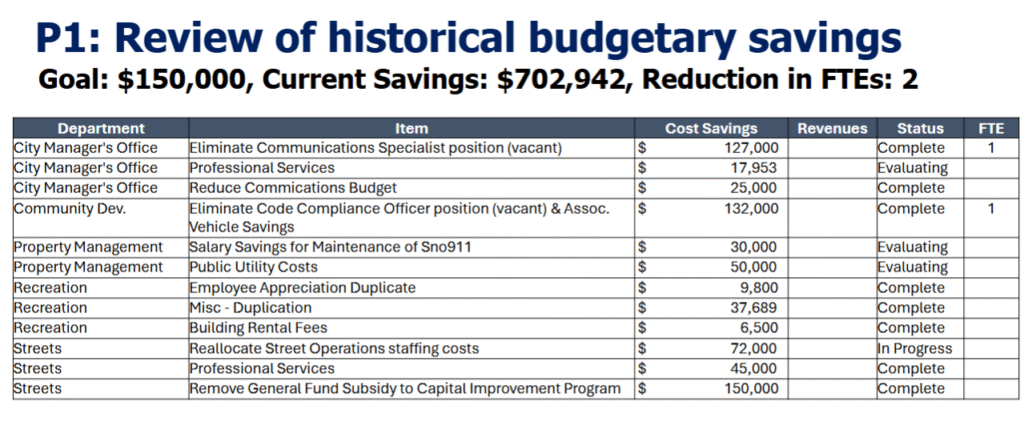
“Historically, the City has used REET between the parks and the streets capital fund,” Hope said. “The state law does allow for a portion of the REET to be used for operations. We’re just trying to bring more general fund money back.”
Phase 2
Phase 2 describes what would happen if the City does not take the full property‑tax banked capacity, which would bring in about $2.4 million. Hope said 12 full-time equivalents (FTE) would be reduced across multiple departments, which includes layoffs in the City Manager’s office, community and economic development, finance and parks and recreation.
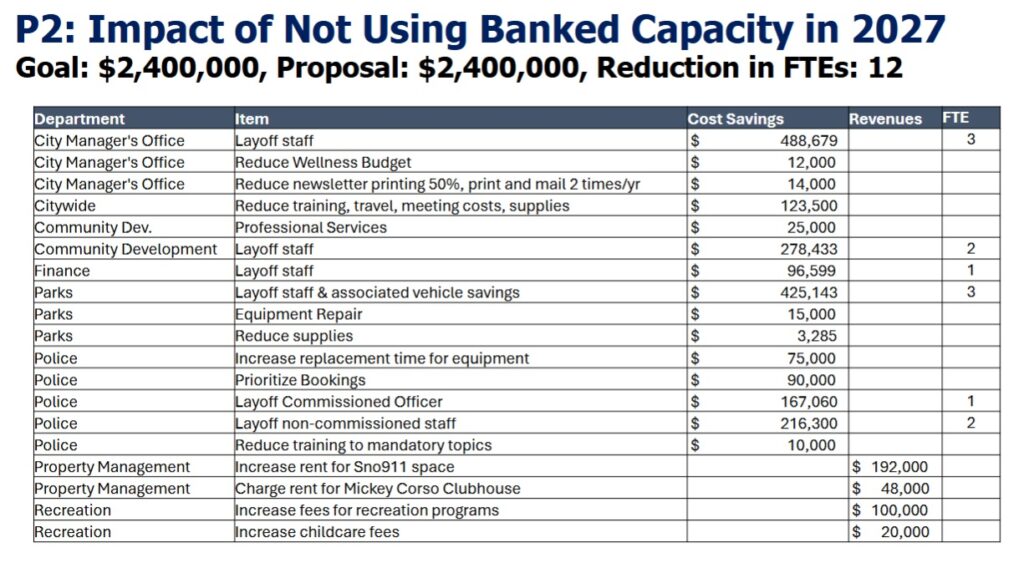
Additional cuts include citywide training and meetings, consulting support for the community development department, park maintenance and equipment repair, and police equipment replacement schedules. Hope said one commissioned police officer and two non‑commissioned police support positions would be eliminated.
For additional revenue, Hope said there may be possible rent increases for partner users of City facilities, such as Sno911 and the Lake Ballinger Center, and higher Recreation Pavilion and child care fees for non-Mountlake Terrace residents.
Phase 3
Phase 3 is cumulative on top of Phase 2 and shows what must be cut if the Transportation Benefit District sales tax ($835,000/year) is not approved or not pursued. Hope said this includes:
- Five more FTE cuts across the community development, recreation and parks, finance and public works departments.
- Dropping priority support for the City’s phone system.
- Reductions to park irrigation, park maintenance supplies and police overtime.
- Cutting two street maintenance staff, materials and contracted services, such as tree trimming.
- Possible elimination of, or reductions in, popular but subsidized programs, such as preschool and dance.
- Reduced postage and printing.
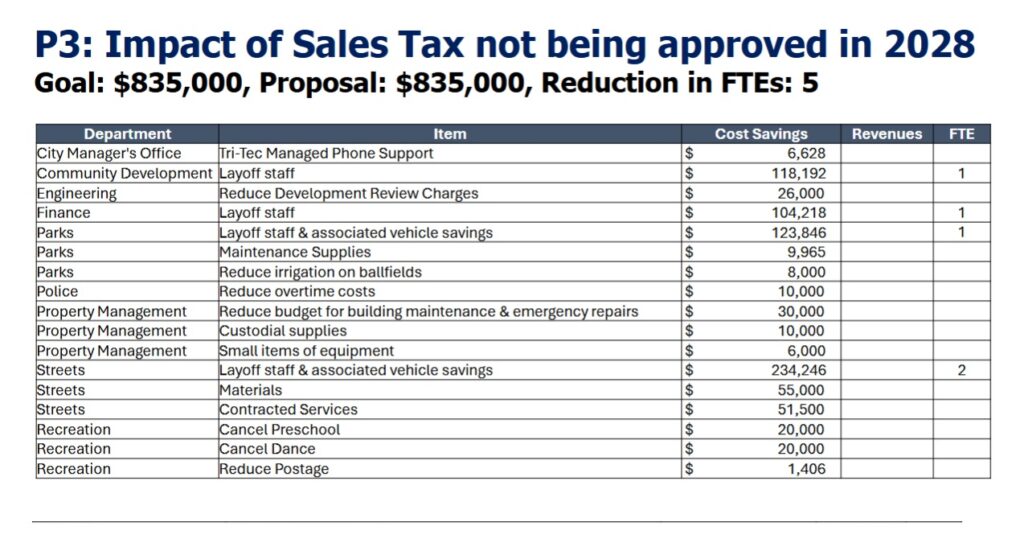
“We do subsidize recreation about $900,000 a year, and so it’s hard in recreation because it’s an enterprise fund, and we’re making money on most of our programs,” Hope said, adding that even though preschool and dance programs are subsidized $20,000 each a year, the City is still making a profit.
Phase 4
Phase 4 is the worst‑case, fully cumulative scenario if the City does not pursue or fails at a parks and recreation funding measure, such as the Metropolitan Park District or comparable levy, that would contribute about $2.1 million. This includes:
- Closure of the Recreation Pavilion and eliminating the current parks and recreation programming. This amounts to 38 FTE lost in recreation, or about 108 people total, with 14 of them full‑time, plus a facilities maintenance position tied to that facility.
- Additional cuts in the City Manager’s office, community and economic development, finance, and police.

Hope said the potential loss of the Pavilion “is a heavy burden.”
“We love the Recreation Pavilion,” she said. “We’ve heard that resoundingly from the Fiscal Sustainability Taskforce, from the community meetings, from the branding project…We have one of the biggest recreation programs outside of Seattle.”
Niten said the Pavilion is part of Mountlake Terrace’s identity and “sense of pride,” adding that the number of contacts for me about the Pavilion increased over time, and that will definitely be felt by members of our community,” he said.
Impact to City departments
Niten said the cuts and layoffs would reduce the City’s ability to communicate with the community and, more importantly, to respond to public records requests. He said that Washington’s public records law is “the strictest Sunshine Law in the nation,” and mistakes can have serious consequences for both current and future budgets.
For the community and economic development department, Niten said investors and developers care about how fast and predictably permits are processed and how accurate the City’s comments are on their applications. With fewer planners and engineers, he said the City will take longer to process permits, be less able to give firm timelines and risks harming its reputation as a place that welcomes and supports investment.
In the finance department, Niten said phase 2 would eliminate passport services and staff would be repurposed to do other financial services. “Reduction of any of these positions doesn’t mean that we can just not do that work,” he said. “It means that one of the other employees that are left is going to be responsible for doing that work, and they won’t be able to do it nearly as quickly…We wouldn’t be able to make any innovative adjustments going forward.”
For parks and recreation, Niten said this is the most visible impact because people see parks and recreation buildings regularly. With reduced staffing, the public can expect:
- Less frequent mowing and general grounds care.
- Browner grass and less visually appealing parks.
- Fewer or less‑maintained garbage cans.
- Potential questions about whether park restrooms can remain open, and if they do, they will not be cleaned or maintained as well.
“One of the things that we’re known for is our park system, our Pavilion, and they just wouldn’t have the same level of identity [and] pride that we take in those facilities today,” he said.
Regarding the Mountlake Terrace Police, Niten pointed out that Washington already has one of the lowest officer‑per‑capita ratios in the country, and Mountlake Terrace’s ratio is even lower than the state average – a little above 1 officer per 1,000 residents.
While he said the current police response times are good, reductions in sworn-in officers and support staff will:
- Make it harder to maintain response times, especially as the population grows.
- Put more work on remaining officers
- Limit training to only mandatory topics and the ability to effectively work with embedded social workers for people in crisis.
For Public Works, Niten said cutting maintenance doesn’t just mean rougher roads today; it pushes streets past a critical pavement condition index (PCI) threshold. Once that happens, the city can’t just patch or overlay. It must fully dig out and rebuild roads, which is “exponentially” more expensive, he said.
“If you remember several years ago, we redid 66th Avenue, which…was not a fun road to drive down,” he said. “[It was] not a long stretch of road by any means, and that was several million dollars just for that one small segment of road.”

He said that broad maintenance cuts will create more “66th Avenue” situations in the future.
Niten reminded the Council that several city buildings, especially the public works operations facility, already need significant maintenance and capital upgrades. With cuts, the city would lose the capacity not only to plan ahead for those needs but also to fund capital improvements, including for key assets like the Pavilion and Lake Ballinger Center. That means buildings continue to age with no clear path to addressing problems, increasing risks and future cost.
“We’re talking about reduction of levels of service, the speed at which we do service, and risk in not fulfilling our duties according to the law,” Hope said.
Councilmember William Paige Jr. said the layoff numbers are “really tragic” and warned that layoffs can trigger an “exodus” of remaining staff who may simply decide to leave rather than absorb extra work. He added that any savings from layoffs can be wiped out by the costs of rehiring and training replacements. He also addressed levies, noting how failed levies can snowball into broader problems in other cities, and residents are already absorbing multiple levies.
“it’s $1 here, $5 here, 30 cents here, but all of a sudden, that pie is overstuffed,” Paige said. “We have to be really mindful because at some point someone’s going to say, ‘Well, what’s next?’”
Mayor Pro Tem Bryan Wahl said the 5% “reductions” in the general fund are actually revenue increases or cost shifts, not true cuts. He suggested finding savings from union negotiations and collaboration with nearby jurisdictions.
“I would reallocate those dollars from the historical budget savings into the budget reductions to meet the 5% goal, and try and find some additional savings in the budget to get that 5%,” Wahl said.
For recreational program cuts, he suggested the City should look for middle‑ground savings and regional collaboration instead of fully eliminating classes or staff.
Councilmember Sam Doyle said that the City should explore a tiered child‑care fee structure based on income, similar to the YMCA model where families who can afford to pay more do so – often on an honor system – to help subsidize others.
Councilmember Erin Murray said that she prefers to avoid asking voters to approve two separate tax increases, given how many tax measures residents are already being asked to consider. She said she reviewed Washington state’s property tax cap, noting that its original intent was to give voters more say over their tax dollars rather than permanently constrain city budgets.
“I think the challenge is we as a city have not been engaged in those conversations with our community,” Murray said and thanked the Financial Sustainability Taskforce for not “kicking the can down the road.”
Mayor Steve Woodard said that layoffs are the “last, last, last, last on my list of ways to proceed.” He suggested looking at reduction in travel, training, meetings, materials and supplies, which could save $124,000.
Details of the phases are on the City’s website.
Budget calendar approval
Earlier in the meeting, Finance Director Sirke Salminen and Finance Technician Caitland Reinke presented the timeline for the 2027-28 budget preparation calendar to City Council.
Salminen noted that the City is starting the budget process earlier than usual during the summer season, but they wanted more time for thoughtful work and public engagement. The timeline is:
- March: Formally launch the biennial budget process.
- April: Finance department sends instructions to all City departments, collects preliminary budget drafts and holds initial “get‑started” meetings to clarify needs and priorities.
- May: Refine budgets and hold two community meetings in different locations to gather public input.
- June through August: Departments and leadership continue working on and revising budgets with ongoing questions and coordination. The city manager and deputy city manager will review the budget at the end of August.
- October, November: The City completes the legally-required budget steps, brings the full proposed budget to Council, holds the required hearings and prepares for adoption.
- December: Council completes deliberations and adopts the final biennial budget, ideally before New Year’s Eve.
Paige thanked the finance department for starting on the budget and said he wanted the public to know that the City is taking its budget seriously by starting the process earlier this year.
Murray said starting early is an incentive because “you don’t want to spend New Year’s Eve here in council chambers.”
The full meeting can be viewed on the City’s YouTube channel.


Real first and last names — as well as city of residence — are required for all commenters.
This is so we can verify your identity before approving your comment.
By commenting here you agree to abide by our Code of Conduct. Please read our code at the bottom of this page before commenting.