
Will you chip in to support our nonprofit newsroom with a donation today?
Yes, I want to support My MLTnews!
About 36 people attended the Regional Water and Sewer Public Forum last week at Mountlake Terrace City Hall and online. Along with three public works directors from nearby cities and one consultant, Mountlake Terrace Public Works Director Gary Schimek led the forum and gave an update on the City’s current projects, water and wastewater infrastructure, and rates.
Schimek highlighted the city’s ongoing compliance with state requirements for long-term water and sewer system planning with a 20- to 50-year outlook. He identified several key challenges, including having a sufficient water supply, maintaining wastewater capacity, addressing climate change impacts and handling aging infrastructure.
Some of these infrastructure, such as water pipes, are more than 50 years old. “That’s actually somewhat young in this area, but in the next 10 to 15 years, a lot of those pipes are going to start breaking,” Schimek said. “We’re also worried about population too, right? The more population, the more flushes, and then there’s only so much capacity that we have in the wastewater facility.”
According to Everett Public Works Director Ryan Sass, Mountlake Terrace’s water comes primarily from the Spada reservoir, located in the Sultan river watershed. From there, the water is transported to the Lake Chaplain reservoir, where it is filtered at a water filtration plant. After filtration, it travels through large transmission lines and terminal reservoirs before being distributed throughout the regional water system to serve communities across Snohomish County.
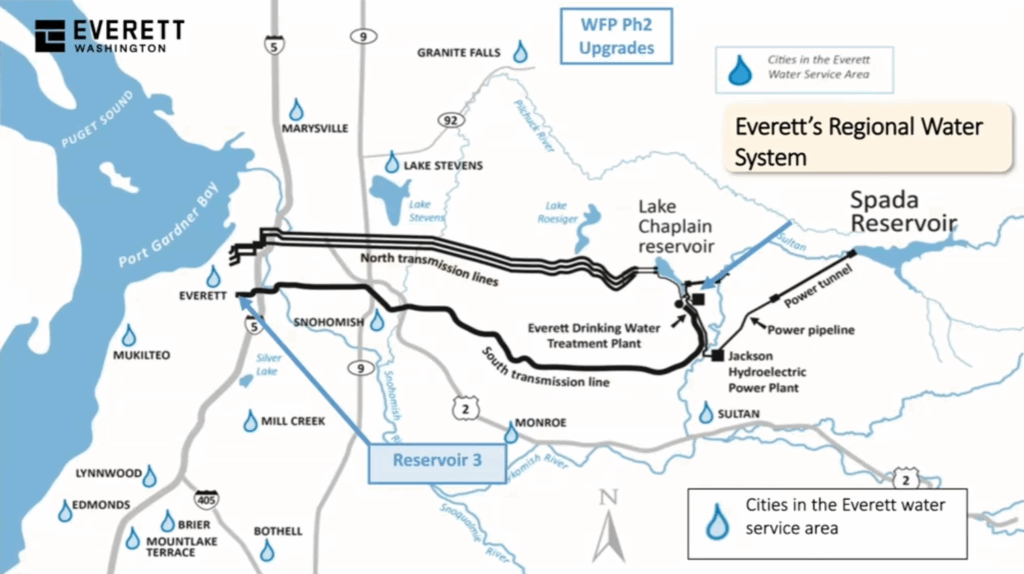
Sass then highlighted a sharp increase of 26% in construction costs in 2021 and an overall 39% increase in those costs from 2020 to 2024. For 2025, there is an additional 5% increase.
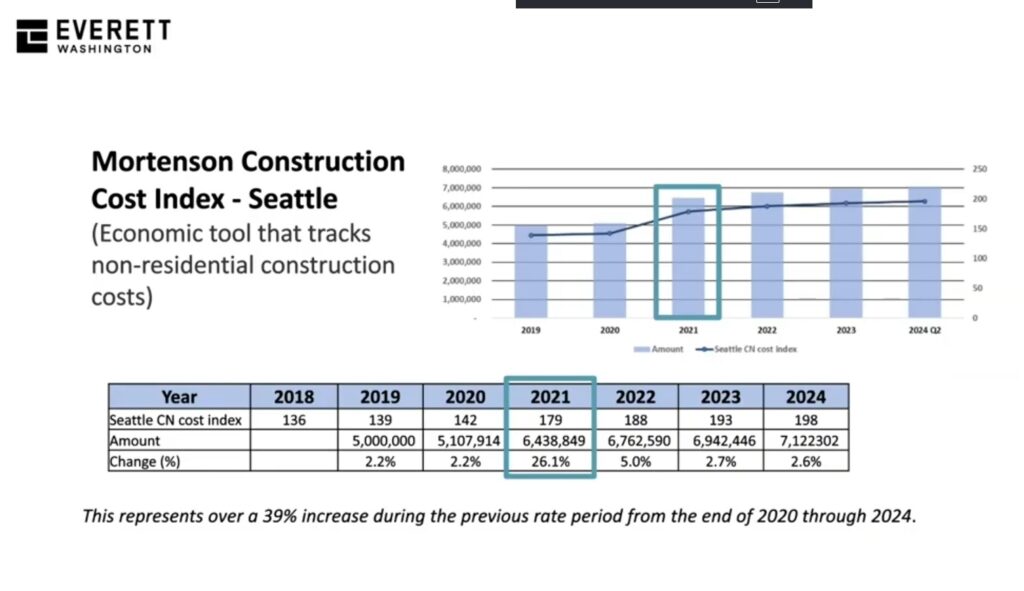
Sass showed two current projects: A replacement of Reservoir 3 and upgrades at the water filtration plant. He described these projects as “generational” and cannot be avoided because of the critical age of the infrastructure. The 100-year-old reservoirs and transmission lines serve more than three-quarters of Snohomish County’s population – 670,000 people – including Mountlake Terrace.
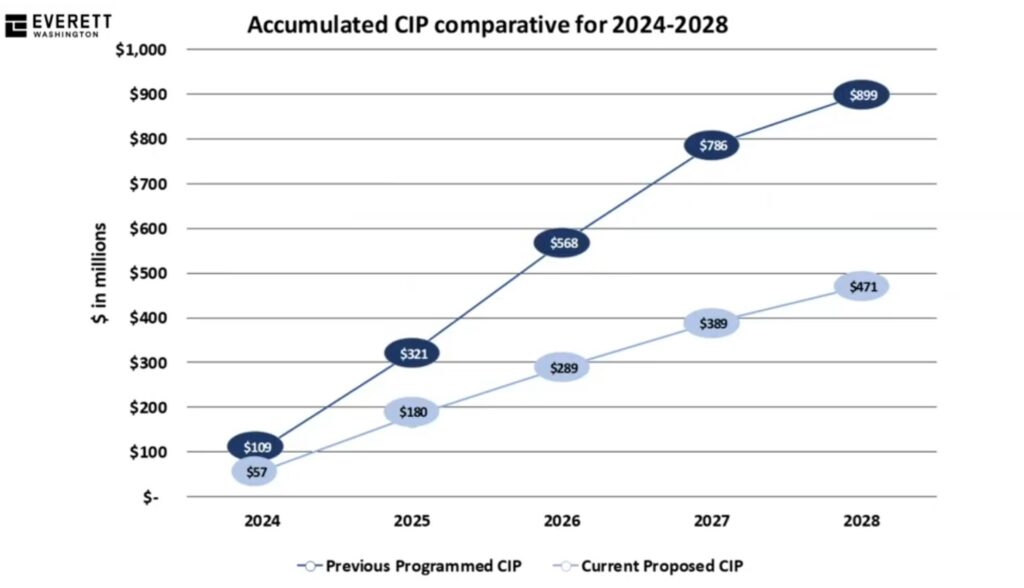
To manage financial impacts, Sass said Everett is deferring some routine capital work until after major projects are complete. “The dark blue line is what our capital program would look like if we did everything we had planned along with these larger projects,” he said. “The light blue line is larger projects, and about half of everything else being deferred until beyond 2028.”
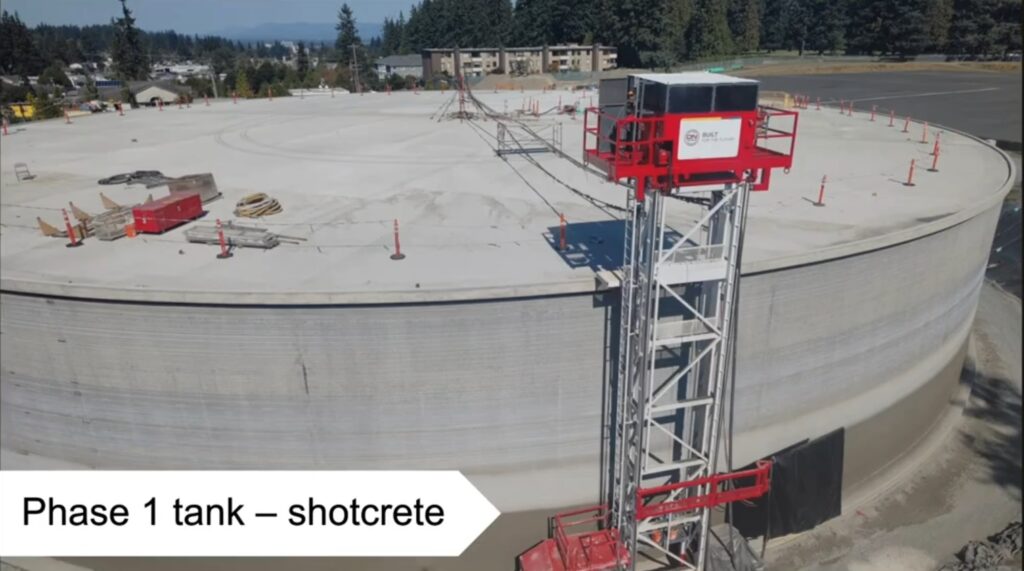
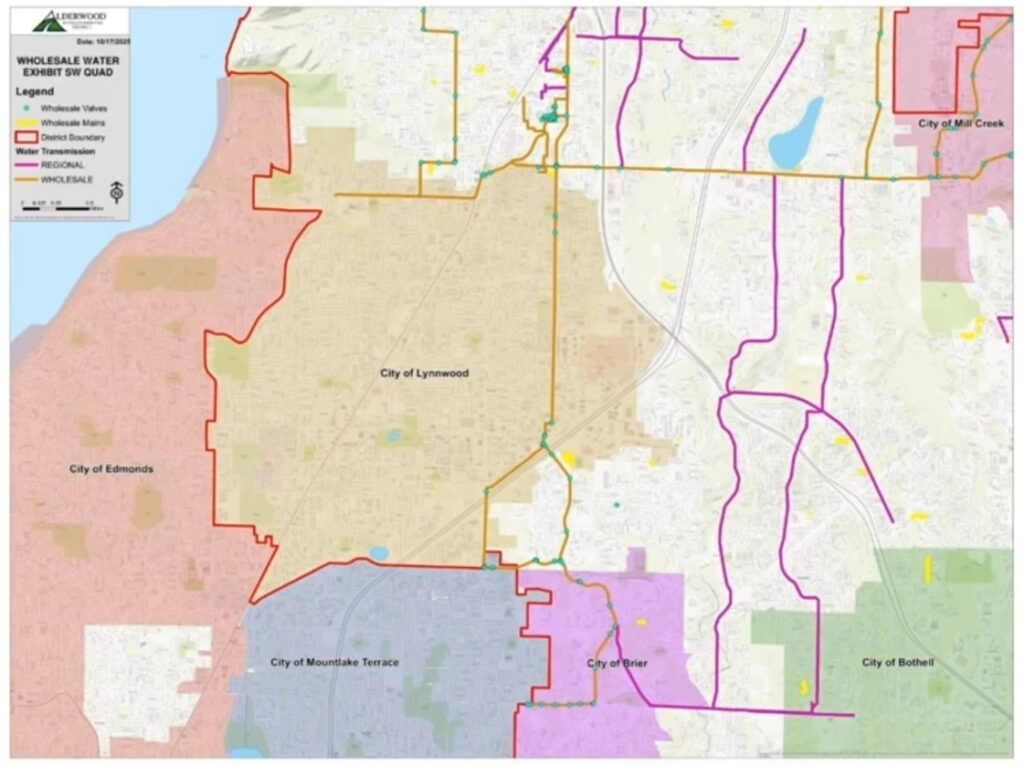
Alderwood Water & Wastewater District (AWWD) General Manager John McClellan said AWWD serves as a key regional wholesaler to distribute water from the City of Everett’s Reservoir 3. AWWD partners with five agencies and cities, including Mountlake Terrace, and services 57,000 water connections, nearly 700 miles of water mains, and about 500 miles of sewer mains.
“Some of you who live in this area realize this is one of the fastest-growing areas in the state, and so we’ve seen 10 to 20 miles of new water and sewer mains installed in our district every year for literally decades,” McClellan said. “That’s how fast our area is growing, and we’re seeing more people move in. We’re seeing an increase in density, so there’s this constant growing of the system, which leads to an increased demand on resources on the water as well as sewer services.”
Phil Williams, former City of Edmonds Public Works Director who is working as a consultant for the city’s wastewater treatment plant, said that starting in the mid-1950s, the Edmonds plant used to discharge its wastewater into Puget Sound. In 1991, the City of Edmonds installed a sludge incinerator to take care of biosolids removed prior to discharging the treated wastewater into the Sound. The City is transitioning to a gasification technology developed by the Pennsylvania-based company Ecoremedy. Williams said this technology reduces environmental impact and is more efficient, particularly in destroying PFAS (“forever chemicals”) in biosolids.
The City of Mountlake Terrace contracts with the City of Edmonds to treat its wastewater, with a small portion treated by King County.
Williams said that cities that discharge wastewater into Puget Sound are now facing new state requirements to reduce nutrient pollutants in wastewater.
“I’ve seen costs that range from about $29 million up to maybe $100 million. That’s actually a lot of money for a town of 43,000,” Williams said. “I’ve worked on water quality issues with nitrogen and phosphorus effects, and I believe it’s the right thing to do, but wow, it’s incredibly expensive.”
Water and utility rates
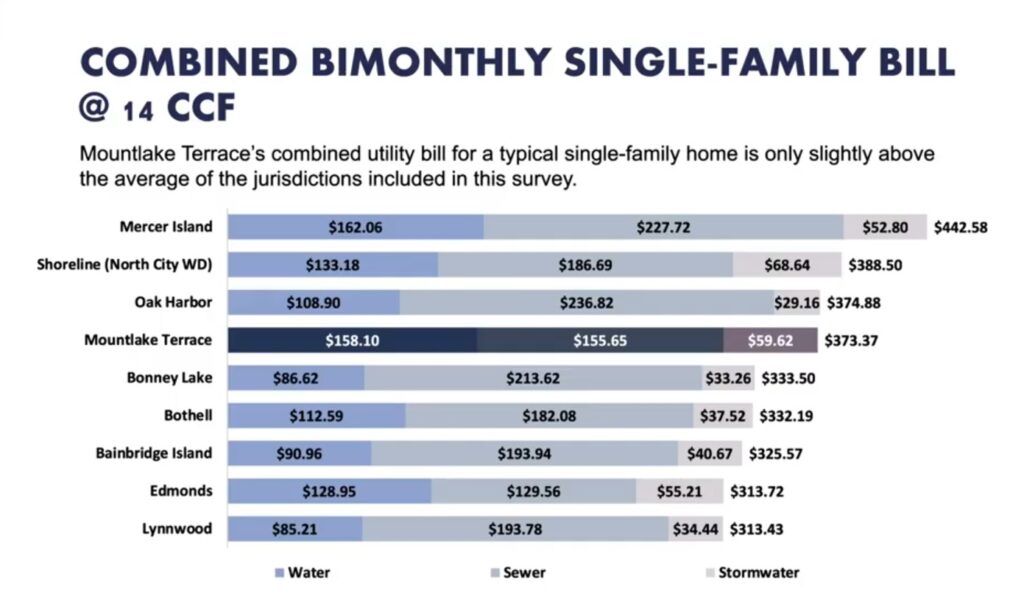
Schimek showed a graph of a bimonthly single-family bill for Mountlake Terrace, which combines rates for water, stormwater and sewer. Mountlake Terrace is slightly above the average rate of other cities surveyed, including Lynnwood, Bothell and Bonney Lake. The Mountlake Terrace rates are:
- Water: $158.10
- Sewer: $155.65
- Stormwater: $59.62
- Total: $373.37
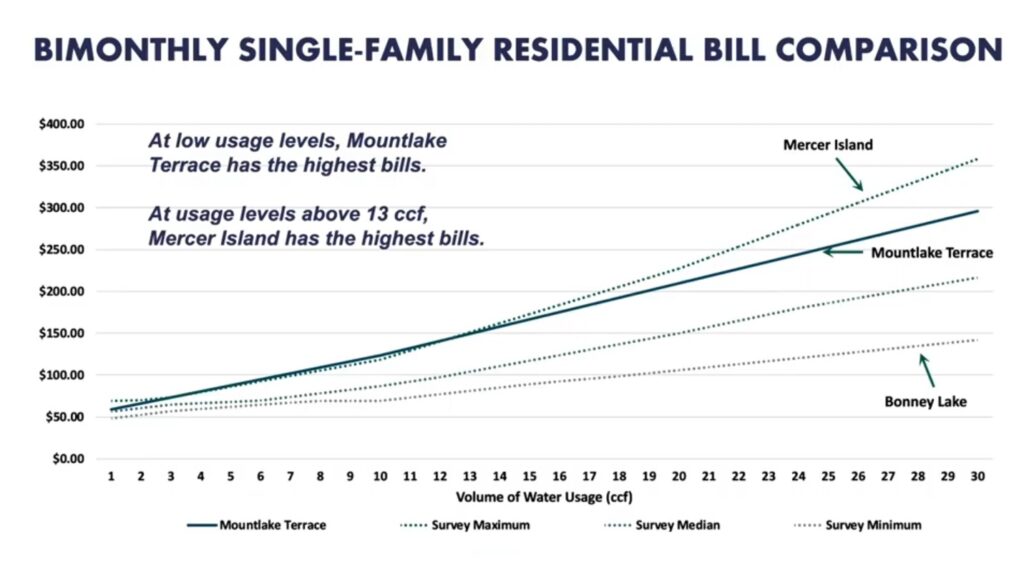
These rates include a base charge for $50 plus a variable usage charge.
Schimek said that the more diverse the customer base is for water providers, the more those providers can choose to push some costs to one of the users. “All cities and agencies have the option to [choose],” he said. “Do they want to charge irrigation customers a little bit higher to subsidize the other ones? Do they want to charge single-family [homes] a little bit higher to subsidize for commercial [properties]? You have to be transparent about it, but that’s what some options are.”
Mountlake Terrace Communications and Community Engagement Manager Sienna Spencer Markles told MLTNews that the water and sewer rates from 2027 to 2032 will be calculated by developing the acceptable cost of service to run the utility for each of the six years. The cost of service over this six-year period includes both the operating costs and capital costs.
Public Works will then present to the City Council three tiered scenarios based on the pros and cons of each. They will ask for public feedback until the City’s water and sewer comprehensive plans go before the City Council for adoption in the second or third quarter of 2026. The City Council will vote on the rates for 2027 and 2028 in the fourth quarter of 2026, and the new rates would start on Jan. 1, 2027 if the City Council approves them.
“One of the final steps in rate setting will be to determine the amount of bonds that the City will need to purchase to pay for the planning, design and construction of capital projects,” Markles said.
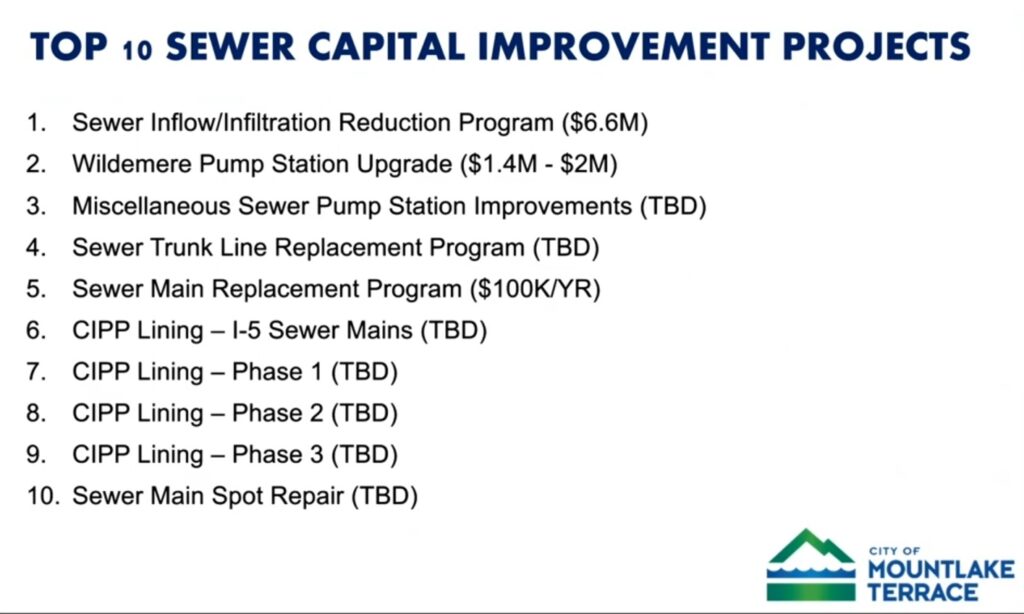
The City’s sewer capital improvement projects include:
- Sewer inflow/infiltration reduction program ($6.6 million)
- Wildemere pump station upgrade ($1.4 – $2 million)
- Sewer main replacement program ($100,000/year)
- Miscellaneous sewer pump station improvements (TBD)
- Sewer trunk line replacement program (TBD)
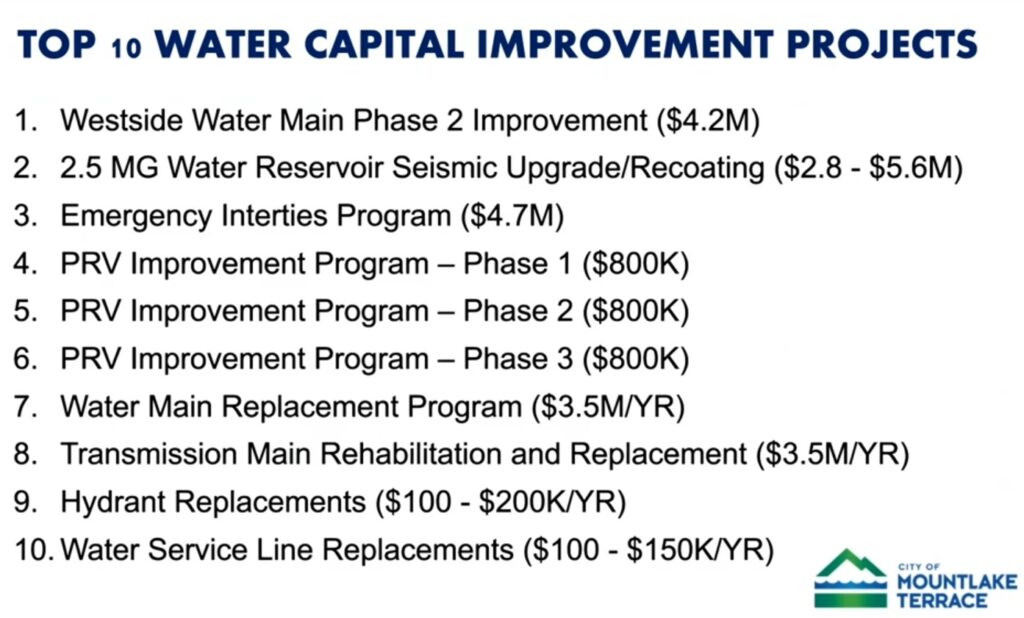
The City’s water capital improvement projects include:
- Westside water main phase 2 improvement ($4.2 million)
- 2.5 MG water reservoir seismic upgrade/recoating ($2.8 – $5.6 million)
- Emergency interties program ($4.7 million)
- Hydrant replacements ($100,000 – $200,000/year)
- Water service line replacements ($100,000 – $150,000/year)
FCS Consulting Principal Chris Gonzalez said that 85-90% of Mountlake Terrace utility costs are fixed, but the city uses a lower fixed base charge and higher variable (usage-based) charges to encourage conservation. Customers with low usage pay relatively more of their bill as a base charge, while higher usage results in higher bills.
“There are some jurisdictions like Edmonds, Oak Harbor, Bainbridge Island and Lynnwood that charge a fixed rate to multi-family customers, like apartment buildings, based on the number of dwelling units,” Gonzalez said. “So the City of Mountlake Terrace…they charge those customers based on the size of their meter. So a 1-inch meter pays this much, a 2-inch meter pays this much, but it doesn’t depend on the number of dwelling units. What you end up with is multi-family customers of the apartments, they pay a greater share, and that allows single-family rates to be lower.”
“We are a cost-of-service business. We are not making profit,” Schimek said. “Our goal is to be as efficient as possible.”
During the public comments, some attendees complained about the city’s water rates. One Mountlake Terrace resident said that a water bill of “$300 a month is insane” for two retired people. “And why don’t we come up with the program…if you use less water or during this period of time, you can get a discount?” she asked. “I have family that lives in Arizona. Do you know how much they pay a month for their water? $63 a month.”
Schimek replied that the City is “looking outside the box” for solutions to the water costs, and he will personally take a look at her water bill.
Another resident said that water usage in Mountlake Terrace should not be compared to Arizona since the $63 cost usually does not include stormwater and sewer services. According to the City of Phoenix, the water and sewer rates depend on usage, season and the users’ location.
That same resident asked whether rain barrels could be used to mitigate water costs. Schimek said that the legality of using rain barrels depends on local regulations, but they may be permitted in Mountlake Terrace. He said he supports exploring rain barrels and graywater and blackwater reuse as part of the city’s Comprehensive Plan.
In response to an online attendee if residents who qualify for low-income discounts, Gonzalez said that they can apply to the city once a year, and they would receive one check a year, which goes directly to the tenant instead of the landlord.
You can watch the entire presentation on the city’s YouTube channel.


I really appreciate this wrap up.
Unfortunately, the question about multi-family discounts was not fully addressed. It only applies to tenants, not to condo owners. Our complex, like other older ones, have multiple low income senior owners, who have no way to receive the discount offered to tenants. That doesn’t seem right to me, but the city just says that we would have to purchase separate water meters for each unit. So basically, as owners, we are not granted the same discount as tenants. How can that be changed, and is the city willing to look at a program like that for low income/senior owners?