
Will you chip in to support our nonprofit newsroom with a donation today?
Yes, I want to support My MLTnews!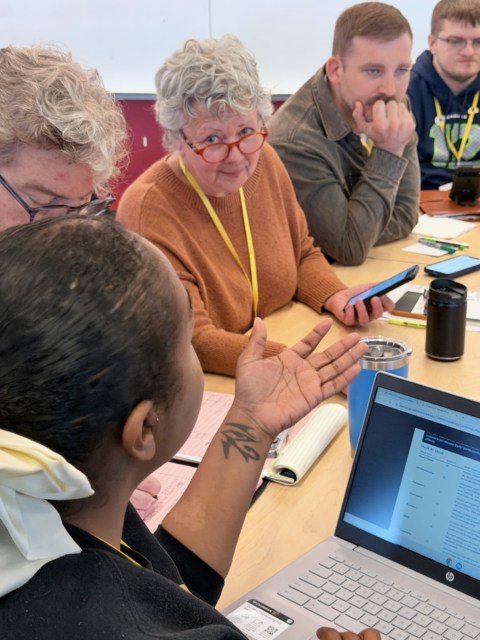
Several dozen randomly selected Snohomish County residents just wrapped up three solid weekends learning about artificial intelligence (AI) from national and local experts, and public and private entities. The goal was to provide specific, citizen-informed direction for Snohomish County government in how they use AI in government processes, programs, communications and more.
The Snohomish County Council not only asked for it, they found a philanthropy to pay for it.
The County hired Civic Genius, a well-known non-partisan, nonprofit, to build out an old-school “civic assembly” – a group of residents who share their values, thinking and recommendations – surrounding AI, one of the most contentious and least-understood types of new technology.
“There are opportunities to use AI and it does work, but what are the guardrails?” asked a participant in early May when this group came together for the first time in Everett.
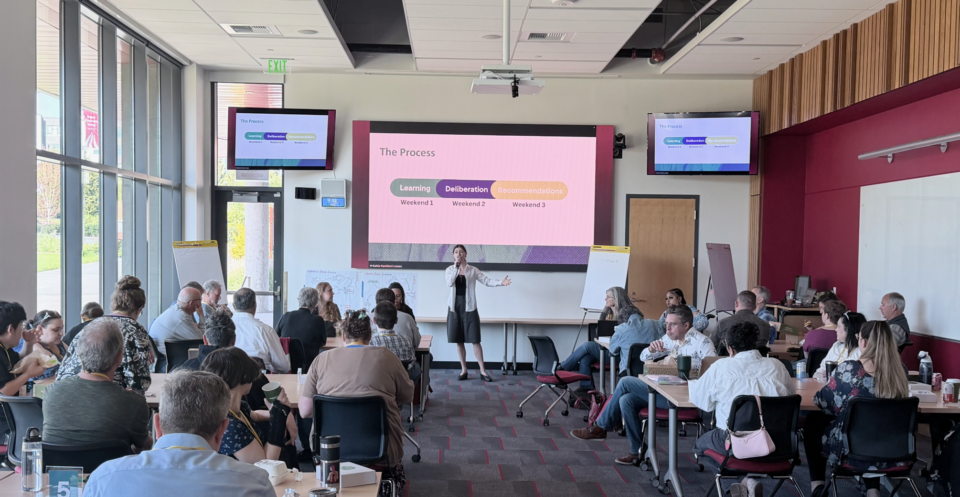
“That’s why we are here. Governance and what that means,” said Civic Genius Executive Director Jillian Youngblood, who ran the weekend events with help from a dozen local certified volunteer conversation facilitators.
Starting at zero
One participant said she was surprised at how many AI tools governments already use.
“I thought we were joining in at the beginning, but they are actually mature,” said Bill Segesser, another participant. “We gotta create rules, but the train has already left the station.”
Cascade PBS released a report last year showing that local government workers routinely use AI for a broad set of tasks, from writing press releases to drafting policy documents to reviewing grants and contracts and responding to constituent email. In a push for increased efficiencies with shrinking budgets, it seems like a good idea. But where, when and how AI is used is not routinely documented, recommended or even tracked.
The report further showed some workers were vigilant about verifying AI information and using it in support of work they manage, while others used it to manipulate contract bids for specific desired outcomes.
Constituents are in the dark about when, where and how it’s used because currently, there are no published rules or guidelines. This could change that.
Daylighting AI use
The starting place for this assembled group was documenting how AI is being used or could be used by government now and in the future (as far as it is possible to see into the future regarding AI, a constantly, rapidly changing technology). Specifically, what tasks government is doing or could do or might do and why AI is a better choice than a human.
By the end of the event, the participants had a better understanding and, with it, developed their 10,000-foot-level recommendations about government use of any AI tool in any situation: transparency, human oversight and accountability.
Transparency was first and foremost. “If it’s an AI response, just say it,” participant Sunny Behl said. “I cut and paste responses from my Google docs. It’s the same thing. An auto-AI response is just like that. But some people don’t want an auto response.” Let people know something is AI and give them an opportunity to choose a real person. That choose-a-real person opinion was shared by nearly everyone because not everyone is comfortable with AI. Some residents do their best communicating with real people.
Human oversight was another priority. Predictive and generative AI – AI that makes new recommendations or ideas based on patterns found on the internet – can get a process started, but it should not be given free reign to make decisions without oversight, according to this group. For example, a process created to review public assistance applications should have an appeals process that involves a human when someone is denied.
Mahindra Lukka, a tech worker, used the 911 emergency response system as another important example. “The cost of inaccuracy [in the tech business] is different from government,” she said. “We [tech] have to be 95% accurate. Emergency responders have to be 100%.” Leaving dispatch up to AI with no human oversight would be a bad idea.
Accountability was a third priority. It came in many forms – from the government to any AI vendor. Megan Osterhus, another participant, shared an example of getting a permit to do work on property. She said she’s confident she could fill out a code request form correctly and receive an accurate response. “But what if a grandma does it and gets bad information from the county AI response and then has to pay fines?” she asked. “That’s not her fault. That’s on the government.”
How it worked
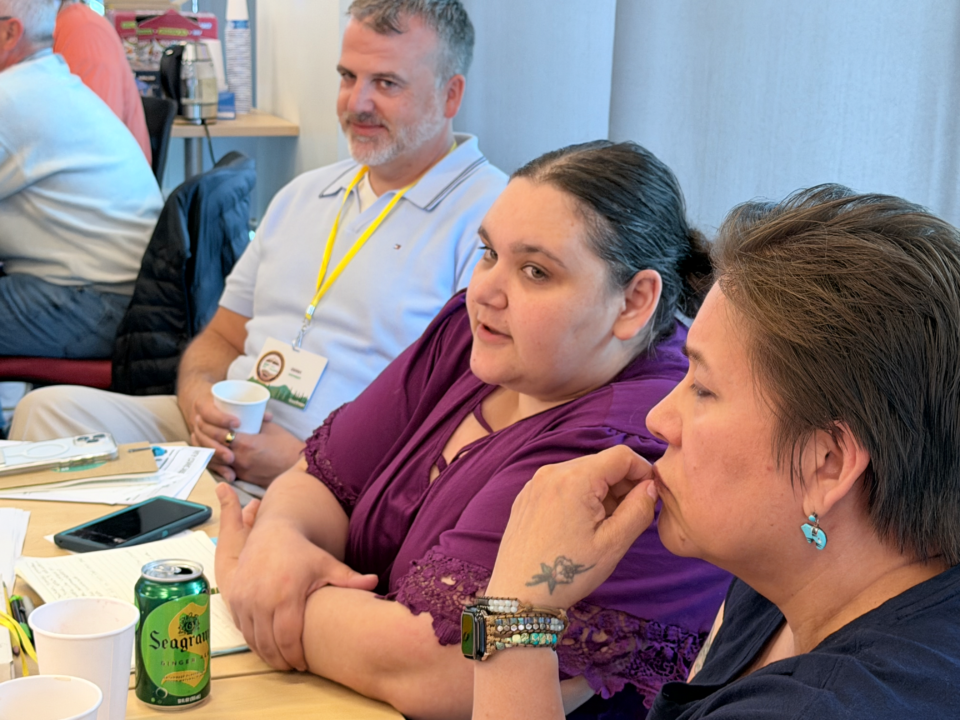
Those discussions and scenarios came up throughout the civic assembly process.
The first weekend was a crash course in learning from private and public experts, academics, consultants and government workers themselves, who talked about doing more with less.
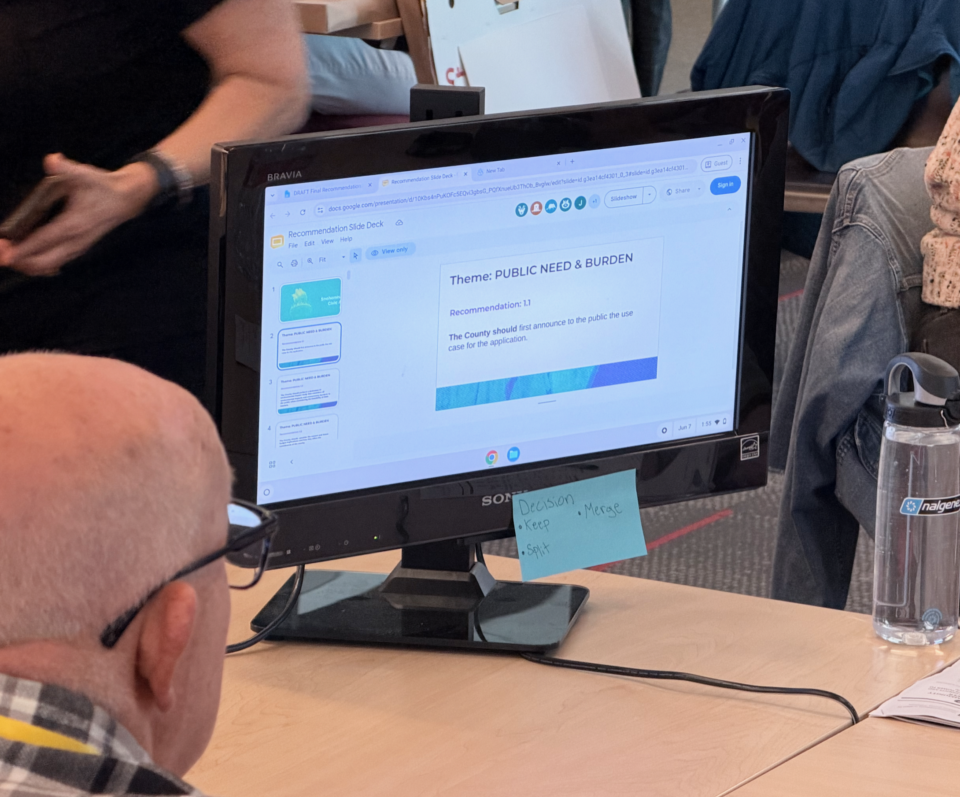
The second weekend was role playing, scenarios and discussions in groups or pairs. On the third weekend, teams made lists of 50-plus specific recommendations, drafted the council report that included values statements, then voted — up or down — on specific recommendations to use when assessing how and when to use AI in any form.
Values
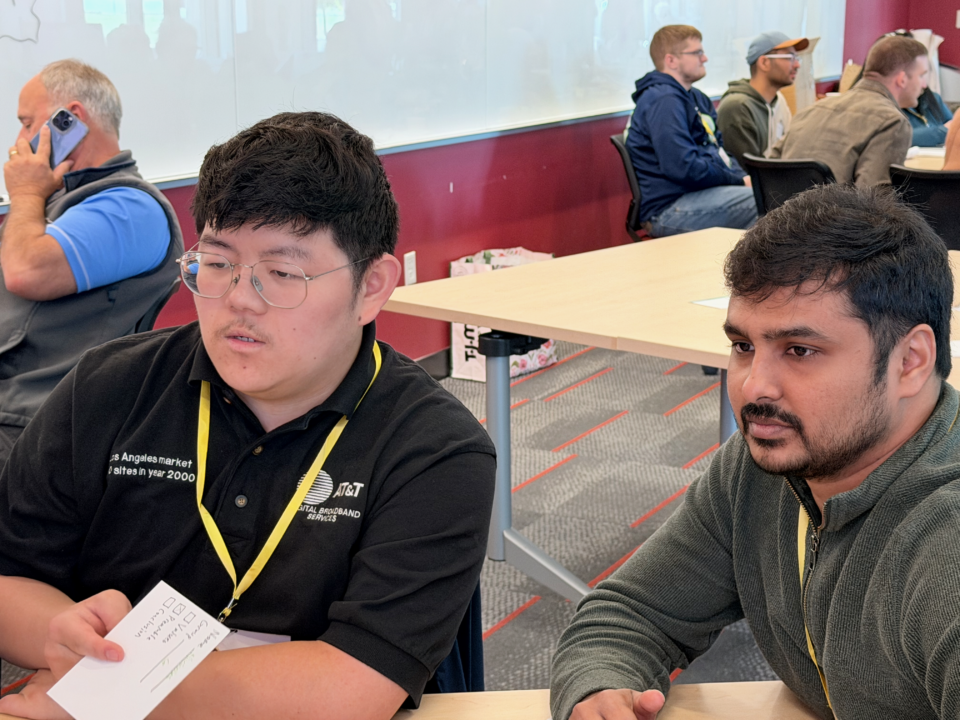
The group made sure group values were at the forefront of their thinking. They will be included in the council report.
Values included:
- Human experience: There must be a human in the loop because we should never cede human authority decision-making to a non-human entity.
- Self-determination: Residents have a right to be free of AI-led interference and government-imposed conditions.
- Transparency: This is key to trust in government.
- Accountability: The County holds responsibility for the outcomes of AI-led systems. We do not accept that an algorithm is an explanation or excuse.
- Precaution: The potential for harm is documented and real. Proactive oversight must be provided at all levels.
- Equity: Political expediency can have an outsized impact on the historically underserved.
- Stewardship: Every innovative attempt must be made to preserve and expand our natural lands, and this includes the placement and infrastructure for AI.
The agreed-upon themes were:
- Public need and burden: Assess the need, assess the burden on the public and provide metrics on what success looks like.
- Human oversight: Provide a human option to ensure a human reviews AI ideas, work and decisions. AI cannot audit AI.
- Transparency: Be clear when AI is used or a constituent is interacting with an AI system. AI decisions should be appealable. Make clear what parameters AI is using.
- Data protection and fairness: All data is private. Do not indemnify vendors if there’s a data leak. For questions about fairness for a particular issue, do a manual (human) review for situations that could go either way.
- Auditing and remedies: Create a clear path for remediation if someone is impacted by AI decisions. Audit AI systems for accuracy and efficiency.
- Vendor control: Do a cost-benefit analysis before deploying a new AI system. Do pilot programs before full implementation. Review accuracy and relook at a contract if too many errors are found.
- Community and human empowerment: Create a formal mechanism that allows the community to weigh in on AI before implementation. Engage in substantive public outreach about the what and why for AI.
The detailed recommendations can be found here. (link)
It wasn’t perfect, but most people got something out of it.
Sunny Behl said she felt participants didn’t reflect the community as well as it could have. The group was mostly white and older. Residents who are financially stressed did not appear to be present in this self-selected group. Volunteers did receive a small stipend for completing all three weekends.
Others said it was interesting to see what it takes to implement policy — step-by-step.
It was a lot of work and a real commitment. “Democracy is exhausting!” Youngblood of Civic Genius said more than once to show her appreciation for the group work.
Youngblood also noted that while some in the room may not have voted the same way in the last national election, it was interesting to see that people mostly had the same values and there was little disagreement – just a different order of priorities.
What’s next
County Councilmember Jared Mead showed up at the end of the voting to thank residents for their participation. The report now goes to the full County Council for review. The County will hold public meetings, then vote to adopt some, part or all the recommendations in the form of ordinances.
“There are five of us,” Mead said of the County Council. “I can’t promise everyone will read it, but a majority of the council wants this.” He also applauded the concept of a civic assembly, a real way to hear from all types of constituents. “I hope you participate in the future,” he said.
Mihindra Lukka said he would, and he thought about how to bring some of the civic assembly concepts to India when he returns home.
Relevance
This week, SpaceX, which includes xAI, will launch its initial public offering (IPO). OpenAI and Anthropic, the maker of Claude AI, filed its IPO plans for later this year.
2026 is the year of AI, when AI “agents” – specifically tasked non-human workers that complete tasks on behalf of and at the direction of human workers – move to the next level.
What does that mean for the government and the residents they serve?


Very well written article on AI. Great “nuggets” of information, such as distinction between “Predictive and Generative” AI. Thanks for publishing this.