
Will you chip in to support our nonprofit newsroom with a donation today?
Yes, I want to support My MLTnews!
This article was updated to correct a statement that failure of the levy would result in an 89% budget reduction. Instead, it would result in a 15% reduction.
Voters living in Edmonds School District is are set to decide the fate of a $361 million, four-year replacement Educational Programs and Operations Levy (EP&O) that will appear on the Feb. 10 Special Election ballot. The levy amount makes up 15% of the District’s general fund, largely paying for extracurriculars, programs, services and staff positions not funded by the state, the District said.
The measure, approved unanimously by the school board in October, seeks to renew an expiring EP&O levy from 2022. If approved, the levy would authorize the collection of up to $83 million in 2027, rising to $97 million by 2030.
Bridging the gap

In a recent interview with My Neighborhood News regarding the initiative, District Finance Director Lydia Sellie said while the state provides resources for its basic education requirements, there are significant gaps in funding for specific roles, including substitutes, crossing guards, playground assistance and high school counselors. The levy also funds student support staff such as nurses and custodians, as well as extracurricular opportunities including athletics, drama, and music.
“It just basically ensures that the programs that we have today are consistent going forward,” Sellie said.
Administrators also highlighted complexities regarding how these funds are used. While levy dollars are intended for “enrichment” activities outside of basic education, such as extracurriculars, the district sometimes uses them to backfill underfunded core functions.
“We’re not supposed to be spending it on basic education, but because we are inadequately funded, it likely crosses over into basic education functions that the state is not adequately providing for,” Sellie said.

District Superintendent Rebecca Miner noted a specific restriction regarding special education: The state prohibits the use of levy funds to directly support special education programs, even though those programs are not fully funded by the state. This forces the district to draw from other general fund resources to cover special education costs, using levy funds to fill the resulting gaps in other programs.
Tax rates and mechanics
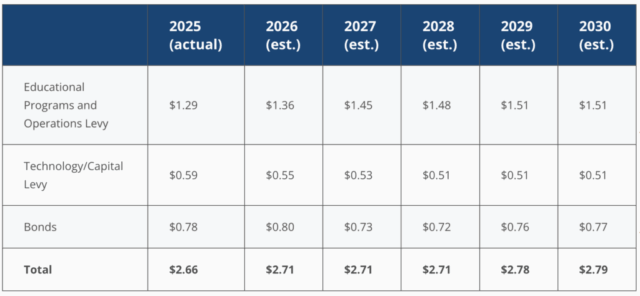
The estimated tax rates for the replacement levy are $1.45 per $1,000 of assessed property value, with collection beginning in 2027. The rate will rise to roughly $1.51 per $1,000 in 2029 and 2030. When combined with existing capital bonds and technology levies, the District projects the total school tax rate to remain relatively stable, moving from $2.66 in 2025 to an estimated $2.71 in 2026 and 2027.
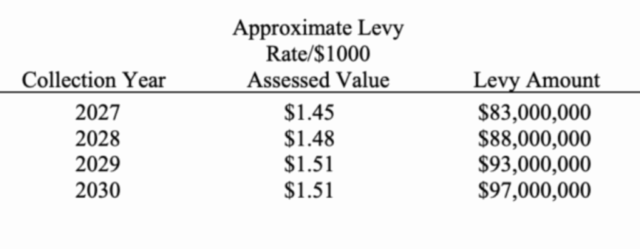
Despite the levy increasing by $86 million from the 2022 levy, tax rates are expected to remain stable until its expiration in 2030. During an interview, District Communications Director Curtis Campbell used a “pie” analogy to explain how property values affect taxes. The levy amount approved by voters acts as a fixed “pie,” and each taxpayer’s slice is determined by their property’s assessed value.
“As more property owners and taxpayers come into the district as there’s more development, those slices can get smaller because you have more people taking slices of that pie,” Campbell said.
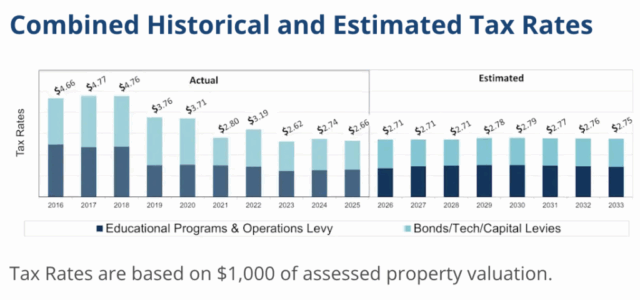
Because the collection amount is capped, rising property values across the community generally cause the tax rate to decrease. Conversely, if property values fall, the rate increases to ensure the district collects the voter-approved amount. In fact, ESD’s rate has dropped over the past decade from $4.77 in 2017 to $2.71 in 2026.
In 2024, voters in Edmonds School District approved two other levies with a combined total of $714 million for collection through 2028: A $594 million School Construction Bond and a replacement Technology/Capital Levy for $120 million.
The technology levy pays for school materials and technology. The construction bond pays for construction of a new middle school at the former Alderwood Middle School property, new buildings for College Place elementary and middle schools and a new Westgate Elementary School. The levy will also help complete construction at Oak Heights Elementary.
Edmonds’ latest levy is among 15 other education levies on the Feb. 10 ballot from districts in Snohomish County including Darrington, Everett, Granite Falls, Index, Lake Stevens, Monroe, Mukilteo and Northshore.
ESD’s tax rate fares lower than neighboring districts. On the higher end is Snohomish School District at $4.10 and Everett Public Schools at $3.64. Districts with a lower rate include Lake Washington School District with $2.43 and Bellevue School District with $1.90.
Budgetary context and cuts
The levy proposal follows approximately $25 million in spending reductions over the last two years to close budget shortfalls from previous years.
While early projections for the 2025-26 school year initially showed a deficit, legislative changes – including the lifting of special education funding caps – helped the district project a slight surplus of about $2.6 million by the end of 2026.

However, Sellie clarified that the 2026 replacement levy is not designed to restore the bulk of previous cuts. The cuts the District made between 2023 and 2025 were “keeping us up with what was happening in the world,” Sellie said. In turn, the levy is intended to help the District maintain current service levels while keeping pace with inflation.
Consequences of failure
If the measure fails in February, the board would likely place it on the ballot a second time – but can only do so twice in a calendar year, per state law. A double levy failure would result in the loss of $83 million starting in 2027 – a 15% budget reduction – which is a gap Sellie said she “can’t even fathom” filling, even if the district sought grants and alternative funding sources.
If the levy were to fail twice, Campbell estimated reductions would be five times larger than the 3% budget reductions the district made in recent years.
“It’s a hard hypothetical to think of because it’s so drastic,” Campbell said, citing the potential loss of extracurriculars, increased class sizes, and reductions in safety staff. “The ramifications of not having a levy for multiple years would be pretty bleak.”
When making cuts, the district uses a hierarchy: legal compliance – including required spending on insurance and utilities – is the first priority, followed by preserving programs impacting the largest number of students. While large programs like multilingual learning are likely to stay due to high enrollment and legal requirements, niche enrichment programs, clubs, and athletics would be vulnerable, Sellie said.
Campbell said the District keeps cuts “as far away from the classroom as possible,” but that would become increasingly difficult with such a large loss of funds.

Voting Information
Ballots for the special election were mailed to registered voters in Snohomish County Jan. 23. Ballots must be postmarked or placed in a drop box by 8 p.m. on Feb. 10. Property tax exemptions are available for qualifying senior citizens and people with disabilities through the Snohomish County Assessor’s Office.
Learn more about the levy on the District’s website.
— Contact Ashley at ashley@myedmondsnews.com.


Real first and last names — as well as city of residence — are required for all commenters.
This is so we can verify your identity before approving your comment.
By commenting here you agree to abide by our Code of Conduct. Please read our code at the bottom of this page before commenting.