
Will you chip in to support our nonprofit newsroom with a donation today?
Yes, I want to support My MLTnews!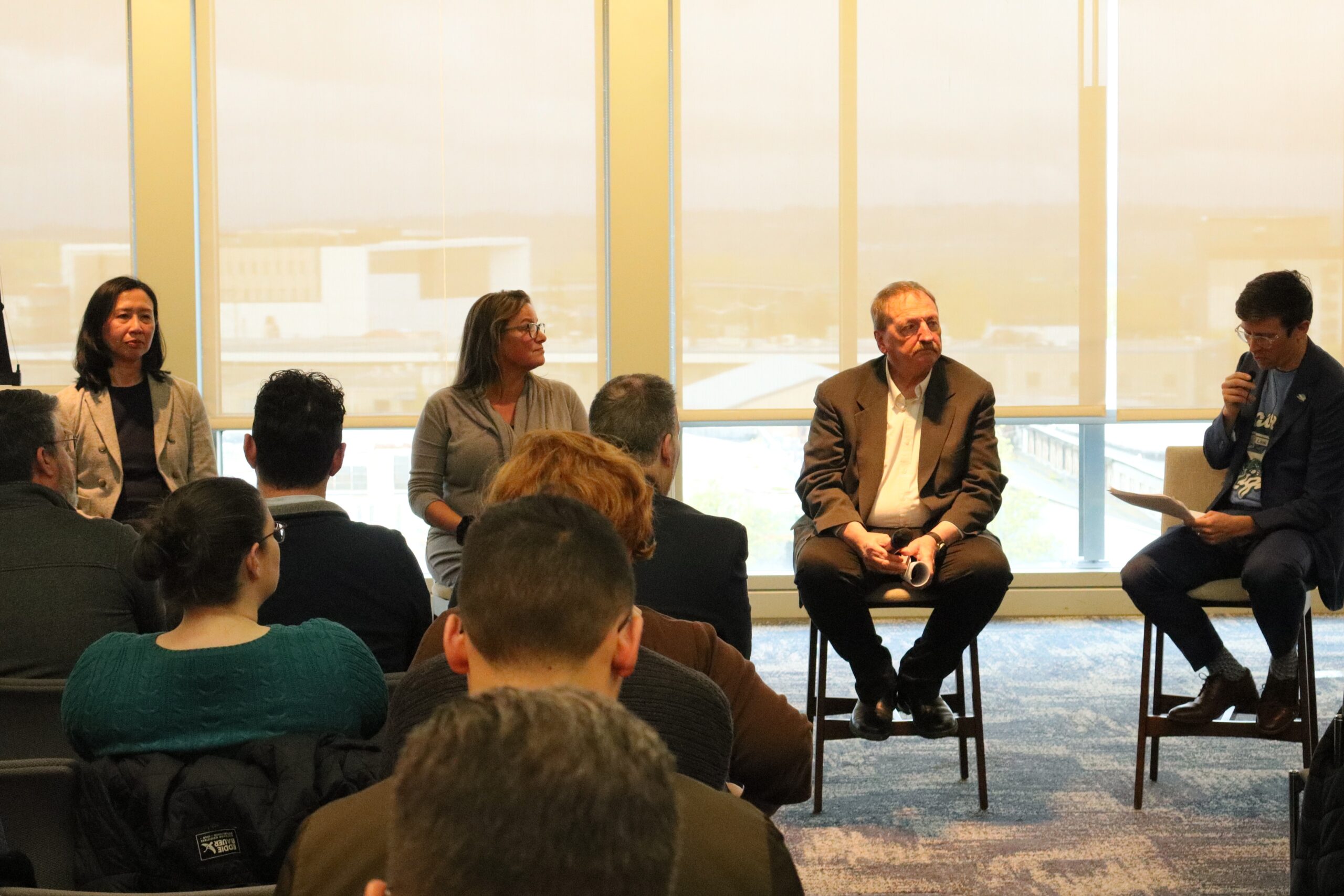
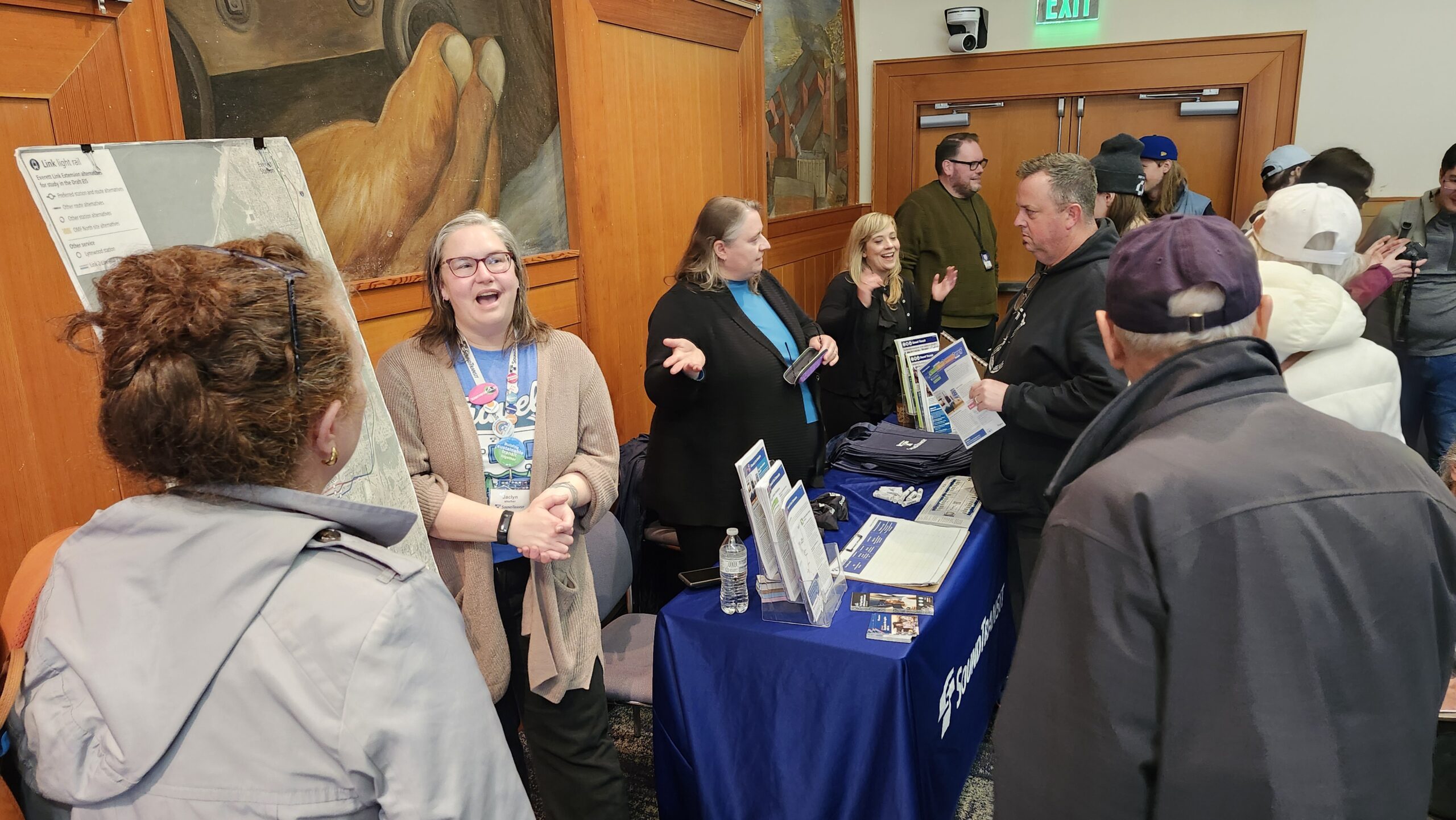
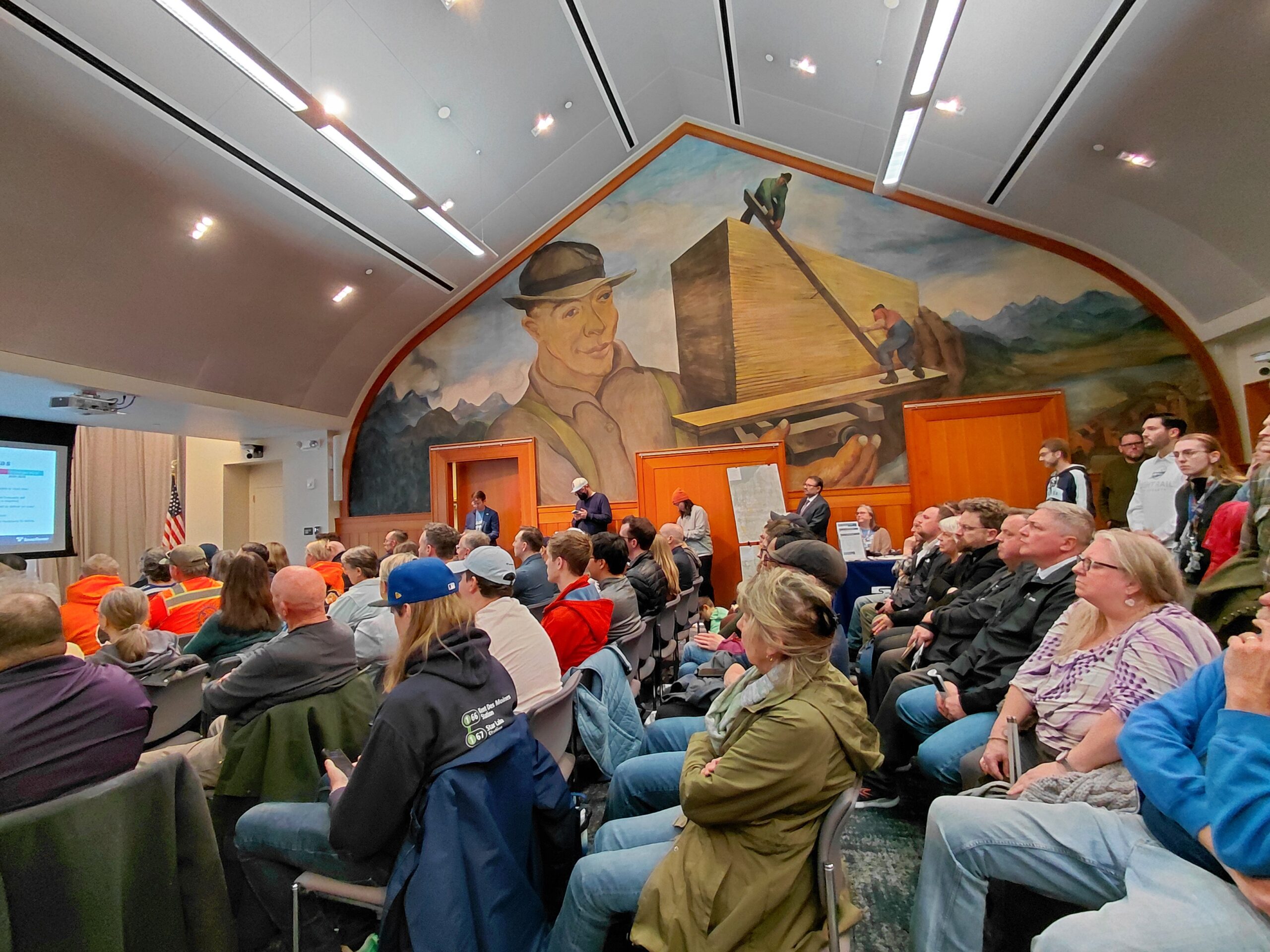
More than 100 people gathered in the Weyerhaeuser Room in Everett Station Tuesday evening for a Q&A session about the Sound Transit 3 (ST3) phase of the regional light rail line. Panelists included Sound Transit Board Chair and Snohomish County Executive Dave Somers, Everett Mayor Cassie Franklin and Sound Transit Central Corridor Project Director Sandra Fann. Snohomish County Transportation Coalition Executive Director Brock Howell was the moderator.
Following the opening of the Federal Way light rail extension in January, Sound Transit is looking at options for ST3 extensions to Everett, West Seattle and Ballard. For Snohomish County, current ST3 plans call for construction from 2037-41, with the addition of seven stops north of Lynnwood City Center – where the rail line now ends. The stops are West Alderwood, Ash Way, Mariner, Highway 99/Airport Road, Southwest Everett Industrial Center, Highway 526/Evergreen Road and Everett Station.
Sound Transit will also build an operations and north maintenance facility near Paine Field, scheduled to open in 2034.
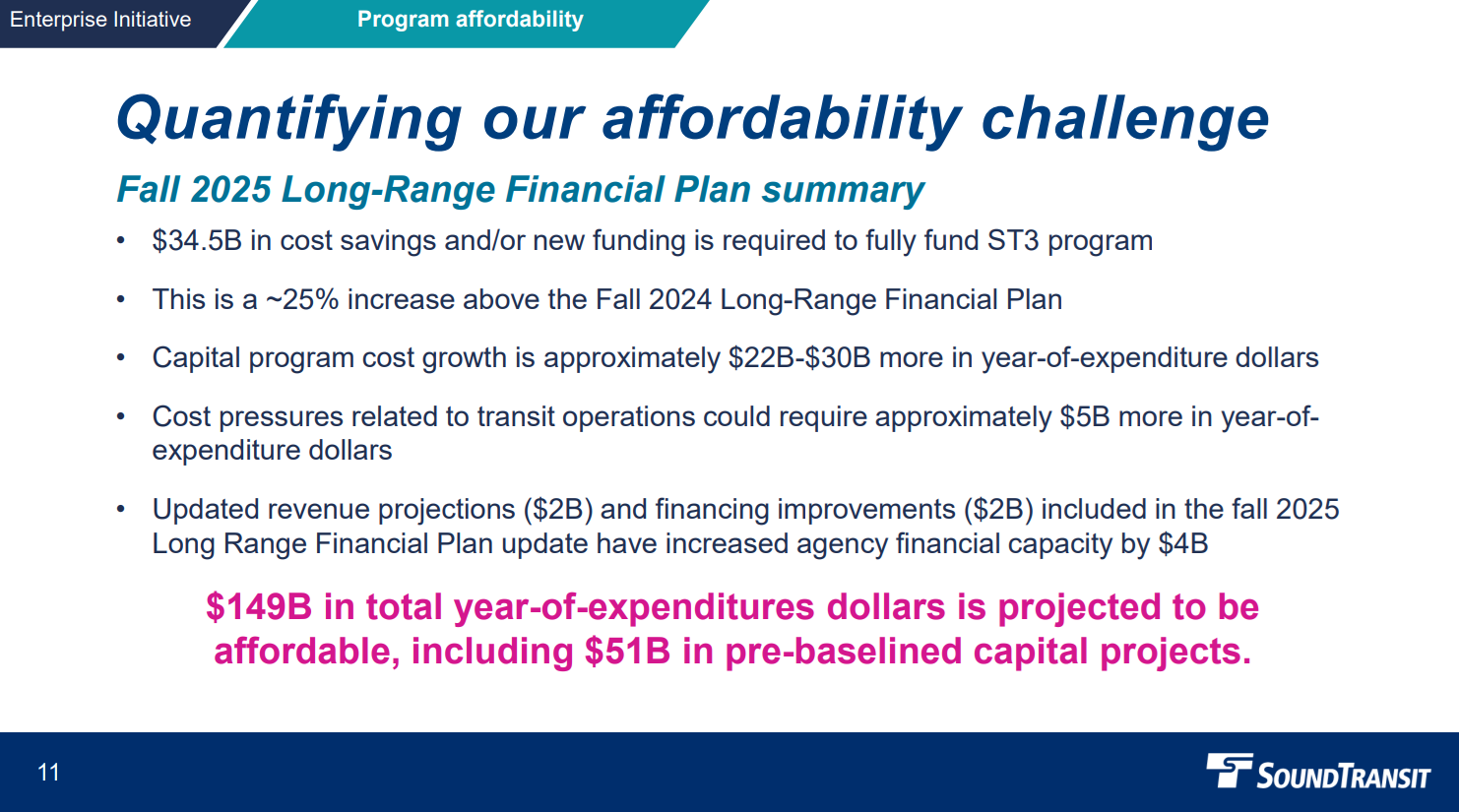
Fann said that “unprecedented cost inflation” has affected capital projects across the public transportation system, resulting in what she described as “an affordability gap” of about $34.5 billion over 20 years.
“This means that we need to find cost savings and/or new funding to fully deliver the ST3 program,” she said. In response, Sound Transit established the Enterprise Initiative to close that gap.
Despite the deficit, Fann said Sound Transit still expects to deliver roughly $149 billion in projects over the life of the Sound Transit financial plan, including about $51 billion in ST3 projects.
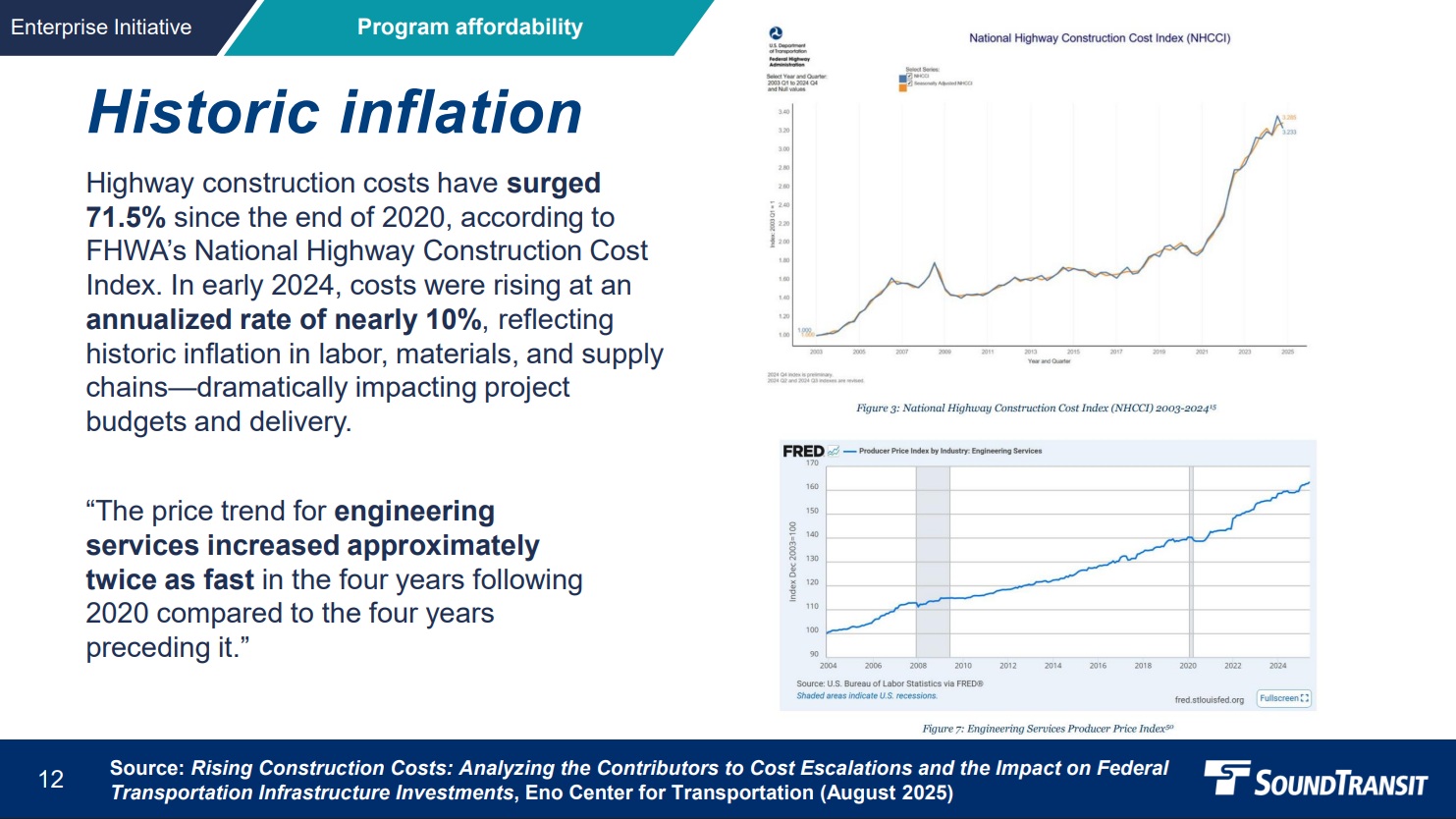
Somers said costs for highway projects increased by 70% between 2000 and 2020, and continue to rise. “We’ve seen the same inflation the last five years,” he said. “That’s [because of] the pandemic. It’s strikes. It’s material costs. It’s the state of the world, frankly.”
Fann said highway construction costs have surged 71.5% since the end of 2020, adding that “soft costs” like architecture and engineering were rising nearly 10% annually in early 2024. Fann said the Sound Transit board in 2025 established a set of guiding principles for its work under the Enterprise Initiative:
- Improve regional connectivity, including serving the local population and job centers.
- Complete the light rail “spine” that runs from Everett to Tacoma.
- Support future growth by maintaining and increasing ridership.
- Align investments with land use patterns and population trends.
- Prioritize passenger experience by maximizing connections, improving safety and ensuring the system is reliable.
- Protect public investments with fiscal integrity.
- Maintain oversight and accountability.
- Evaluate trade-offs in decision-making.
Fann said each of the initiative’s workstreams – which include operations, policy and planning, capital delivery and finance – identified potential ways to reduce costs, many of which are interconnected across different areas of the agency.
“$34.5 billion is a very large shortfall, which means we are going to need to make some tough decisions,” Fann said.
To address the increasing costs, she said Sound Transit outlined several ways to help policymakers understand trade-offs by presenting three options. None of the approaches are meant to be a final solution, Fann said. Instead, they are frameworks to show what would be gained or delayed under different strategies.
Option 1: Keep active light rail projects
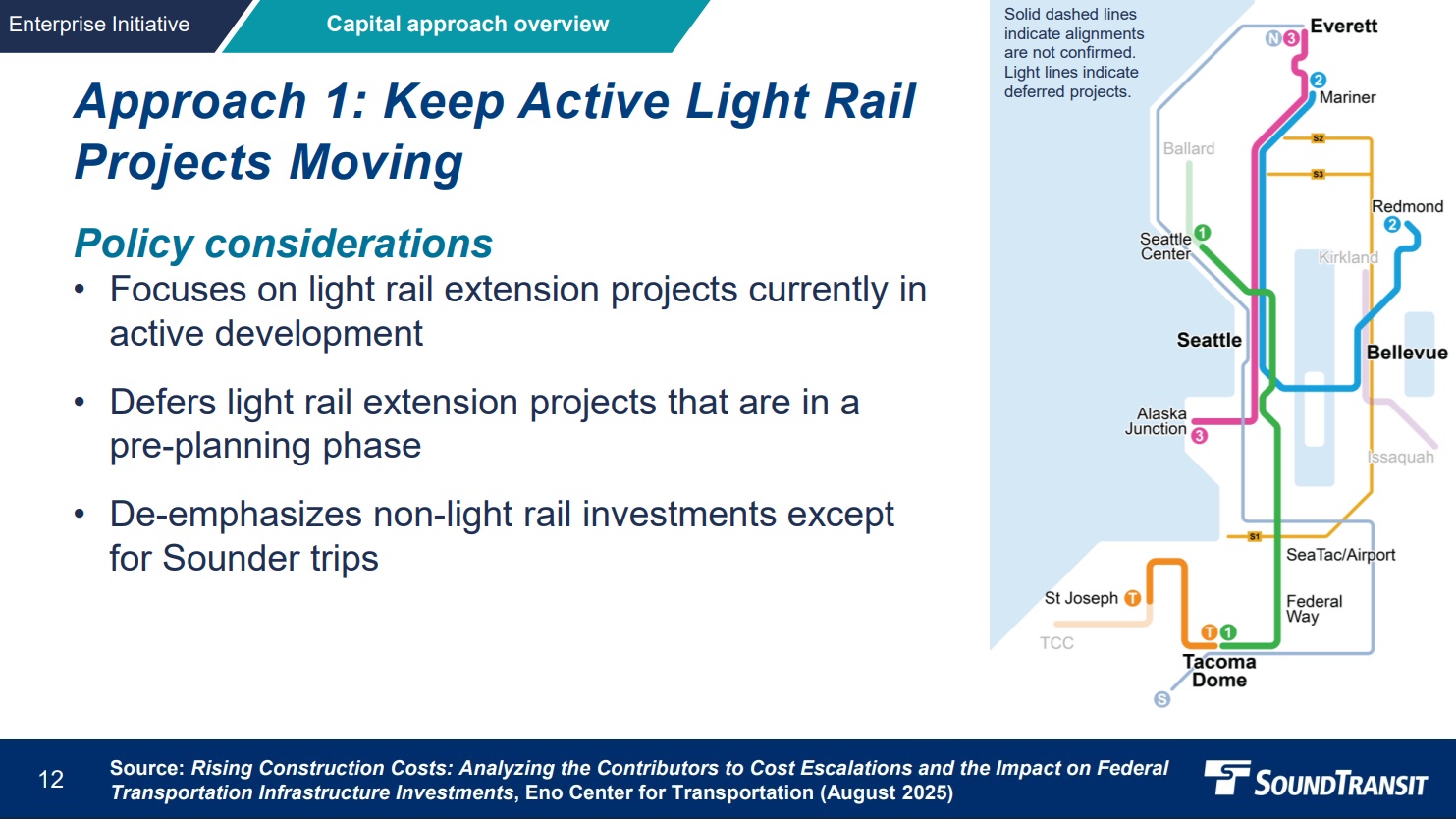
This prioritizes continuing light rail projects that are already in active planning or development. It keeps major projects moving forward, including extensions to Everett, Tacoma Dome and West Seattle. Projects that are still in early, pre-planning stages – such as Tacoma Community College and the South Kirkland-Issaquah line – would be deferred.
Option 2: Advance regional connectivity
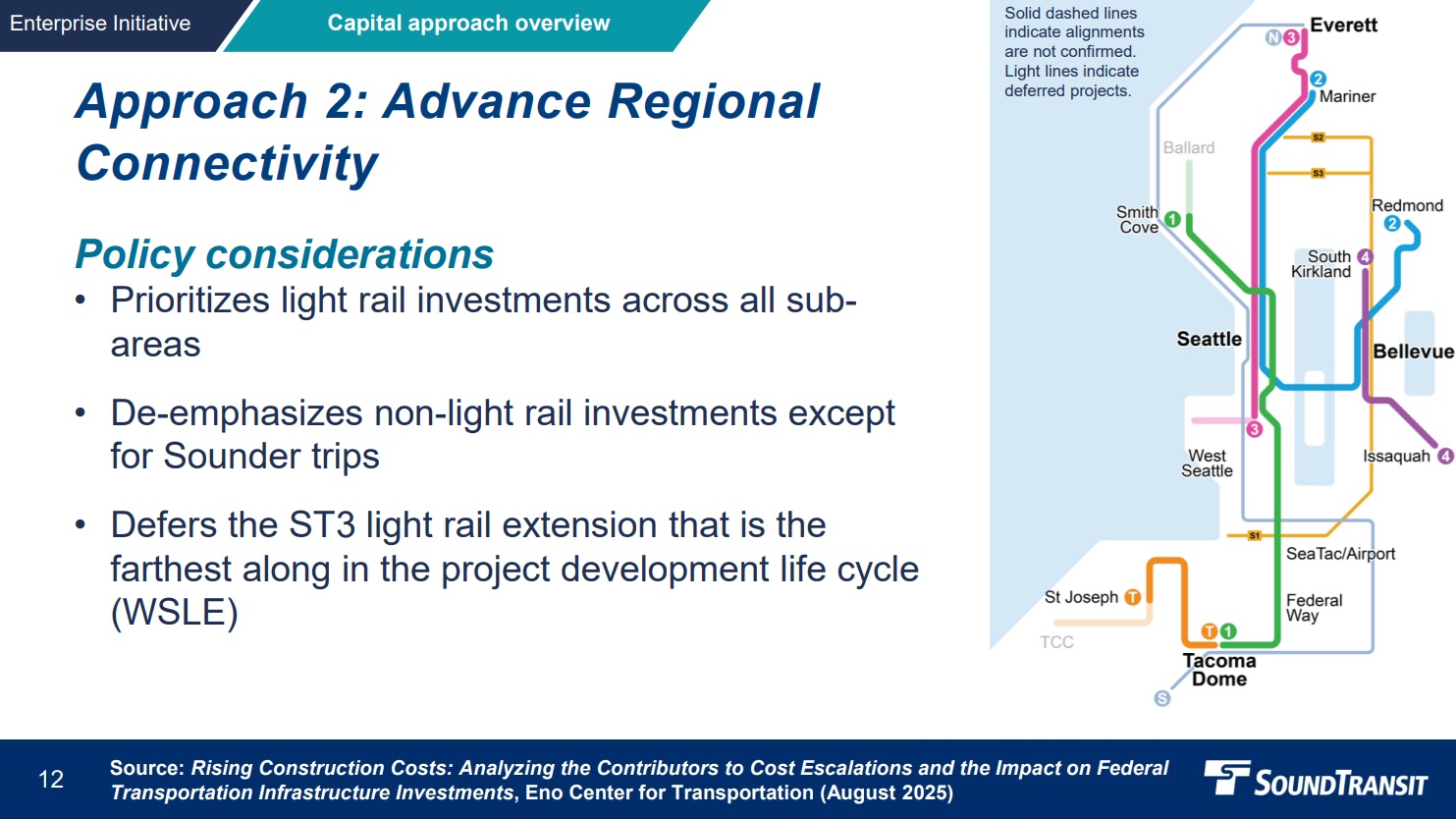
This prioritizes light rail but spreads investments more evenly across all subareas. It defers the West Seattle extension while bringing the South Kirkland-Issaquah project back into consideration.
Option 3: Phase all light rail extension projects
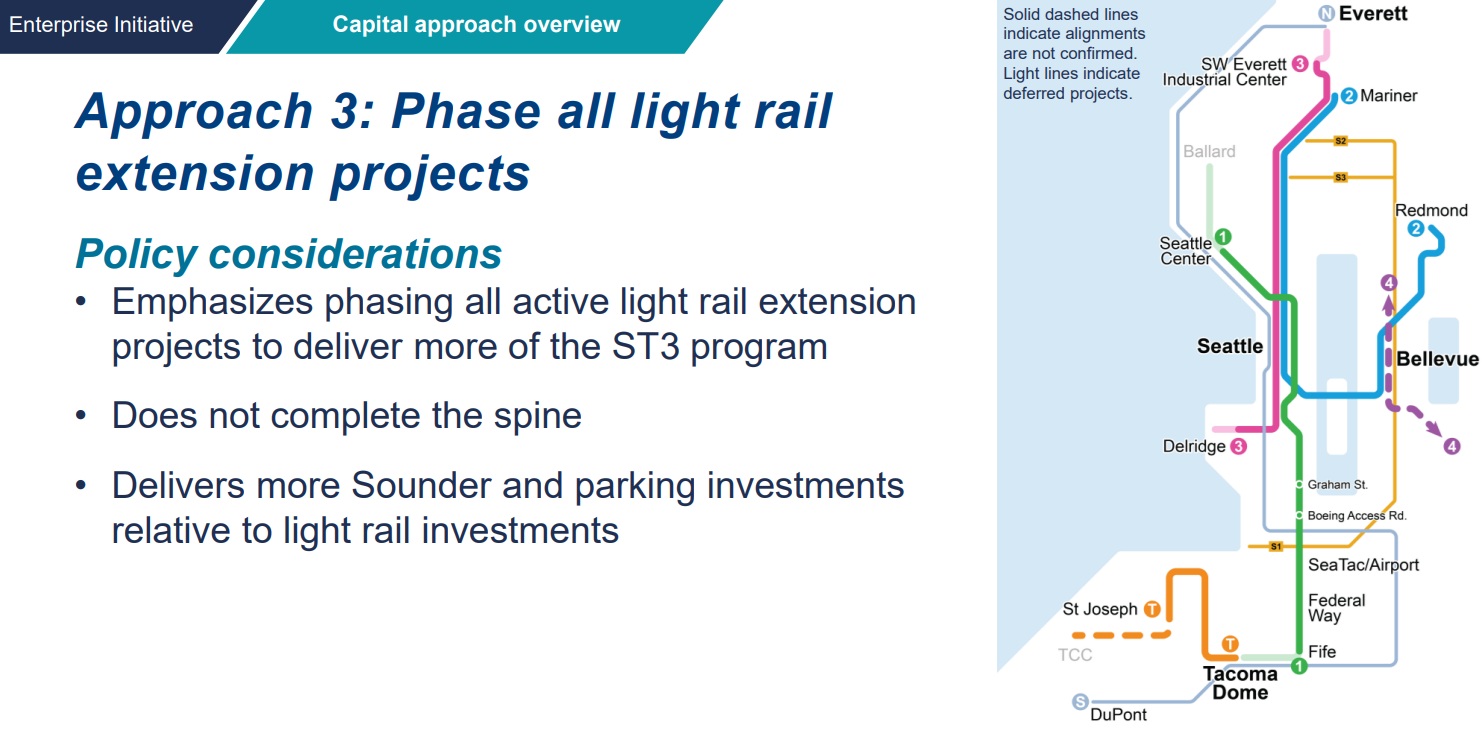
This defers the completion of full light rail extensions and instead phases projects in segments. It would deliver partial builds rather than full corridors. For example, construction would stop short of Everett, and would complete only portions of the Tacoma Dome and West Seattle lines. The spine would not be finished, and investments would be emphasized on the Sounder train and parking.
“The agency and our board has faced and has successfully navigated program affordability challenges several times over the course of our history,” Fann said. “While this time it’s a little bit different in terms of the overall scale… we can also look at our history and learn lessons for how to solve today’s problem.”
Unlike Sound Transit’s 2020-21 realignment program, which was created in response to revenue losses from the COVID-19 pandemic and rising real estate and construction costs, she said Sound Transit is “maintaining momentum and advancing projects” and delays may result in higher costs.
West Seattle vs. Everett
Franklin said costs for the Ballard and West Seattle extensions have nearly doubled, driven in part by higher property acquisition costs in Seattle. In contrast, cost increases for the Everett extension rose 5-10%. She added that the cost reductions do not involve eliminating stations, and she opposes any phase that would scale back light rail extensions.
“Option 3 … is simply not an option in my mind,” Franklin said. “Everett is not just downtown Everett,” Franklin said. “Everett is the southwest industrial center, southwest Everett and the Casino Road station. That’s Everett.”
Franklin said Everett’s industrial center alone supports about 35,000 jobs. “It’s like a city within a city. So not going out there would be crazy,” she said.
She also cautioned against routing light rail along Interstate 5. “You don’t want light rail blazing along I-5. You’re not going to see any housing, any walkability — the community is not going to benefit from that system,” she said. “The community benefits when we serve the entirety of Everett.”
Fann said Sound Transit is closely monitoring changes to the Federal Transit Administration’s Capital Investment Grant program. “There’s a lot of uncertainty still about the [grant] program,” she said, adding that the agency is also tracking a federal funding package and potential changes to grant criteria.
Somers noted that many Sound Transit projects rely heavily on federal grants, including about 40% of the West Seattle project and about 30% of the Everett extension. Somers said the draft environmental impact statement (EIS) – which is required by federal law to assess the environmental impact of a construction project and was expected around this time – has been delayed by the Federal Transit Administration for unclear reasons.
“Those [grants] are all kind of up in the air,” Somers said. “For future board members, be patient, because we’re going to be dealing with some rough waters for a while and a lot of uncertainty.”
Other issues
Some of the topics raised by audience members included the following.
Elevated light rail
Franklin and Somers said building an elevated light rail line along Everett’s Airport Road to reduce property acquisition costs has its own financial and logistical challenges. Franklin said elevated rails are costly, sometimes offsetting potential savings from avoiding property purchases. She said Sound Transit is exploring more cost-effective options, including at-grade stations.
Fann said that placing infrastructure in the middle of a roadway can create extra complications, such as the need to redesign surrounding access and traffic flow.
Somers said elevated rails still require acquisition of property. “You can’t fit it all in the right of way,” he said.
Infrastructure
Somers said future light rail stations are being designed to support housing, walkability and bicycle access, with a focus on creating transit-oriented communities. “We really want people to be able to live and be able to walk [near the stations],” he said.
Franklin said the city has been planning for light rail for years by updating zoning and working with communities to prepare for growth while minimizing displacement. She added that creating walkable, livable neighborhoods is a key goal, along with reducing reliance on cars as the transit system expands.
“The goal is…we won’t need three-car families anymore,” Franklin said, emphasizing bicycle infrastructure around stations. “We want to see people walk to the station, pick up their bicycle, ride over to their station…or even take it with them on the train,” she said.
EIS report
Sound Transit Senior Project Manager Miranda Redinger said the draft EIS for the Everett Link extension will be this fall, followed by a 45-day public comment period and a series of community open houses.
She said the draft EIS will include detailed environmental analysis but will also highlight key decisions, such as station locations and route options.
“The main questions are still, should the station be here or here, and why,” Redinger said. “We don’t know exactly where the tracks and stations are all going yet.”
The EIS process is expected to extend into 2027, when the board will formally adopt the project and seek federal approval and funding.
The next Transit Town Hall event will be in Pierce County from 6:30-8 p.m. Monday, April 27, in MLG 110 at the University of Washington Tacoma, 1950 S. C St., hosted by Transportation Choices Coalition and Tacoma on the Go.
Scheduled speakers include Pierce County Executive Ryan Mello, Tacoma City Councilmember Kristina Walker and Sound Transit staff. The hybrid event will be moderated by Tacoma on the Go Executive Director Laura Svancarek. The event is open to the public.
Sound Transit is asking the public to complete a survey about priorities of the Enterprise Initiative.


Real first and last names — as well as city of residence — are required for all commenters.
This is so we can verify your identity before approving your comment.
By commenting here you agree to abide by our Code of Conduct. Please read our code at the bottom of this page before commenting.