
Will you chip in to support our nonprofit newsroom with a donation today?
Yes, I want to support My MLTnews!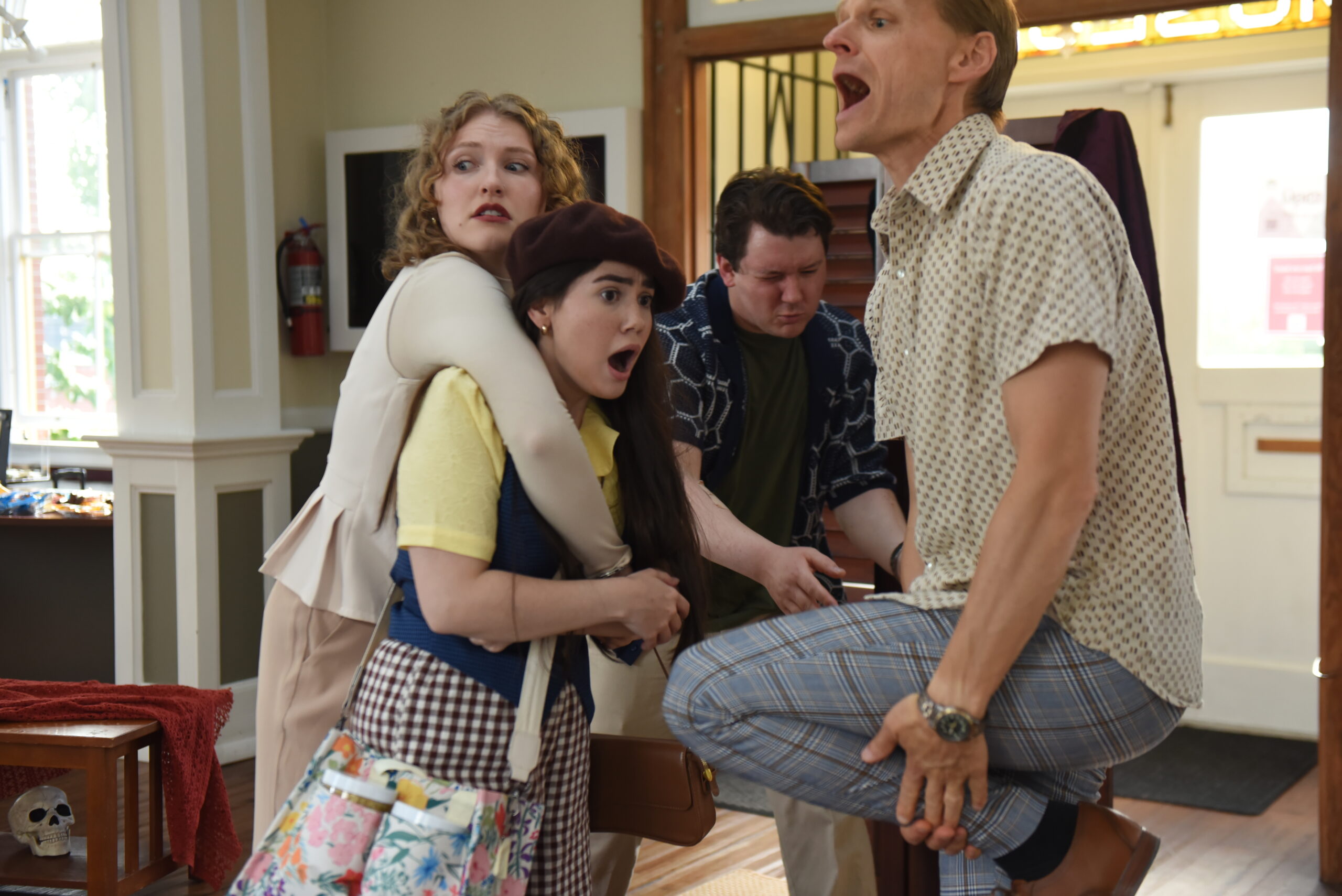
What happens when a modern adaptation of Shakespeare’s The Comedy of Errors is staged inside a history museum?
My Neighborhood News Group recently spoke with Artistic Producing Director Anna Doepp and Technical Producer Breanne Pancarik of Lampstand Theatre about bringing This is NOT Comedy of Errors to the Edmonds Historical Museum and asked why the venue was the perfect fit for this production.
Doepp said the choice of venue came after they attended a murder mystery performance at the Edmonds Historical Museum and immediately recognized its potential for immersive theatre.
“We both [thought], ‘Oh my gosh, this is absolutely perfect for an interactive production where our characters can move through the space and interact with the audience throughout the show,’” said Doepp. She added that the museum’s smaller, intimate setting fit the company’s style while allowing visitors to engage with the exhibits as part of the experience.
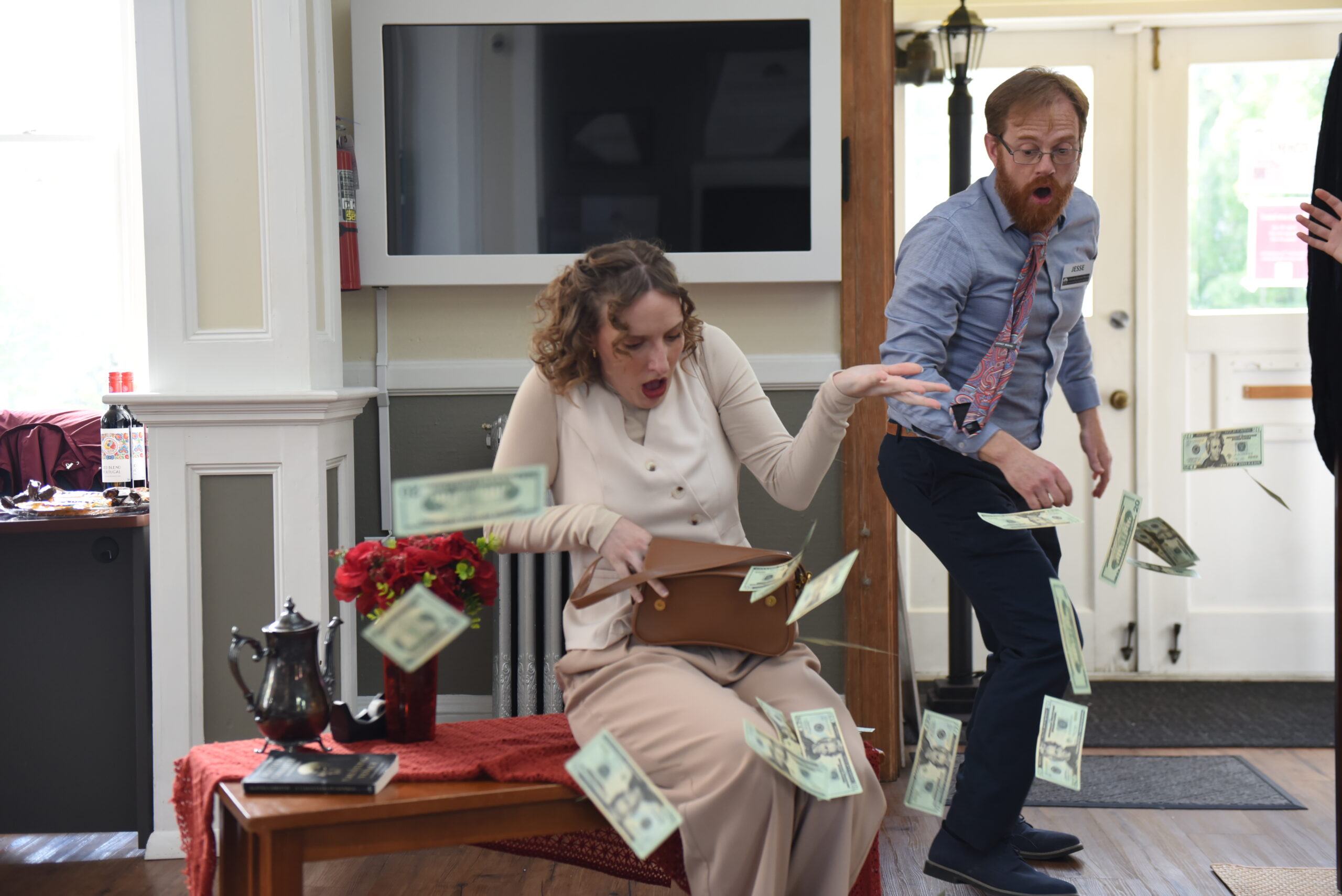
Written by Doepp and Pancarik and directed by Doepp, the production reimagines William Shakespeare’s The Comedy of Errors. The play involves stolen money, missing jewelry and competing accusations, with the museum woven directly into the fabric of the story.
Doepp traces the company’s approach back to theatre professor Ryan Miller at Vanguard University, who introduced them to site-specific performance.
“We were performing in different locations throughout campus, and it became this really unique way to present theatre,” Doepp said. “Instead of building a set on stage, we thought it would be really cool to take that concept and perform it in [different] locations based on the content.”
Inspired by those experiences, Lampstand Theatre was born in 2020 and Doepp and Pancarik began producing classic plays, particularly works by American playwright Eugene O’Neill.
“We started with classic plays. We’ve done a lot of Eugene O’Neill and pieces that were written kind of early 1900s that were relevant to today,” Doepp said. “We didn’t find local theatre companies producing them, and so we said, ‘Hey, let’s bring these back to life.’”
When asked about Shakespeare, Doepp said the challenge became finding ways to make the playwright’s work more approachable for contemporary audiences through the company’s site-specific approach.
“People do Shakespeare, but how can we present Shakespeare in a way that’s more accessible?” Doepp said. “If we have a play that we can set in a specific location due to the content, we’re able to both produce site-specific theatre, but also present it in a way that is really accessible to audiences.”
Part of that approach includes introducing contemporary language and other framing devices that help audiences engage with the story.
“We’re able to make it more understandable while still preserving the heart of the original work,” Doepp said
The Comedy of Errors is a play the company says is both appealing and unusually challenging for modern productions.
“It’s not as commonly done, because there’s two sets of twins,” Doepp said. The farce hinges on mistaken identity between two sets of identical brothers, a structure that often requires either carefully matched casting or actual twins.”
That complexity is part of what appealed to Lampstand Theatre, along with the creative challenge it presented.
Pancarik said stage managing a site-specific production requires balancing more logistical responsibility compared with a traditional stage show.
“It’s a lot of fun. It is also a lot of work,” Pancarik said. Because the set must be moved from location to location, she said it has to remain somewhat minimalistic while still being effective in telling the story.
“It means that you are accounting for all of the variables, you’re preparing the actors for all the possibilities, carry emergency kits, you carry all of the things that a normal traditional theatre would have,” Pancarik added, noting that the work involves anticipating changing conditions while still maintaining the essentials of a production.
Doepp remarked that Lampstand Theatre’s productions are intentionally site-specific, meaning performances take place in public spaces where unexpected interruptions can and do occur.
“I think the funniest thing that happened because it’s site specific…” Doepp said, explaining that the company often performs in locations ranging from closed indoor spaces like museums to outdoor environments like parks or marinas. “We will have random people walk through the performance…we’ve definitely had a couple times of that happening.”
She noted that actors are trained to treat those moments as part of the performance. In one instance, a bicyclist rode directly through a show, surprising the audience but prompting performers to incorporate the interruption into the scene through ad-libbing and improvisation.
Doepp said Lampstand’s productions follow the script but allow space for improvisation, with some characters using modern language to respond to unexpected occurrences during performances. That flexibility, she said, helps make Shakespeare more accessible and responsive to the environment.
She added that no two performances are exactly alike, since audience experience can shift depending on location and spontaneous interactions between actors and their surroundings.
The writing process itself begins with Shakespeare’s original text, Pancarik said, and then is carefully restructured for the performance.
“When we start writing these shows, we always start with the source text,” she said. From there, she identifies “the essential parts,” then trims and combines characters to fit a smaller cast and the portable production.
“This show has probably about 20 characters in it, and we did not want to have that big of a production,” Pancarik said.
Once the structure is set, the team layers in modern language to support audience understanding without replacing the original work.
“We can then rearrange, we can cross outlines and do all the things we need to do to adjust it to our modern speaking characters,” she said.
Doepp said the approach ultimately reflects the company’s goal: making classical theatre more approachable while preserving the heart of the original work.
This is NOT Comedy of Errors review
What was scripted? What was ad-libbed? Who was a performer and who was just another museum visitor? That was the question.
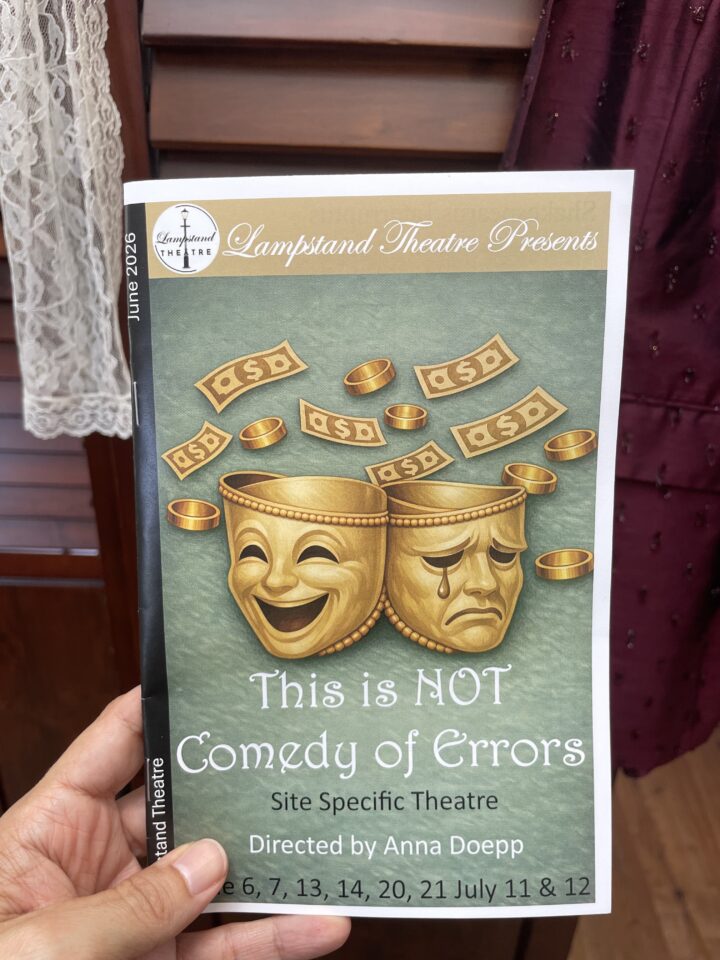
As I walked through the door, I noticed chairs arranged at the back of the room facing the entrance. At the center stood a three-fold partition draped with costumes and scarves, a structure that appeared at first designed for quick costume changes.
Audience members filed in enthusiastically, taking their seats and flipping through the playbill. Yet before the performance had fully begun, one of the productions’ greatest strengths had already emerged: its ability to blur the boundaries between performance and reality.
Jesse Stoddard, who had greeted me at the door, entered asking audience members if they had seen a missing set of keys. Most of us got up from our seats to genuinely look for them. He began with enthusiasm and quickly escalated into anger, barking, “Do you think this is funny?!” at one guest. Eeek!
Moments later, Rhodessa Defigh appeared in classic black as the stage manager, informing the audience that Macbeth would be starting shortly. The same announcement appeared in the playbill. Surely, we weren’t about to see two Shakespeare plays at once?
The answer remained delightfully unclear.
As This is NOT Comedy of Errors continued, Lampstand Theatre’s adaptation felt accessible and contemporary. Actors regularly slipped modern expressions into the performance. Stoddard casually remarked, “Smooth like butter,” and Mark Savchenko’s Luca delivered, “Trouble in the marriage bed? Oooohhh,” while covering his mouth with both hands.
The production’s energy never faltered…once. Each and every actor performed with full commitment, embracing the physicality and heart-on-the-sleeve style that I often associate with Shakespearean plays.
Particularly impressive were Nicole Roundy as Antiphola of Syracuse and Madison Taylor as Dromia of Ephesus. The pair were energetic, confident and mesmerizing to watch. Interestingly, while taking notes, I accidentally wrote down the names of Emma Chi (Antiphola of Ephesus) and Keira Stoddard (Dromia of Syracuse) instead.
The confusion speaks both to the production’s attention to detail and to the strong performances delivered by all four actresses.
Although there are not actually two sets of identical twins in the cast, the team invested extraordinary attention to detail in making the pairs appear nearly identical. The actresses shared matching costumes, earrings, hairstyles, hair color, hair length and even similar styling choices down to curls, eyebrows and freckles.
I giggled, noticing several audience members repeatedly flipping through the “Who’s Who” section of the program trying to keep track of who was who.
That level of visual precision made Shakespeare’s mistaken-identity premise work exceptionally well, even in the intimate entryway of the Edmonds Historical Museum where every detail is visible up close. It was genuinely impressive.
Scott McKinstry’s Adrian brought passion and commitment to the role. The museum’s acoustics also served the performers well, allowing dialogue to remain clear throughout.
The performance ran approximately 90 minutes without intermission, yet I never once felt like I needed a break. The brisk pacing, combined with the actors’ spirited momentum and unwavering commitment to character, carried the production from beginning to end.
One of the funniest moments was the “Quoth he” scene featuring McKinstry (Adrian), Savchenko (Luca), Stoddard (Employee) and Taylor (Dromia of Ephesus). Their playful verbal sparring and refusal to miss a beat elicited several laughs.
The comedic partnership between McKinstry’s Adrian and Savchenko’s Luca was also very entertaining and well-matched. Heather McGuire, playing goldsmith Angela, brought authenticity to the role.
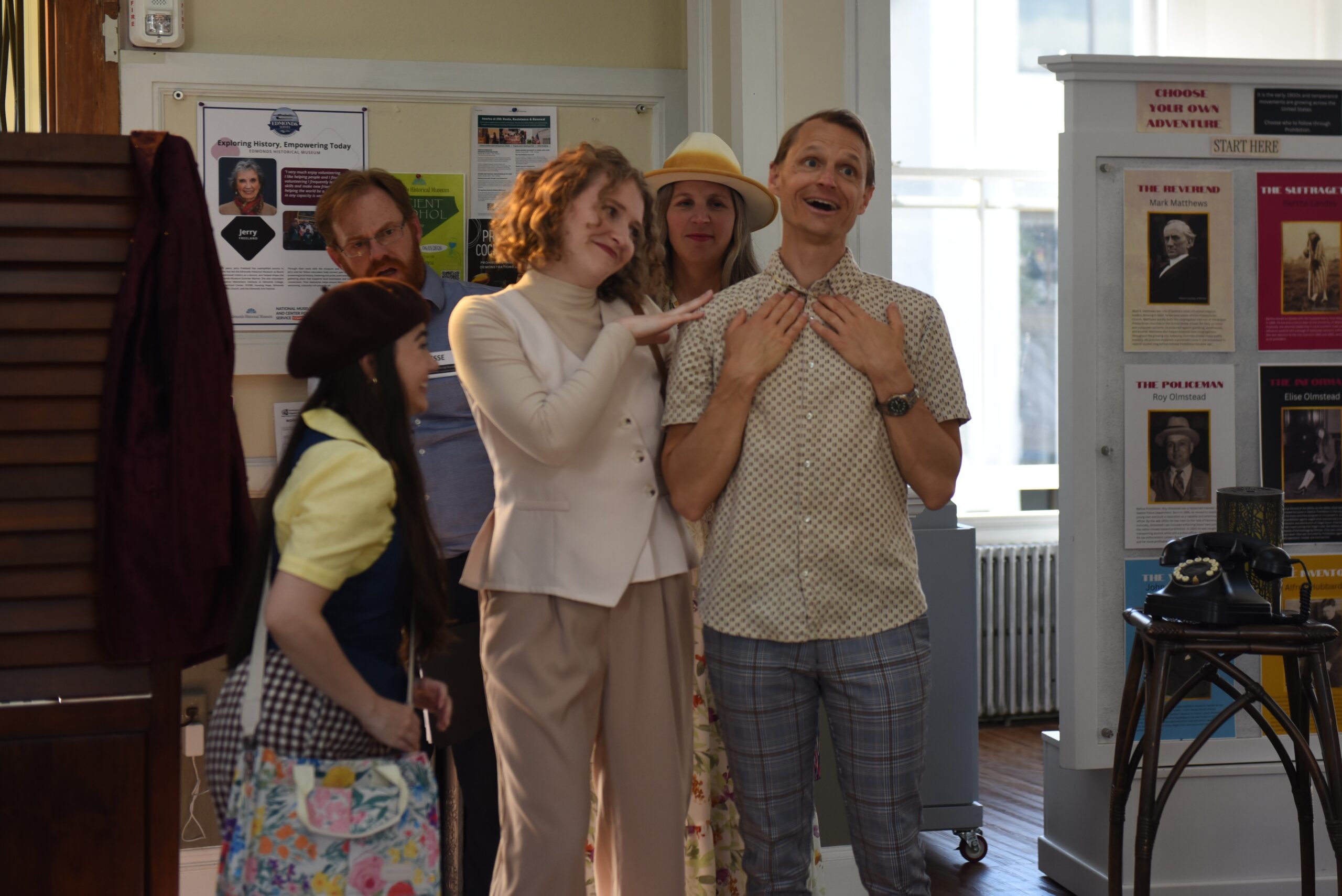
Director Doepp made good use of the museum’s unique spaces. Actors interacted with existing museum features including an old rotary telephone, a silver vase, the elevator and the front entrance. They cleverly used unseen exits and entryways, transforming the museum into an active performance space.
Movement became central to the storytelling too. Actors sprinted around the partition in chases and circular pursuits. The visual effect was animated and perfectly suited to the farcical nature of the play.
The museum employees continuously broke the fourth wall, apologizing for the actors’ misbehavior and assuring audiences that the “real” play would begin shortly. These interruptions consistently landed laughs and reinforced the production’s immersive nature.
There was also a surprising amount of physical contact, staged attacks and close-proximity action occurring only inches from audience members. The intimacy of the space kept viewers engaged and occasionally on edge – in an exhilarating way.
The production excelled at creating those socially uncomfortable moments that provoke laughter: a nose blown too loudly, a public argument, a sudden outburst of anger – human awkwardness.
Pancarik, who also appeared as the museum manager, further blurred the line between actor and staff member. Was she actually part of the staff or part of the cast?
Costumes were impeccable down to the last stitch, particularly in establishing the illusion of the identical twins. Numerous props contributed to the storytelling, while scene transitions occurred with impressive speed and efficiency.
Another funny moment happened when new characters entered through the museum’s front door, prompting Stoddard’s employee to exclaim, “I have another form for you to fill out!” This line consistently drew chuckles.
Equally impressive was Stoddard’s commitment to remaining in character before and during the performance. Watching actors maintain the illusion outside the “stage” boundaries adds another layer of immersion.
The ending, as Doepp notes, flips Shakespeare’s original structure on its head.
In The Comedy of Errors, Egeon’s speech appears at the beginning of the play in Act 1, Scene 1. Here, Jeremy Weeks delivers a passage at the conclusion, reading from a book while sounds and reactions from the cast continue around him.
Weeks delivers the epilogue with eloquence, serving as a bridge between the production’s playful chaos and the audience’s return to reality.
Lampstand Theatre demonstrated how Shakespeare’s comedy can still surprise audiences when staged with heart, imagination, superb acting and relentless energy.
Performances continue at different locations June 20-21 and July 11-12. Don’t miss it.


Real first and last names — as well as city of residence — are required for all commenters.
This is so we can verify your identity before approving your comment.
By commenting here you agree to abide by our Code of Conduct. Please read our code at the bottom of this page before commenting.