
Will you chip in to support our nonprofit newsroom with a donation today?
Yes, I want to support My MLTnews!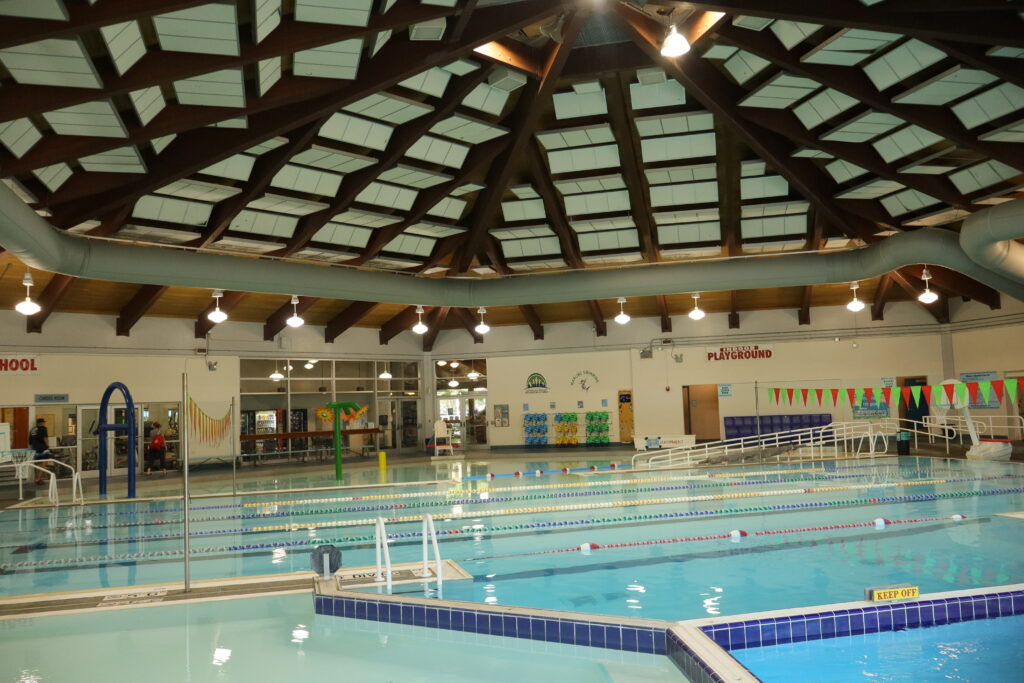
Key takeaways
- Councilmembers and city staff discussed the joint resolution and funding of a regional aquatics center in South Snohomish County.
- City staff discussed funding and details about the water quality project in Melody Hill.
- New land use codes and redistricting were discussed for adoption later this year.
- Public addresses pedestrian and bicyclist safety in the City.
In addition to Mountlake Terrace’s 2025 performance report, the City Council reviewed with city staff at the July 23 work session two major projects: a shared regional aquatic center with the City of Edmonds and a water quality project at 70th Avenue West and 220th Street Southwest.
City staff have presented the need to replace the Recreation Pavilion and the financial challenges of rebuilding it without partners at previous City Council meetings since 2024.
Beginning April 2025, Mountlake Terrace has held monthly meetings with regional partners to evaluate a potential South Snohomish County aquatic facility. The Mountlake Terrace and Edmonds city councils approved a joint resolution on July 21, requesting the Snohomish County Council to use real estate excise tax (REET) funds as a potential short-term funding source for local aquatic facilities.
The resolution seeks REET funding for Snohomish County Council Districts 3 and 4 during the 2027-28 biennium to support capital improvements at Edmonds’ Yost Pool and the Mountlake Terrace Recreation Pavilion. The resolution would ask Snohomish County Councilmembers Strom Peterson and Jared Mead to allocate county grant dollars toward regional aquatics work in South Snohomish County.
During the work session, Deputy City Manager Carolyn Hope said the costs for a local pool had escalated beyond what the City could realistically fund through its own ballot measures. She said city staff have been meeting with nearby cities, school districts and agencies, and are moving toward a memorandum of understanding (MOU) and a feasibility study.
Recreation and Parks Director Jeff Betz said that Edmonds’ request through Petersen would focus on assessing needed repairs and maintenance at Yost Pool and potentially using remaining funds to help fix the outdoor facility. Mountlake Terrace’s request, routed through Councilmember Mead, would seek $150,000 for a conceptual design of a potential regional aquatics facility.
Betz said the intent is to have the participating jurisdictions sign a MOU and hire a consultant. The consultant would examine existing pools in the region, update demand data, define what a regional facility should include (lap lanes, recreation features and swim lesson capacity), and identify potential locations, options and funding paths.
“There’s no guarantee that they would support our project. [Or] it could be something less than the full amount [$150,000],” Betz said.
Councilmember Erin Murray asked about the grant timeline and whether residents could lobby for support. Betz said that decisions would likely coincide with the County’s budget process in November or December. Murray noted that residents can contact their local and county representatives about the pool funding.
The Council will hold a special meeting Thursday, July 30, to vote on the joint resolution. Can we add the meeting link/additional info here, or is that too extra?
Water quality project
Stormwater Program Manager Patrick Hutchins briefed the Council with a state‑funded water quality project at 220th Street Southwest and 70th Avenue West around Melody Hill.
According to City documents, the 220th Street Southwest and 70th Avenue West water quality retrofit project is funded by a $4.71 million grant from the state Department of Ecology. The project will treat runoff from 32 acres before it reaches Hall Creek and Lake Ballinger, reducing pollutants, such as heavy metals and petroleum due to heavy traffic on 220th Street Southwest.
The funding includes a $3.83 million forgivable loan and an $879,601 grant, covering the project’s full cost if grant requirements are met. City staff aim to finalize the agreement with the Department of Ecology by the end of this year.
Hutchins said construction may begin in spring 2027 and finish by late summer or fall of that year. The City is working with Jacobs Engineering on final design and will bid the work to a construction contractor, while city staff handle project management and inspection.
Hutchins said the project would “completely fulfill” a key stormwater permit requirement. “We only have to treat 3.5 acres of stormwater every year per our permit, so we will be treating 10 times the amount that we’re required to,” he said. “It’s pretty exciting to be able to have that big an impact.”
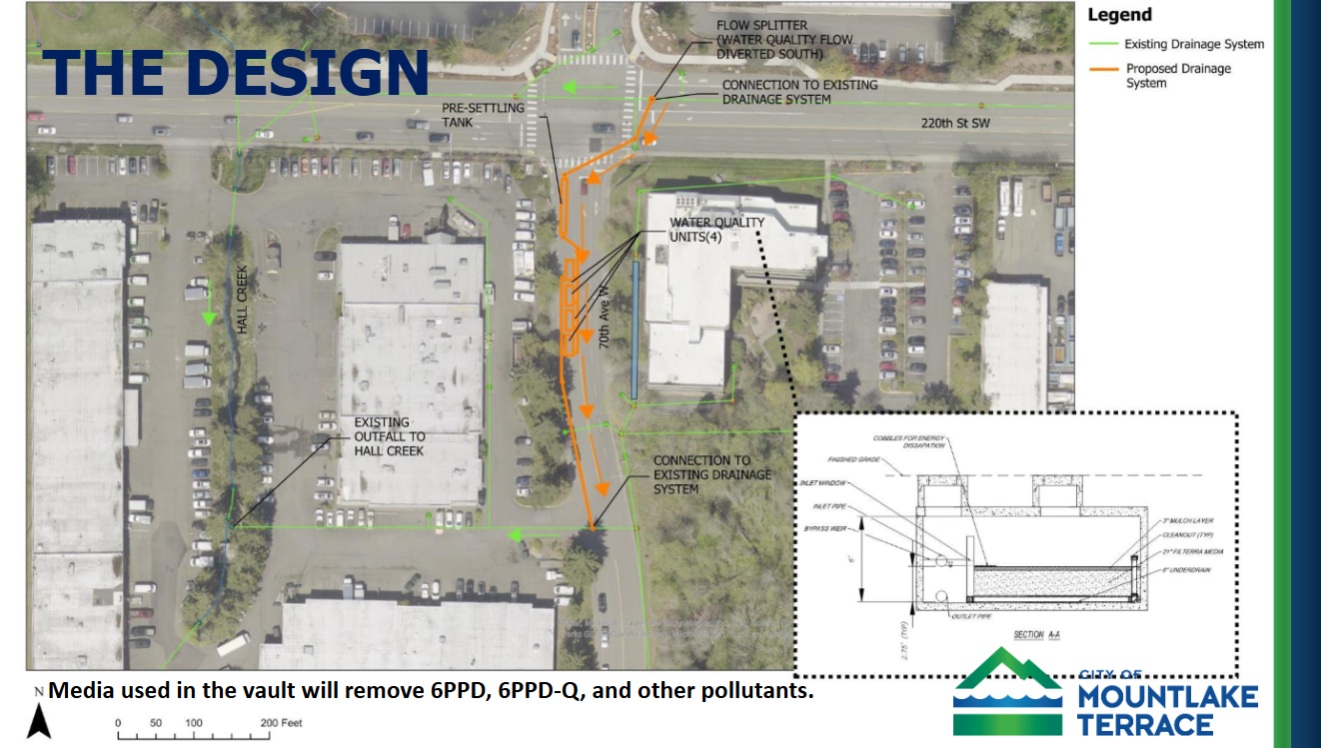
Hutchins then showed the Council how stormwater from 220th will be rerouted to 70th through a series of four large water‑quality filter vaults. Each vault will use a layered media of sand, biochar, coconut fiber (coir) and a proprietary mix to remove pollutants, especially 6PPD‑q, a chemical in car tires that is lethal to coho salmon.
“We’re protecting not only our human quality of life…but also our non‑human neighbors,” he said, noting that coho are among the few salmon species still present in Hall Creek and Lake Ballinger.
Mayor Steve Woodard asked whether the work would also yield pedestrian improvements in that intersection. Hutchins agreed. Because the project cuts across a crosswalk, the City is “actually required by the Americans with Disabilities Act to upgrade those crossings,” he said. He added that staff will improve pedestrian safety and accessibility across 70th Avenue West as much as the steep grade on 220th Street allows.
Councilmember Sam Doyle asked about long‑term maintenance costs. Hutchins said the upper mulch and coir layers will likely need replacement every six months to a year, which is “relatively cheap” and can be handled with a vacuum truck. The underlying materials have a much longer lifespan of about 10-15 years, he said.
Hutchins added that the project may provide some flood‑relief benefits in the Nelson Business Park area by rerouting about 85% of upstream flows to a different outfall and slowing discharge through the filtration system. He said he will return later this year with a negotiated agreement and a request for a council resolution authorizing the city manager to accept the $4.71 million grant.
Land use codes
Community and Economic Development Director Brooke Eidem briefed the Mountlake Terrace City Council on two land use code projects: Consolidating land use tables and implementing Zoning Phase Two to carry out the City’s 2024 Comprehensive Plan.
Eidem explained that the land use project will consolidate permitted-use tables into a new city code chapter, which improves organization and incorporates state-mandated updates for uses, such as daycare centers, co-living, emergency housing, permanent supportive housing and transitional housing.
The Planning Commission is expected to continue its review through August before forwarding a recommendation to the City Council, which is tentatively scheduled in September.
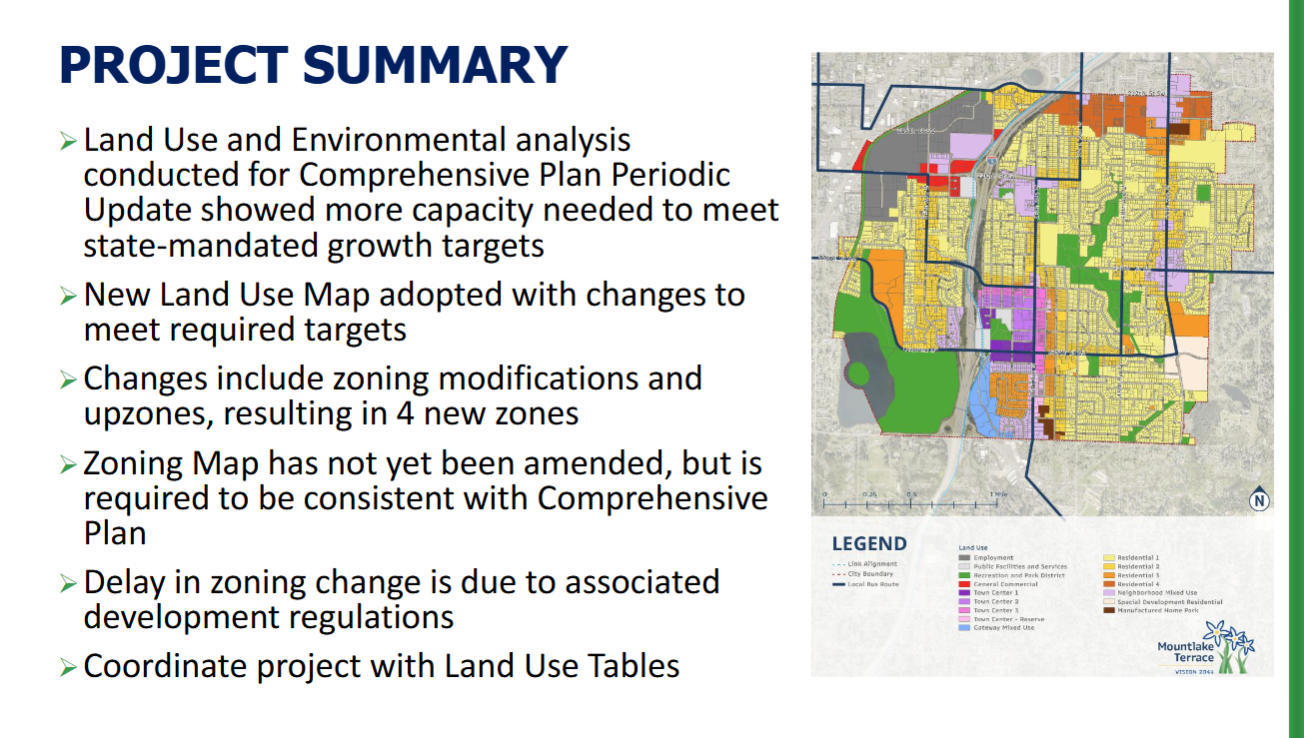
Regarding Zoning Phase Two, Eidem said it calls for four new districts: Employment, Manufactured Home Park, Neighborhood Mixed‑Use, and Gateway Mixed‑Use.
She said the Comp Plan’s environmental analysis evaluated the City’s assigned growth targets under three growth alternatives, and that the preferred alternative includes all four zones. Before the City can adopt a new zoning map, it must adopt development regulations for each new District and coordinate them with the new land use tables.
For example, in the Employment zone, Eidem said it will replace the existing Light Industrial Office Park (LIOP) District in the northwest Melody Hill neighborhood. The area also includes a 1990s‑era “sexually-oriented adult businesses” overlay (Chapter 19.70) that tracks the old zoning boundary. Eidem said the overlay is “outdated” and “not necessary” to regulate adult businesses and will be repealed. Instead, such businesses would be addressed directly in the land use tables with a “far more simplified” definition.
When Mayor Woodard asked whether the adult‑use overlay covered marijuana shops, casinos and bottleshops, Eidem said it doesn’t.
“The marijuana shops are actually addressed separately in the code,” she said. “This is more sexually-oriented entertainment businesses. I’m not sure we actually have any.”
Councilmember Kyoko Matsumoto Wright said the code was written in the time when the City had adult bookstores. “We don’t have any more,” she said. “They disappeared and we don’t know what new businesses are going to come in to take its place.”
In the Manufactured Home Park District, Eidem said it will replace the City’s mobile home park zone, which previously had no regulations. Instead, there are outdated standards that must be amended. A new zoning chapter will set development regulations for new and existing manufactured home parks, with an explicit intent to preserve existing parks and “avoid issues for those existing sites as much as possible,” Eidem said.
Matsumoto Wright asked whether the new zoning protects mobile home parks to “remain mobile homes forever” and whether a future Council could rezone those properties. Eidem said that a future Council could only pursue a rezone “if it is no longer being used as a mobile home park,” and that owners would have to show the area is abandoned and not viable.
She said the City is modeling its approach after a recently-adopted Everett ordinance and has consulted Everett staff. Woodard and Matsumoto Wright both voiced support for policies that retain mobile and manufactured home parks “as long as possible,” given past pressure on residents due to rent hikes and redevelopment.
For Neighborhood Mixed‑Use, Eidem said the District will be mapped in small “nodes” across the City. Staff proposed to house both mixed‑use zones—Neighborhood and Gateway—in a single code chapter because they share a similar design vision. She said staff are conducting outreach to property owners and using the Comp Plan’s vision statement to guide land uses and site and building design standards. The Planning Commission is handling land uses through the land use tables discussion and recently-reviewed design concepts. Draft regulations are scheduled for commission review next week.
The Gateway Mixed‑Use district will replace the Freeway Tourist zone along Van Ry Boulevard and is used as a more “intensive” and “regionally-scaled” mixed‑use area. Eidem said the Planning Commission will continue discussions on both mixed‑use zones through August and is expected to bring a recommendation in September.
Public comments
Mountlake Terrace resident Jackie Trio addressed traffic speed and safety on 232nd Street Southwest near her home on 52nd Avenue West, especially during school hours. She said “people will honk at us” when she bikes with her 6-year-old who attends first grade at Terrace Park Elementary.
“I don’t think parents feel comfortable letting them walk to and from school, which was something I did as a kid when I lived in a little neighborhood community like this,” she said. “[It’s] really unfortunate because it feels like the City has invested so much into making this such a great place to be.”
Referencing the City’s Main Street Phase 2 project, Trio said she supports the planned bike lanes but criticized the lack of physical barriers to protect cyclists. She noted that “a lot of really experienced bicycle riders have died because they didn’t have separated protected bike lanes” and argued that if the City is already investing in improvements, “it would be great to have those extra protections so that kids can ride in there and new residents can safely get around without a car.”
The full July 23 work session meeting is on the City’s YouTube channel.


Real first and last names — as well as city of residence — are required for all commenters.
This is so we can verify your identity before approving your comment.
By commenting here you agree to abide by our Code of Conduct. Please read our code at the bottom of this page before commenting.