
Will you chip in to support our nonprofit newsroom with a donation today?
Yes, I want to support My MLTnews!
Growing older is inevitable no matter where you live. But in a city like Edmonds where the median age is about 25% higher than Washington as a whole, long-term care is even more essential.
Certified Nursing Assistants (CNAs) are a vital part of that care, helping patients with daily activities and assisting nurses. According to a 2025 study by the Washington State Department of Health (DOH), CNAs make up 36% of the nursing home workforce in Washington and the state faces a “critical shortage”.
In an effort to bolster this workforce, policy changes aimed at training and recruitment are underway.
A 2025 Washington state law took effect this year on July 1, giving the Washington State Board of Nursing (WABON) all regulatory authority over nursing assistants in the state. Previously, DOH handled licensing and discipline, WABON managed education and training, and the Department of Social and Health Services (DSHS) took the lead for long-term care. This division of authority created confusion and red tape. It’s also unique to nursing assistants, as regulation of other nursing professions is handled solely by WABON.
“It was only appropriate for the board of nursing to take over the discipline and the licensure,” said Reuben Argel, director of nursing assistant education at WABON. “We’re already doing it for LPNs, RNs, nurse practitioners, nurse anesthetists.”
Renee Rassilyer-Bomers, the chief nursing officer of Providence Swedish North Division, which includes the Swedish Edmonds Campus, agrees.
“When we talk about the board of nursing now overseeing nursing assistant practice, it made a lot of sense,” Rassilyer-Bomers said. “There’s a close partnership between nurse assistants and nurses because our work relies on each other.”
The change comes amid other efforts by WABON to make CNA training and certification as smooth as possible. To obtain their license, CNAs must complete a state-approved program, pass a state skills test, pass an online knowledge test, and then apply for their license. In the past, third-party skills test proctors — another deviation from the norm of nursing education — have complicated the process.
“It took them forever and a day to get someone to give them an exam,” Argel said. He cited instances in which students traveled far distances to test with a third-party proctor who didn’t even show up.
Kyra McCoy, the director of nursing at Edmonds College, is familiar with that frustration.
“We would have a testing day for our own students, but a third party person had to come in and do it,” McCoy said. “They wouldn’t know the students, the students wouldn’t know how they did. You had to fax the results to someplace in Texas. I mean, it was just stupid.”
Delays in certification, added costs for applicants and worse test scores ensued.
“Kids were really nervous,” said Marina Orobinskaia, a CNA instructor at Woodinville High School. “They were making a lot of mistakes, and it didn’t necessarily reflect their ability to perform the skills.”
Two pilot projects launched by WABON in 2023 and 2024 began replacing third-party proctors with program instructors and integrating skills testing into CNA training programs. The goal is to make testing more accessible and affordable. Under WABON’s new authority, all training sites will administer testing themselves.
A September 2025 report to the legislature from the DOH concluded that these projects shortened the time between training completion and CNA certification from 96 days to less than 26 days. WABON saw an 88% increase in the number of monthly test takers.
McCoy highlighted the importance of support resources like Edmonds College’s I-BEST program. I-BEST class sections have an advisor who offers additional support of all kinds, from math, to English language support, to assistance with CNA certification after program completion. These kinds of programs allow the college to better serve immigrant students, first-generation college students, and students working multiple jobs.
“Not everybody is young and has parental support and isn’t married and doesn’t have kids. Those aren’t my students. My students are the people who are working,” McCoy said. “They can’t quit work and go to school full time, but if you can give them a part-time program and give them some support, they make fabulous nurses.”
Paula Kett, deputy director of the Center for Health Workforce Studies at UW, believes WABON’s new authority will help fix testing and certification delays, but she said that the problems facing this workforce don’t end there.
“Entry is a big piece, but honestly, retention is a lot of it,” Kett said. She explained that inadequate staffing of CNAs is often an issue of distribution rather than a shortage across the whole state. Rural areas and long-term care settings have more difficulty attracting and retaining adequate staff compared to urban areas and hospitals.
A 2024 Long-Term Care Workforce Legislative Report estimates a 50% turnover rate in Washington state long-term care facilities. High turnover is significantly associated with worse patient outcomes, according to the 2025 Washington State LTC Workforce Initiative Report.
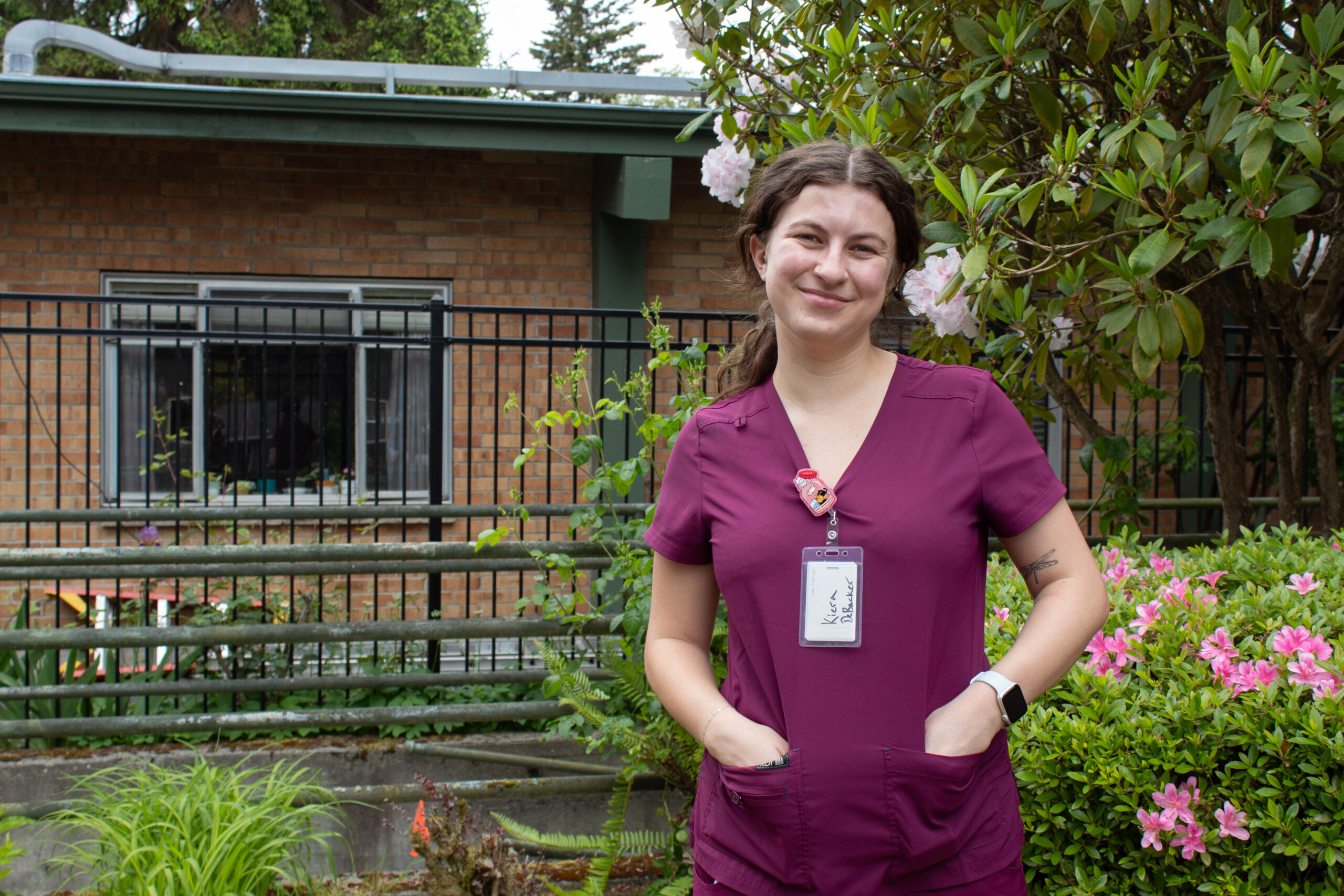
The most obvious solution to improving CNA retention is increasing pay. As a CNA in a nursing home, University of Washington third-year Kiera DeBacker barely makes more than she did as a barista at Starbucks. “Although Starbucks can be stressful and hard, it wasn’t like this. I wasn’t taking care of someone’s grandma,” DeBacker said. “It’s actually ridiculous how little CNAs get paid for the amount of work they do.”
Kett agrees that higher pay could increase retention, but she also emphasized that peer-mentorship programs, opportunities for career development, and a more supportive organizational culture could all contribute to better retention rates.
Rassilyer-Bomers understands that CNA retention requires opportunities for career progression.
“For Edmonds and for Everett [hospitals] specifically, what we’re looking at is how do we help our nurse assistants have different opportunities within our organization,” said Rassilyer-Bomers. “A nurse assistant in an ICU looks different than a nurse assistant on an oncology floor or on a med-surge floor. So how do we build pathways so that they can transfer and get that level of experience without leaving our facility?”
Edmonds College offers a variety of pathways for nursing assistants to advance their careers. Students can become acute care nursing assistants, patient care technicians, and licensed practical nurses. They can also transfer elsewhere to earn a bachelor’s degree in nursing.
Argel hopes that both CNAs pursuing higher nursing certifications and those who want to continue as CNAs will be supported as their careers progress, since their work is essential in every healthcare setting, and especially in long-term care.
“If it weren’t for CNAs, people wouldn’t get out of bed, they wouldn’t get changed, they wouldn’t get showers,” DeBacker said. “Nursing homes wouldn’t exist without CNAs.”
Olivia Asmann is a reporter and the podcast editor for UW Daily and previously worked at KUOW RadioActive.


Real first and last names — as well as city of residence — are required for all commenters.
This is so we can verify your identity before approving your comment.
By commenting here you agree to abide by our Code of Conduct. Please read our code at the bottom of this page before commenting.