
Will you chip in to support our nonprofit newsroom with a donation today?
Yes, I want to support My MLTnews!A sobering statement emerged from the Edmonds Civic Roundtable talk on Media Literacy Monday night, featuring two local school librarians who specialize in teaching children to sort through misinformation and AI manipulation that get harder to detect “every 24 hours.”
“At 12, students have to question everything they see [online],” Alderwood Middle School librarian Stacy Wright said. “We [people from the pre-AI generation] didn’t have to do that.”

Wright and elementary school librarian Deborah Fournier spoke to more than 100 people about the mental heavy lifting that now goes with gathering information – deciding whether some, none or all of it is true. Deciding whether to share it on social media. Deciding how and when to use artificial intelligence (AI) and what are the implications now and in the future to them and anyone they share it with …. the list goes on and on.
Even experienced people can be fooled.
Wright and Fournier are recipients of an Office of the Superintendent of Public Instruction (OSPI) grant for media literacy and digital citizenship. They had stories and quizzes for the audience who found they, too, could learn something.
Sourcing a study about children, Wright asked attendees, “Which of these organizations would you consider a reliable source? American Academy of Pediatrics or the American College of Pediatricians?”
While the names are similar, the missions are not.
Wikipedia says the American Academy of Pediatricians was founded in 1930 and is the largest professional association of pediatricians in the U.S.
Wikipedia says the American College of Pediatricians is a socially conservative advocacy group of pediatricians founded in 2002, known for supporting homosexual conversation therapy.
Wikipedia is a reliable source, just one of many and one way to verify and crosscheck information, the speakers said. They call it “SIFTing.”
SIFT to stop misinformation
SIFT stands for Stop, Investigate, Find, and Trace. Developed by Washington-based digital research scientist and literacy expert Mike Caulfield, the SIFT method is an evaluation strategy used to determine whether online content can be trusted.
Stop: Before you share, ask yourself, how does this information make me feel? Does it make sense? Don’t share without thinking.
Investigate: What is the reputation of this source? What is its motive? Is it left, right, center? Knowing the reputation adds perspective. One place to start is Media Bias/Fact Check, which provides data about the organization’s leanings. If you aren’t sure, open more tabs and find the same story on other sites, and check Wikipedia. They call it “lateral reading”.
Find: Find better articles. If you aren’t sure about the story, visit other trusted sources or go to fact-checking sites like Snopes, Politifact or factcheck.org.
Trace: Trace claims, quotes, pictures and videos back to the original source to see if the version you are looking at is true. Strategies here include hovering over profile or reverse image searches for photos using Google Lens. This short video explains how to do that.
Working with AI
The speakers also discussed how to use AI and how not to use AI by understanding what AI is.
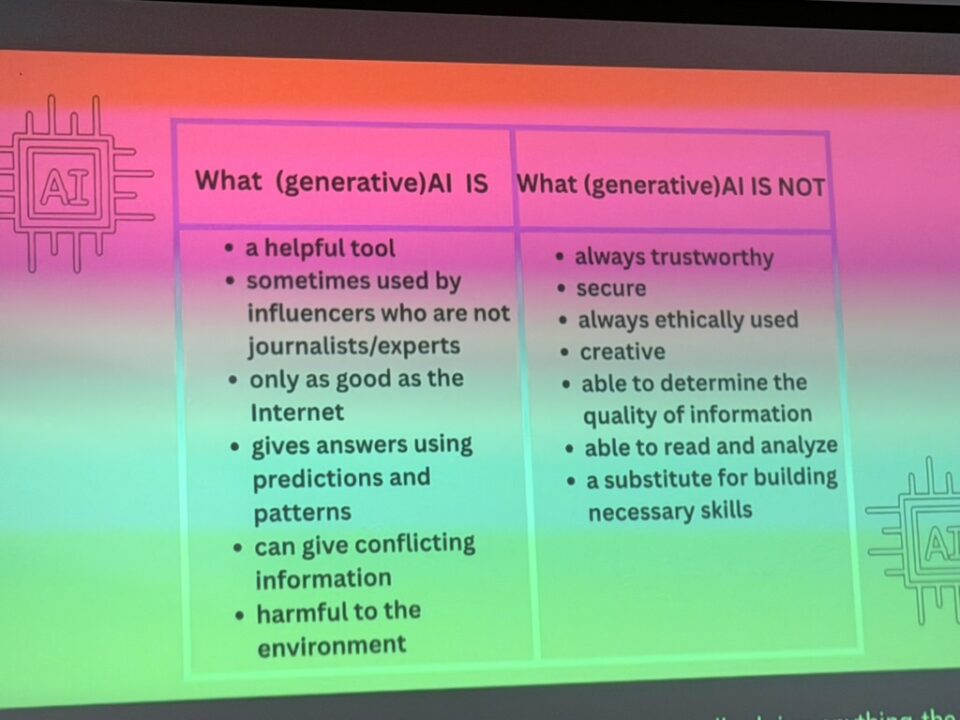
One audience member said he’s using AI to teach himself to play bridge. Another audience member said he asked Claude AI to plan a party with menus, quantities and cost estimates. Both are good AI tasks, the speakers agreed. “It predicts patterns. It does not answer questions,” Fournier said. AI finds the most likely answer based on frequency, not evidence… yet.
“Treat it like an intern,” Wright said. Give it really good direction and check its work every time.
The talk ended with a couple fact-checking exercises or AI quizzes to test their new knowledge.

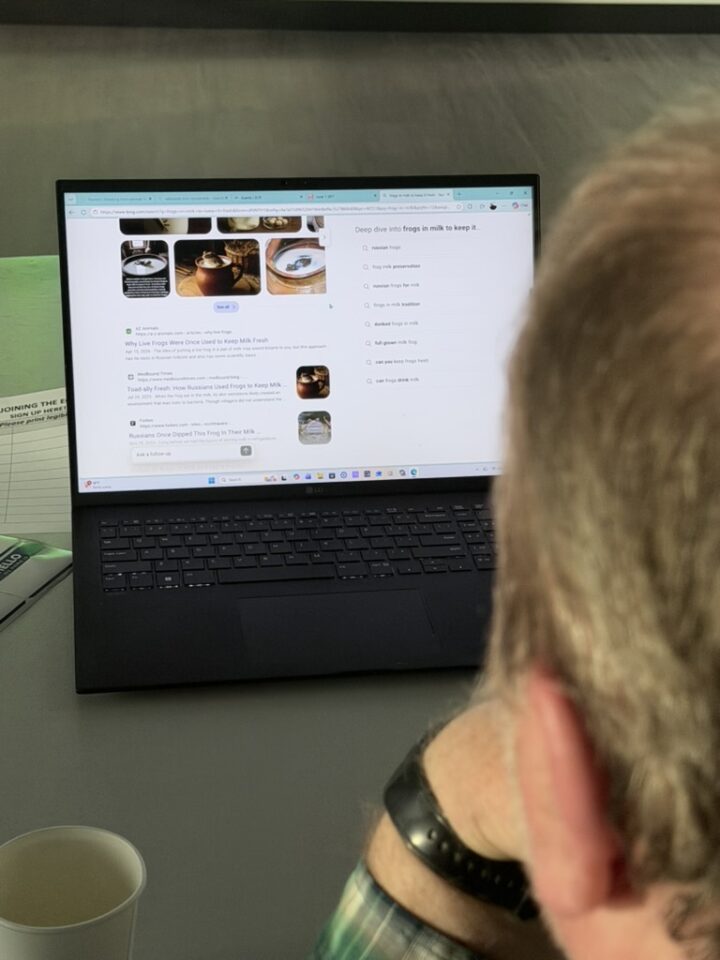
Audience members took out their phones or got on computers and fact checked a statement on social media: You can preserve milk by putting a live brown frog in the pot. (FYI: Reddit is NOT considered a reliable source.)

Audience members found this on several reliable news sites including Forbes and agreed it was true.
Other quiz involved this post:
“Dubai police are now patrolling from the sky on hoverbikes!”

Turns out this is true, but the “hoverbikes” don’t look like this.
Speakers said online searching is a good start. But then use the “news” tab to find reliable sources like CNN. For this story about Dubai, the story could be found in Police Magazine and the International Business Times.

It’s another way to find the kernel of truth while rejecting the AI-generated ‘hoverbike’ picture social media post.
Wright shared an interesting piece of information about AI and creative people like singers, songwriters and musicians.
In late 2025, the song Walk My Walk by Breaking Rust hit number one on the Billboard Country Digital Songs chart. The music, the lyrics, the persona of a bearded cowboy who sounded like famous country singer Chris Stapleton was all AI, sparking a heated ethical discussion.
Fact checking at MNNG
If you are curious about fact-checking at My Neighborhood News Network, check out the new weekly piece called “Fact Briefs”. Each week, staff take a comment or statement from the local comment section or other local sources and fact check it. Staff source all data and provide links to those primary sources so readers can check for themselves.
MNNG is the only news organization in the Pacific Northwest to join this national nonprofit, Gigafact, whose mission is to rebuild trust with readers through fact-based journalism and primary sources.


Real first and last names — as well as city of residence — are required for all commenters.
This is so we can verify your identity before approving your comment.
By commenting here you agree to abide by our Code of Conduct. Please read our code at the bottom of this page before commenting.