
Will you chip in to support our nonprofit newsroom with a donation today?
Yes, I want to support My MLTnews!
Last week, a friend asked for help explaining what is wrong with natural gas.
The first thing I tell people about natural gas is that the natural gas fad is over. What is left is people who installed gas years ago and a few enthusiasts with personal reasons.
Here is how natural gas installations have plummeted in new homes in Snohomish from home improvement data from the Snohomish County Assessor’s Office.
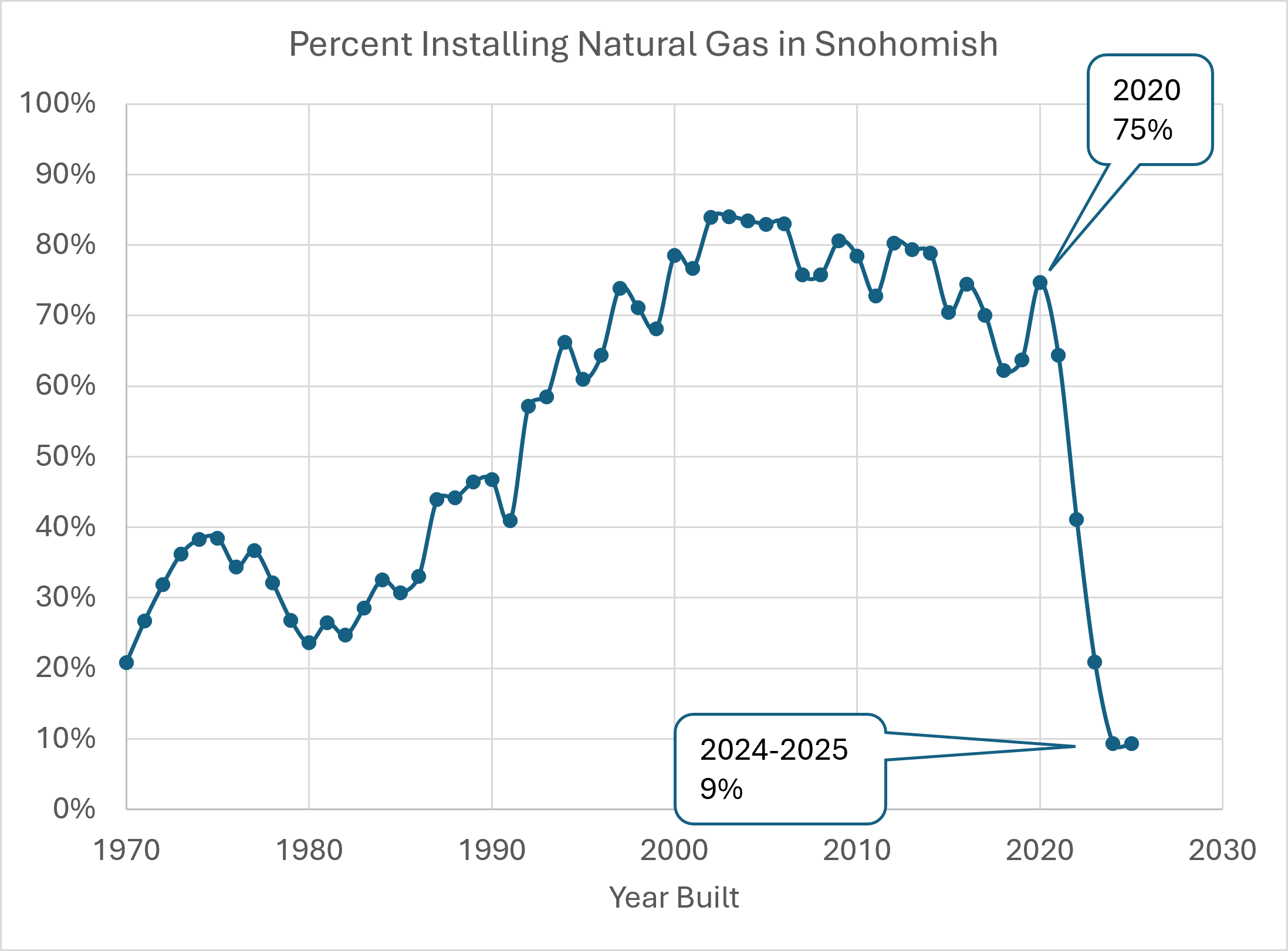
In homes built in 2020, 75% had natural gas. By 2024, that portion was down to 9%.
What happened was the heat wave of 2021. From June 26-30, highs in Snohomish County stayed above 98F for five straight days, reaching 112F on June 29, according to NOAA. Temperatures more than 104 degrees are life-threatening, and about 600 people in Washington died from direct and indirect results of the heat wave.
For most people, that was the end of building homes without air conditioning. It’s cheaper to install a single heat pump that provides heat and air conditioning than it is to install a natural gas furnace and air conditioning.
Once people have lived with heat pumps and induction stoves, they are unlikely to go back to natural gas. Natural gas comes with a few very small risks. When you live with natural gas, you learn to accept the risks. When you heat with a heat pump, it’s hard to imagine returning to those risks.
The first risk that everyone thinks about is something folks learned about in a Jason Bourne movie. At one point in The Bourne Supremacy, Bourne is alone in someone’s home, and baddies are coming to get him. Bourne pulls the natural gas line out of the wall and stuffs a magazine into a toaster. Bourne flees out the back of the house as the baddies approach the front. The toaster ignites the magazine, which ignites the natural gas leak, and the house explodes like a bomb.
It is very rare for houses to blow up from gas leaks. Each year, only about 30 homes in the U.S. blow up in natural gas explosions. In the U.S., about 16,000 fires are caused by natural gas or propane each year, according to the National Fire Incident Reporting System, but only 30 of those incidents include explosions.
A common thing to say is that, when you heat your home with natural gas, the chances that your home will blow up are much smaller than the chances that you will die in a highway accident. That’s not very reassuring. In 2025, 36,640 Americans died in traffic accidents, according to the National Highway Traffic Safety Administration.
Many years ago, my mother-in-law moved into a new home in Mill Creek. After a few months, she started having headaches and nausea. Her doctor took lots of tests but couldn’t figure out what was wrong. It looked like it was something she had to live with.
One day, we were putting a broom away in the closet that housed her natural gas furnace and saw the furnace was coming apart. One riveted seam had split, and you could see into where the natural gas was burning. When we brought in a smoke detector that also detected carbon monoxide, it quickly told us the air was poisonous.
We replaced the furnace and my mother-in-law recovered quickly. (Whew!)
Lots of people live with natural gas furnaces that are running past their designed lifespan. If your natural gas furnace is more than 20 years old, it’s time to replace it.
Also replace your carbon monoxide detectors frequently. I don’t have confidence in carbon monoxide detectors. With smoke detectors, you can hold a candle under them and make sure they work. For carbon monoxide detectors, all you can do is press the button and hope the beeping means that it would go off when there is carbon monoxide. Even so, it’s better to have one than not.
A related issue is the indoor air pollution of cooking with gas. Scientists have been concerned that fumes from natural gas harm lungs, possibly causing or worsening asthma and chronic obstructive pulmonary disease, or COPD. So far, there have not yet been randomized controlled experiments where half of the participating families are assigned to homes with natural gas and half are assigned to homes with electric stoves. That’s partly because researchers think it might be unethical to assign families to live in homes with natural gas. The bottom line is that we don’t know for sure whether natural gas causes breathing problems. It’s just a risk.
But you don’t have to worry about the fumes from natural gas cooking. As long as you have a ventilation hood over your stove and make sure to turn on the hood fan every time you cook, you’ll almost certainly be fine. It’s kind of like lead paint. If no kids lick or eat the paint, chances are they won’t have any trouble. Same goes with natural gas.
People who live with natural gas don’t worry about these risks. For people who live with heat pumps and electric stoves, it’s hard to understand why you would pay extra to take on such a deal. But the additional costs and the risks are not the big problem.
The big issue is that burning natural gas releases carbon dioxide. Natural gas burns when carbon atoms bond with oxygen atoms, creating carbon dioxide. That’s how it is. You can’t get away from it.
Households in Snohomish County that burn natural gas release half again as much carbon dioxide as households that heat and cook with electricity. An average car releases about five tons of carbon dioxide each year. The average household in Snohomish has two cars, according to Washington State Department of Licensing data. An average Snohomish household burns enough gasoline to release about 10 tons of carbon dioxide per year.
An average home that burns natural gas uses about 1,000 therms of gas each year, releasing about 5.3 tons of carbon dioxide. If your home is larger, you probably burn more. If your home is well insulated, you probably burn less.
An electricity-based home releases very little carbon dioxide. In Snohomish County, 95% of our electricity is generated without burning fossil fuels.
The average electric household that drives two gasoline cars releases about 10 tons of carbon dioxide each year. Meanwhile, the average natural-gas home that drives the same cars releases about 15 tons.
What is so bad about carbon dioxide?
It helps to understand carbon dioxide to see how carbon dioxide monitors work. Carbon dioxide monitors contain a heat lamp that shines infrared heat radiation through the air flowing through the monitor. On the other side of the air, the monitor has a sensor that measures how much heat was absorbed by the air.
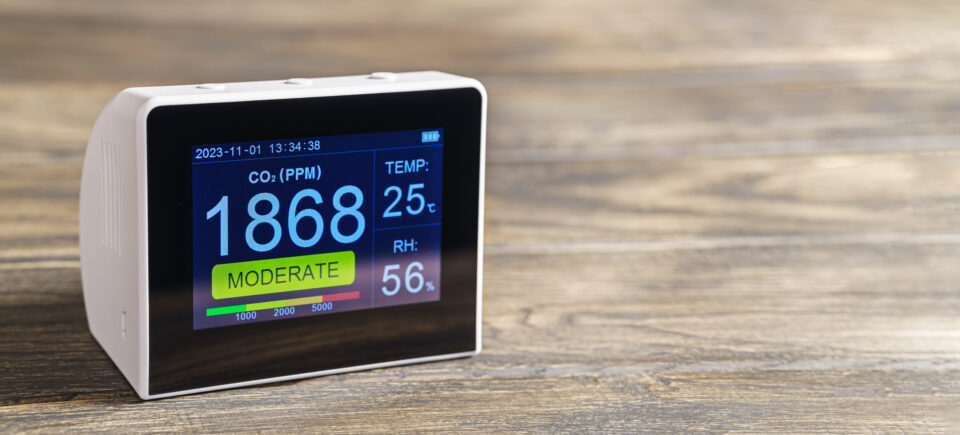
The sensor is like the light meter that photographers use to set their exposure times. The last step is a little math to get from how much heat is absorbed by the air to how much carbon dioxide is in the air. Higher heat absorption means more carbon dioxide.
You may have read that carbon dioxide levels have gone up over the last 100 years. That is based on carbon dioxide monitor measurements. What was actually measured was that our air now holds on to more heat than our air held before 1900. More heat held means a hotter planet.
We know why carbon dioxide is going up. For the last 200 years, taxes were collected on sales of coal, oil and natural gas. Historians have told us how much was burned, and chemists have told us how much carbon dioxide was released. Physicists told us how much that carbon dioxide would heat the air. Climate scientists have checked and found that the historians were correct and the physicists were correct: We are heating our planet by burning coal, oil and natural gas.
That rise in temperature has all sorts of bad effects: heat waves, like the ones broiling the East and Midwest now and overheating Europe; droughts that disrupt farming and cause wildfires; extreme rainfall that washes away dams and fills cities with pestilential floodwaters; and faster wind speeds in hurricanes and typhoons that travel more slowly, spending more time chewing up the homes and farms they roll over.
Heat pump discounts
If you currently heat with natural gas, the Kicking Gas organization may pay a lot of the costs to replace your natural gas furnace with a heat pump. The Kicking Gas program varies from year to year, based on how much it raises in funding each year. Applications for 2026 Kicking Gas support will be accepted soon, from Aug. 16 through Dec. 15.
If you already heat with electric resistance, Snohomish County PUD will chip in on your costs to switch to a heat pump so you save electricity and save money.

Nick Maxwell is a certified climate action planner at Climate Protection NW, teaches about climate protection at the Creative Retirement Institute and serves on the Edmonds Planning Board.
Start your morning with the latest local news.
Subscribe to the FREE My MLTnews Newsletter
We will never send spam or annoying emails. Unsubscribe anytime.


Real first and last names — as well as city of residence — are required for all commenters.
This is so we can verify your identity before approving your comment.
By commenting here you agree to abide by our Code of Conduct. Please read our code at the bottom of this page before commenting.