
Will you chip in to support our nonprofit newsroom with a donation today?
Yes, I want to support My MLTnews!
Code fixes proposed to the Mountlake Terrace City Council on Feb. 13 will provide clear definitions, add a penalty cap and allow backyard camping.
Families who have set up tents in their backyard to introduce their kids to camping may be surprised to learn that they technically broke a municipal code due to an oversight in the city’s temporary shelter encampment laws.
Code Compliance Officer Laura Stevenson said the current code addresses temporary shelter encampments in Chapter 19.111 but does not allow people to sleep in a tent on their property without a permit.
Further, code section 19.125.070(B) 4 restricts the occupancy of a trailer or recreational vehicle on a property. The occupancy must not create a public health hazard or nuisance and cannot exceed two weeks within any six-month period.

The proposed amendment, 8.15.040(N) Backyard Camping and Tents, allows the following:
– A camping tent may only be occupied by individuals for recreational purposes if it is entirely located on a lot with a single-family detached house with the permission of the lawful occupant of the house.
– The tent occupants must have access to the house’s bathroom and cooking facility.
– Occupancy must not create a public health hazard or nuisance.
– The tent may not remain standing for more than two weeks within any six months.
– Only one assembled tent is allowed on the property at any time. It is limited to the backyard and must be screened from view of any public property.
– The tent must not exceed 140 square feet, the average size of an eight-person tent.
Stevenson said she isn’t going around the city and taking notes of every tent she finds, but she will note tents that have obviously not moved in a while – tents with weeds growing around them and faded fabric, for example.
Defining Yards
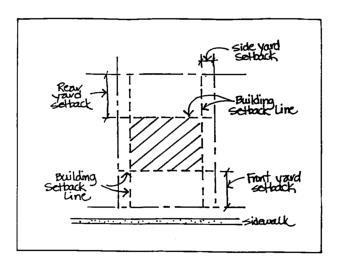
Stevenson said that the city’s current nuisance chapter does not define yards. The zoning chapter defines yards as the area from the property line to the setback requirement but leaves out the area between the required setback and the primary structure.
Without a specific definition for yards in the nuisance code, the gap between the setbacks and the house can create an area where the regulations do not apply.
The proposed code reads:
MTMC 8.15.030(J) “Yard” means the required open space area on a lot lying between the property lines and the principal structure.
A. “Front yard” means an area extending across the full width of the lot and lying between the front property line and a line drawn parallel thereto, ending at the principal structure.
B. “Side yard” means an area extending from the front property line to the rear property line at a depth measured from the side lot line to a line drawn parallel thereto, ending at the principal structure.
C. “Rear yard” means an area extending across the full width of the lot and lying between the rear property line and a line drawn parallel thereto, ending at the principal structure.
Defining heavy equipment
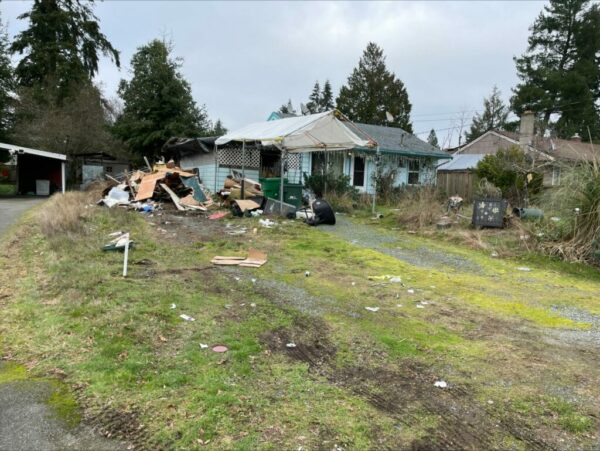
The council also addressed the current city codes regarding heavy equipment. Establishing a definition for heavy equipment, Stevenson explained, would limit parking and storage in residential areas and restrict commercial vehicles in the nuisance chapter.
Stevenson said there are regulations for parking and storing RVs, trailers and personal and commercial vehicles; however, heavy equipment has no provisions. Commercial vehicles were addressed in the zoning chapter but not in the nuisance chapter.
The following definitions were proposed to be added to the code:
MTMC 8.15.030(K) “Heavy equipment” means heavy-duty vehicles that are specifically designed to assist with agricultural, construction, industrial, maritime, mining or forestry tasks, regardless of size.
MTMC 8.15.050(G) Commercial vehicles and heavy equipment shall not be parked on public or private property in residential zones unless actively engaged in loading or unloading, or when related to permitted work as determined by the director of the community and economic development department or their designee. A variance for the parking of a commercial vehicle or heavy equipment may be granted based on hardship and other conditions pursuant to MTMC 19.110.210.
Limiting outdoor storage of building materials
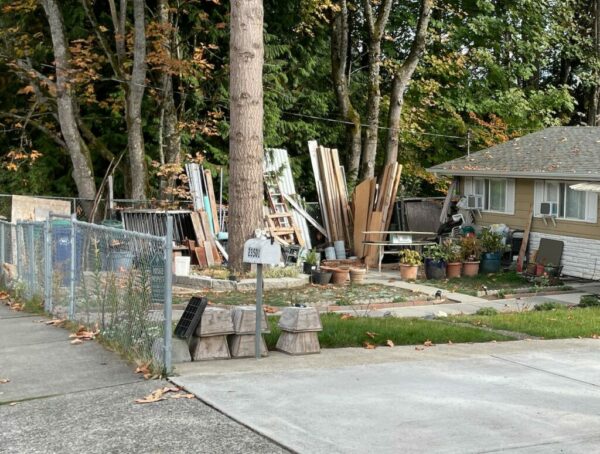
Stevenson said code 8.15.040(E) restricts outdoor storage of building and construction materials to permitted projects or a 90-day limit for work that does not require a permit. The current code allows materials to be stored outdoors indefinitely if they are associated with an ongoing project, leading to prolonged outdoor storage.
The proposed code reads:
8.15.040(E) Building and Construction Materials. Accumulations, stacks, or piles of building or construction materials not associated with a current in-progress project, including metal, wood, wire, electrical or plumbing materials, in disarray or exposed to the elements on the property.
Materials associated with projects that do not require permits must be cleared from unenclosed areas within 90 days unless an extension is granted by the director of the Community and Economic Development Department or their designee.
Defining unsafe conditions
Stevenson said the proposed definition of “unsafe conditions” aligns with International Building Code 116.1 (2021) and reads:
1.15.020(V) “Unsafe conditions” refer to any part of a property, including structures and premises, that are unsafe, unsanitary, have fire hazards, or other dangers to human life or public welfare. This includes illegal or improper occupancy and inadequate maintenance. Vacant properties that are not secured against unauthorized entry are also considered unsafe.
Adding penalty caps
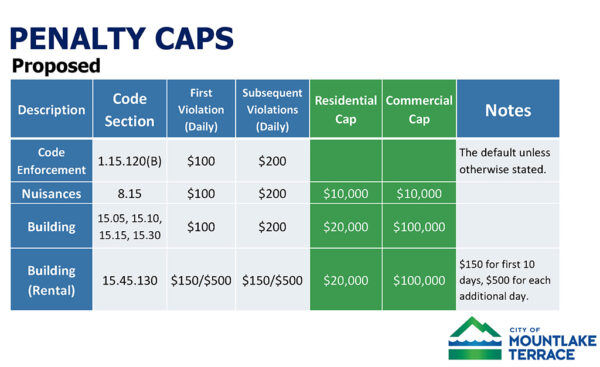
Fees for code violations are not capped, Stevenson said, allowing a single violation to accumulate indefinitely until it is corrected.
There is some discretion regarding when the fees begin to apply, but they are used inconsistently. Stevenson said implementing fee caps for specific nuisance and building code violations promotes fair and equitable enforcement.
In other business, the city council removed two items from the Feb. 20 consent calendar for further consideration.
One of those was the $99,500 budgeted agreement with Baker Tilly for long-range sustainability planning from the consent calendar.
If approved, the consultants will assist the city’s Long-Range Financial Sustainability Task Force, which the council is creating. The group will consist of interested community members who recommend a long-range financial plan to the city council.
Councilmember Laura Sonmore opposed hiring a consultant, stating that the city has adequate staff to handle its needs. Although she said she wants to hear from the community, she doesn’t think a consultant is needed to tell the council and city staff what they already know: The city can go bankrupt if action isn’t taken.
Sonmore suggested the city instead do what it did during the previous budget crisis in 2008: Go to each department and ask where cuts could be made. She said that some cuts could be as deep as a moratorium on activities, stating they were a bonus rather than a necessity.
“We don’t have to have recreation,” Sonmore said, pointing out essential priorities, such as roads and law enforcement, which she said could be outsourced to the Snohomish County Sheriff’s Department.
Mayor Pro Tem Bryan Wahl said the city is “in such a dire position that we need expertise” and supports hiring a consultant.
Councilmember Erin Murray said that the city has a“very lean city staff.” Having big projects directed entirely by staff “is not a fair ask and is not an ask that ultimately gets us to good solutions if we want thoughtful time put into these projects,” Murray said, adding that a consultant can provide fresh eyes.
The council plans to discuss and vote on the proposal at a later date.
The council also removed from the consent calendar the city’s public defense agreement with Feldman and Lee.
City Manager Jeff Niten explained that federal and state laws require the city to provide an attorney to individuals charged in Mountlake Terrace with a misdemeanor or gross misdemeanor crime if they can’t afford one. In 2012, the Washington State Supreme Court adopted new Standards for Indigent Defense, limiting the number of cases public defenders should handle each year. The standards state that full-time public defenders should not have more than 300-400 misdemeanor cases yearly.
The current contract with Feldman and Lee is $18,000 a month and expires on Dec. 31, 2025. Due to potential changes and increased costs, Niten said Feldman and Lee requested renegotiation.
Niten said the City of Mountlake Terrace and Feldman and Lee wish to maintain their agreement for public defense services. With the uncertainty surrounding new caseload standards now being considered by the Washington State Supreme Court, a short-term contract is appropriate, he added.
Feldman and Lee requested a roughly 47.22% increase to $26,500 monthly to cover increased costs and caseloads. The proposed contract lasts six months, from Jan. 1, 2025, through June 30, 2025.
Niten said other cities had issued requests for new representation with limited responses that reflect similar prices. The City of Shoreline issued a request, and the only response was from the public defender already representing them.
Niten recommended accepting the contract and issuing a request for proposals when the contract ends.
The council removed the item from the Feb. 20 consent agenda pending the State Supreme Court’s decision.
In other business Thursday, the council:
– Reviewed the recommendations of the Lodging Tax Advisory Committee. Further discussion will be held to determine how to take advantage of light rail and the upcoming FIFA World Cup in Seattle in 2025.
– Approved the $100,000 agreement budgeted from the street, water, sewer and stormwater department funds to contract with Krazan On-call Engineering for third-party materials and performance testing for city projects for the Feb. 20 consent calendar.
– Moved to the Feb. 20 consent calendar the budgeted $92,915.00 agreement with Fehr and Peers to analyze the current transportation impact fee and code language.
– Received presentations on Edmonds wastewater treatment by City of Edmonds Interim Public Works Director Phil Williams and a presentation by Alderwood Water and Wastewater District General Manager John McClellan.
The next city council meeting will start at 7 p.m., Feb. 20, at Mountlake Terrace City Hall, 23204 58th Ave. W., Mountlake Terrace. To attend the meeting online, visit zoom.us/join and enter meeting ID 810 1113 9518; no passcode is needed.
To make a public comment remotely, complete the registration form within 24 hours of the meeting’s start.
To listen via telephone, call 1-253-215-8782 and enter the same meeting ID.
You also can view livestreamed meetings and past video recordings at www.youtube.com/cityofmlt.
The agenda can be viewed here.


Real first and last names — as well as city of residence — are required for all commenters.
This is so we can verify your identity before approving your comment.
By commenting here you agree to abide by our Code of Conduct. Please read our code at the bottom of this page before commenting.