
Will you chip in to support our nonprofit newsroom with a donation today?
Yes, I want to support My MLTnews!
Six years after the Edmonds School Board removed police officers from schools over concern for student safety, a local nonprofit – joined by parents, teachers and students – are pushing for the District to reverse course, citing a need for security following a string of youth violence in South Snohomish County in recent years.
Nearly a month after a Minneapolis police officer killed George Floyd in 2020, hundreds of Edmonds School District parents, students and community members spoke out against having police officers in schools – known as school resource officers (SROs). At the time, District leaders said the flawed nature of policing as a whole posed a potential threat to students, especially students of color.
“Given the facts of our highly-dangerous national and state systems of policing, supervision and incarceration, by being housed in our high schools – no matter how helpful and beloved they are – police are a real risk to many of our students and they contribute to stress and bad health for hundreds of children,” Board President Deborah Kilgore said at a Board meeting in June 2020.
Six years later, a different narrative has emerged. Since 2022, there have been 14 shootings involving teenagers in Lynnwood, injuring at least 18 people and five deaths, Lynnwood Mayor George Hurst said in a statement last month. The statement came shortly after two youth-involved shootings in Lynnwood within 48 hours.
In response to the uptick in youth violence, a movement to reintroduce police in middle and high schools gained momentum among parents, teachers and students. Two organizations are leading the movement: The ACCESS Project and Jaguars Community. Both are local nonprofits dedicated to serving local youth, and they are proposing police in schools as a potential solution to youth violence.
“Several young lives in [the District] have been lost due to violence, especially gun violence,” ACCESS Project founder Wally Webster said during public comment at the July 7 Edmonds School Board meeting. “We cannot continue to do nothing and simply hope the violence will stop. We must act with urgency, compassion and common sense.”
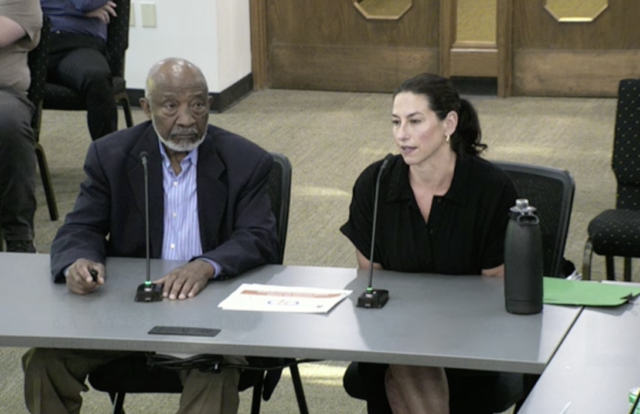
While the District has yet to release an official statement on the matter, School Board members said the matter will appear on a future meeting agenda after summer break.
The data
At the July 6 Lynnwood City Council meeting, Webster presented school crime data from the Lynnwood Police Department comparing the 2018-20 period (with SROs) to 2022-24 (without). At Meadowdale High School, case reports rose from 31 to 50 (61%), calls for service rose from 241 to 244 (1.2%), and arrests held flat at five.
Increases were sharper at the middle school level, although SROs were not formally stationed there. Meadowdale Middle School case reports rose from six to 23 (283%) and arrests from two to six. College Place Middle School case reports rose from 12 to 18 (50%) and arrests from zero to three.
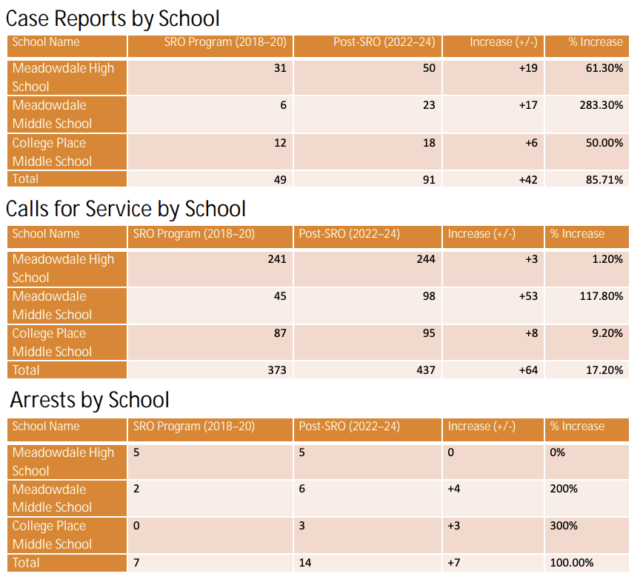
“Many people stepped away from SROs… without data indicating that they were the gateway to the penitentiary and the criminal justice system,” Webster told the Council. However, “times have changed” since 2020 when the district removed SROs, he said. “Today I have not had anyone show us data that supports that perception, but I can show you where SROs did make a difference.”
The plan
Webster and MacCoy are proposing a one-year SRO pilot program at select schools that steps away from traditional law enforcement models. Instead, the reimagined initiative focuses on prevention, relationship-building, early intervention and de-escalation.
“A reimagined SRO program should not be about criminalizing students, but it should be about building trust, positive relationships with students, [and] providing a safe and approachable adult students can turn to in times of need,” Webster told the School Board.
Under the proposed pilot, SROs would be strictly prohibited from participating in routine school discipline, leaving those matters to school administrators – in accordance with state law. Officers selected for the program would also undergo specialized training in adolescent development, trauma-informed practices, cultural responsibilities and conflict de-escalation.
To alleviate financial concerns, Lynnwood Police Chief Cole Langdon offered to provide one officer to the school district at no cost for the duration of the pilot program, Mayor Hurst said at the Council meeting earlier this month. Also, if an emergency occurred, police could respond immediately rather than waiting multiple minutes for first responders to arrive.
“[Langdon] feels it’s a huge priority,” Hurst said. “He said he would sacrifice a little bit to get someone into schools because he feels it’s proactive…the benefit would be a reduction of shootings and escalated crime, so he’s making it a priority.”
My Lynnwood News contacted Lynnwood Police Department to request an interview, but due to scheduling conflicts staff were unable to meet with a reporter prior to the publication of this story.
Some Councilmembers expressed concerns over this proposal, especially given the City’s recent financial challenges. Staffing levels are at an all-time low, and police have reported burnout and less-than-ideal working conditions after the City slashed the department’s budget and staffing levels to close multi-million-dollar budget deficits in recent years.
Further, Councilmembers asked whether SROs were truly the best solution.
“What I’m struggling to understand is how the evidence presented leads to the conclusion that we need police officers on campus…rather than investing in counselors, therapists, social workers and other restorative justice principles,” City Councilmember Isabel Mata said.
MacCoy, who is a licensed clinical social worker, said SROs would collaborate with, but not replace, school counselors. Counselors are bound by therapeutic confidentiality, which limits their ability to step into authoritative or disciplinary roles during a crisis, she said.
“It’s two very distinct scopes of work,” McCoy told the Lynnwood Council, noting that an SRO can handle authoritative interventions to dismantle risky behaviors before they escalate into violence.
Mata also asked whether the data showed that the increase in police calls to schools could be attributed to the departure of SROs, rather than other factors like post-pandemic behavioral changes, social media and other broader community impacts. Webster said the data he reviewed didn’t identify the cause of the violence, only the outcomes.
“We have not stated in any way that the SRO program is the solution,” Webster said. “We know that’s a program that did exist, we knew that the program had good results…But we cannot just do nothing. If there are some better ideas on what we should do, let’s do those.”
Are SROs effective?
Karen Pillar is the executive director of Team Child, a nonprofit established in 1995 providing Washington youth with legal representation. The organization regularly encounters cases involving SROs, she said.
“We represent a lot of kids who are having challenges at school and the addition of an SRO often adds complications,” Pillar said Friday in an interview with My Lynnwood News. “The biggest trends that worry us is the poor integration of SROs with the needs of special education students.”
Schools usually have specific guidelines for students in special education and issues can arise if SROs are not properly trained or complying, she said. This can “add a layer of consequence” for the student, potentially escalating the level of discipline a student would have received opposed to if an SRO was not present.
“It’s natural for student to make mistakes,” she said. “A large percentage of those mess-ups are not crimes…but if a mess-up happens to a police officer, that creates a crime.”
She gave an example of a case where a student with special needs was wearing a hat in school, which was against school policy. An SRO tipped the hat off the student’s head and the student reacted in a physical manner.
“It’s not aggressive, but it’s completely inappropriate for that child, who then lashes out and is then facing an assault charge against the SRO,” Pillar said. “It’s a dumb problem to have a kid arrested for and completely preventable.”
Despite state law prohibiting SROs from disciplining students outside criminal manners, Pillar said those boundaries are often blurred. Further, children of color are more likely to be at the receiving end of this discipline, she said.
It’s vital for schools to establish clear boundaries between misbehavior and crime before introducing SROs, she said.
“[SRO] presence alone begs the question for the school: Is your plan to have the misbehavior addressed at a school level? Or is your plan to address student behavior as crime?” she asked.
As far as research on goes on the effect SROs have on school safety, data is conflicting, with little information specific to Snohomish County.
On a regional level, there is some research on the relationship between young people of color and law enforcement. A 2022 University of Washington study found that “for Black youth, an encounter with police by eighth grade predicts they will be arrested by young adulthood – but the same is not true for white youth,” a university news article on the study reads. The study observed over 300 young adults in Seattle and found that Black youth who experienced a police encounter in their early teens were 11 times more likely to be arrested by age 20 than Black youth who didn’t have that contact.
According to a 2023 brief by the Cato Institute, there is research to support the claim that violence decreases in schools with SROs. However, out-of-school suspension increased in many schools with SROs nationwide and Black and Hispanic students saw the highest rates of exclusionary discipline, followed by students with disabilities. The brief also states that youth who experience exclusionary discipline experience higher rates of anxiety due to social exclusion and are more likely to reoffend in the future.
Community concerns
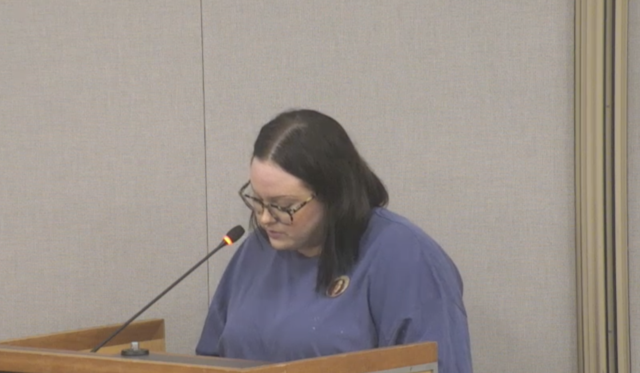
In early July, Webster and McCoy gathered a few dozen parents, teachers and students to speak in support of the proposal during the public comment period at an Edmonds School District board meeting. Overall, they said violence is present in schools and is growing in frequency and severity, and children are joining gangs and committing crimes at younger ages.
One of those who spoke was Tabitha Johnson – the mother of Jayda Woods-Johnson. Jayda was 13 when she was killed by a stray bullet in an Alderwood Mall shooting in 2024.

“Kids are carrying guns and bringing them into places where our children are every day, ” she said at the board meeting earlier this month. “I can’t help but wonder, maybe, just maybe, if an officer had been stationed at the mall that day, my daughter would still be alive. Maybe the teen who pulled the trigger that day would have seen an officer present and thought twice before making a decision that changed so many lives forever. If having officers in schools…can prevent one family from going through what my family has gone through, then I believe it’s worth considering.”
A group of students also spoke in favor of bringing back SROs. One Lynnwood High School student told of an hours-long lockdown during her senior year. She said lockdowns are common and usually students and teachers aren’t told the reason for them.
“Each lockdown that occurs, most students have the same thought that goes through their head: ‘What if it’s a gun?’” she said.
She added that a police presence on campus might help ease students’ minds during lockdowns and mitigate violence before it happens.
Diana Del Villar is a mother who volunteers at the Meadowdale elementary, middle and high schools. She said she’s heard firsthand accounts from students involved in gangs or participating in illegal activity.
“These kids join gangs because they need protection and because they don’t get much attention at home,” she said in an interview with My Lynnwood News. She noted that her son and other parents said they would feel safer with police at schools.
In Del Villar’s experience, students start to encounter serious problems in middle school and those problems often intensify in high school in the absence of intervention. “If we don’t do anything now, we’ll have big problems in the future.”
No one spoke against the proposal at the Lynnwood Council or Edmonds School Board meetings.
The Edmonds School District isn’t the only district seeing a community push to reinstate SROs. After the Northshore School District in May voted to eliminate its last remaining SRO from Bothell High School, hundreds of students walked out of class in protest and a recall campaign against board members followed, KUOW reported. According to a 2024 survey, 79% of students in Northshore School District strongly agreed that SROs supported safety.
In Seattle, community members called on the district to bring SROs back following a fatal shooting at Garfield High School in 2024, per KUOW. The board rejected a measure to reinstate SROs in 2025.
Current district safety measures
After ending the SRO program, the School District launched a liaison officer model, in which patrol officers are assigned as points of contact for high schools but aren’t stationed on campus daily and respond to emergencies as available, according to the District’s safety and security page.
Absent the SROs, the District has other measures in place to support student safety and well-being. This includes an anonymous tip line, annual safety and emotional well-being surveys, psychologists, family resource advocates and a partnership with Joon, an online therapy site providing free therapy for students ages 13 to 26. The District also employs software on all District-owned devices to monitor student activity. In addition, staff undergo crisis training in the case of a traumatic incident.
The District also has a “threat assessment team” made up of counselors, law enforcement, school administrators, special education teachers and community partners. If a student displays threatening behavior, the team works to identify the threat level and provide the student with care while working to protect the safety of others, per District policy.
Webster and MacCoy created a petition to reinstate SROs in Edmonds School District. At the time of reporting it had over 670 signatures. View the petition and learn more about the SRO proposal here.
— Contact Ashley at [email protected].


Real first and last names — as well as city of residence — are required for all commenters.
This is so we can verify your identity before approving your comment.
By commenting here you agree to abide by our Code of Conduct. Please read our code at the bottom of this page before commenting.