
Will you chip in to support our nonprofit newsroom with a donation today?
Yes, I want to support My MLTnews!For Gardeners is a monthly column by and for local gardeners.
As I was walking through my garden the other day, I passed by a young tomato plant. To my astonishment, it said, “Psst! Hey buddy! Howz ya doin? Could ya wet my whistle – I’m parched. Anudder ting – how about dem Mariners? Doze bums can pitch AND hit this year.” I was surprised it could talk and even more surprised that it sounded like a New York mobster!
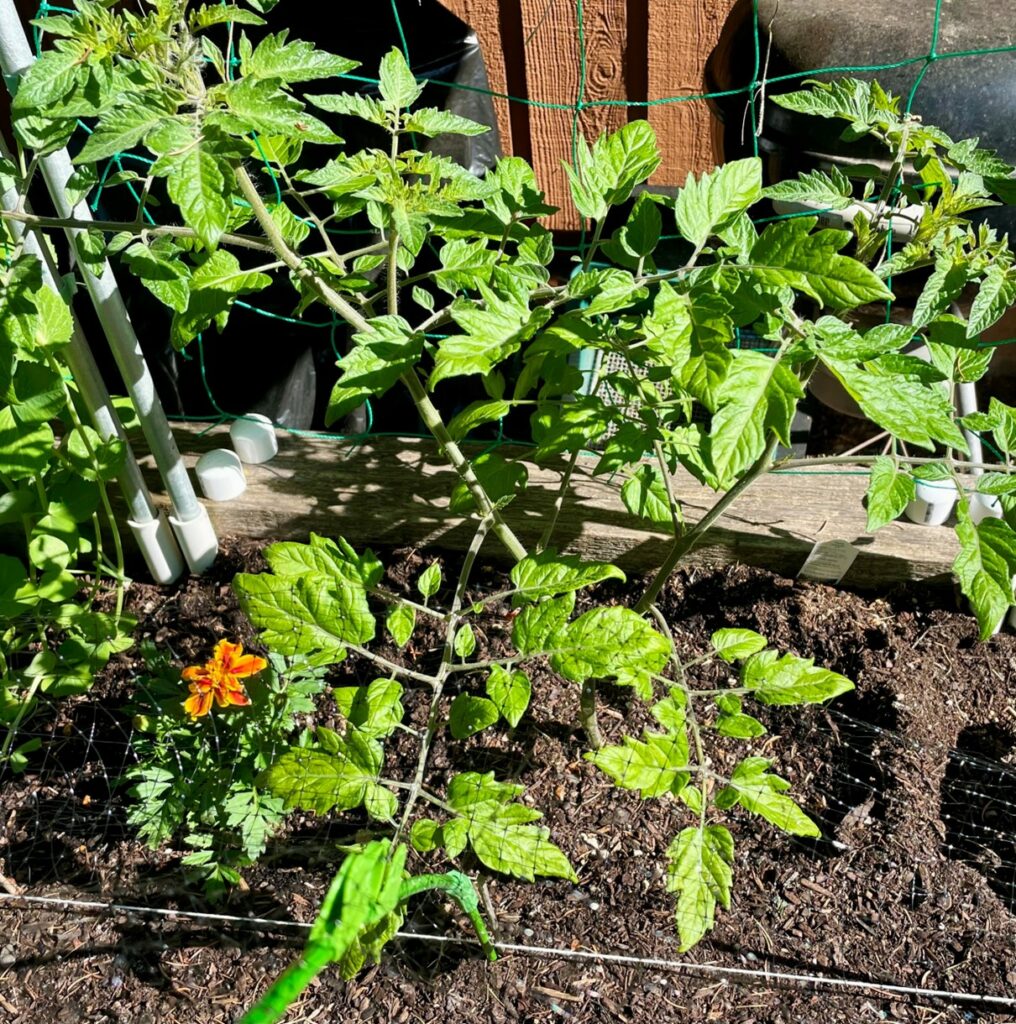
Well, plants in your garden really do “talk,” just not to you. Why should they? Plants were on our planet about 130 million years before animals, so they had lots of time to develop complex relationships with the other organisms present at that time, like fungi.
Garden plants used to be viewed as isolated individuals, each one receiving inorganic nutrients and water from the soil and manufacturing its own sugars using sunlight by photosynthesis. Our gardening practices of yore reflected this. We used to till up the garden bed, use synthetic fertilizers, and liberally treat any visible and possible disease symptoms with synthetic pesticides. Not best practices today. What changed?
We keep learning more and more over time. Our understanding of the complex interconnectivity and interdependence of all living things – many times learned the hard way – has given us an appreciation for an ecosystem view of the garden instead of a living museum of pretty plants.
It used to be hard to visualize that a dam placed on a river hundreds of miles inland would decrease orca populations in our Salish Sea. We get it now. We are also starting to “get” that our gardens are connected to the world around them in complicated and fascinating ways – like talking.
Plants talk? Now for a little semantics. Plants communicate with each other; they don’t talk. Spoken words – talking – is a human-centric communication construct. Recall that plants were evolving their communication style millions of years before animals even existed.
For the purposes of this article, communication is the transfer of a signal from donor plant to a receiver plant. There is good discussion about whether the signal sent from one plant to another must be purposeful and for the benefit of the donor plant – i.e. altruistic – to count as communication. I didn’t take any philosophy classes, so let’s keep it simple: plant-to-plant communication occurs when a donor plant transmits a signal to a receiver plant. There needs to some observable response in the receiver plant for us to know it got the message.
Plants have two ways to talk to other plants. One way is through the air – a “wireless” mode. The other is through direct physical connections – a “wired” mode.
Wireless communication
Plants don’t talk to each other in words. Their main communication tool is chemistry. Plants produce an amazing array of diverse chemicals that help them survive drought, protect themselves from insects and pathogens, attract pollinators and recruit soil fungi.
Some of these chemicals are volatile and can travel through the air. They are called, logically, volatile organic compounds (VOCs). The composition and relative concentration of these VOCs become the “words” communicated wirelessly to other plants.
We get “wind” of this chemical communication cocktail when we walk in our garden and notice the rich variety of odors – floral perfumes, spicy notes and the smell of freshly mowed grass, for example. We can sense some of them with our noses, we just don’t speak “plant.”
The VOCs produced by one plant can move through the air and affect a neighboring plant — communicating in their “language” of VOCs – the “wireless” network.
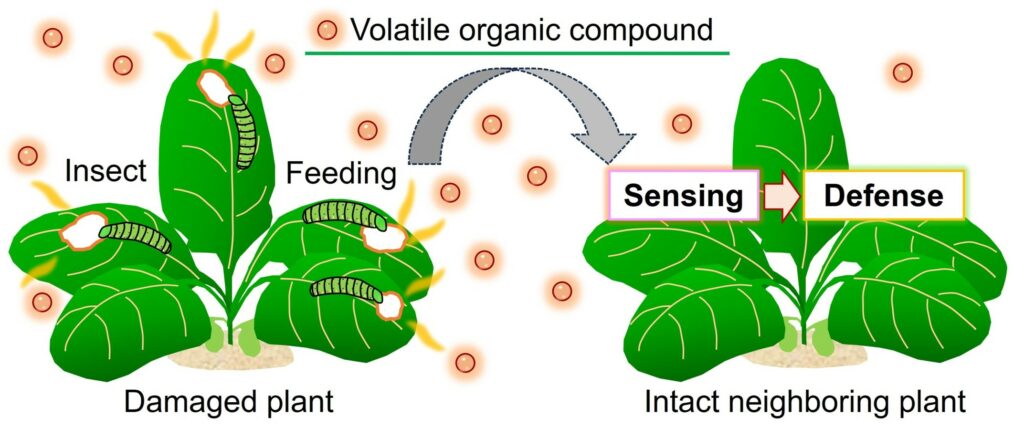
For example, corn plants emit a cocktail of VOCs when caterpillars start feeding on them. That chemical message is transmitted through the air to neighboring corn plants, who fire up their caterpillar-munching defenses. A human analogy might be a storm hitting one island and those inhabitants sending a radio warning to neighboring islands so they can protect themselves. Like the affected island, one plant is, in a sense, warning another about a threat using its volatile chemical cocktail language.
Wired Communication
The other mode of plant-to-plant communication is “wired.” Plants are intricately interconnected by strands of fungal mycelia, the “wire.” This underground network was first described for trees in the forest and has been dubbed the “Wood Wide Web.” Like my internet service, where the communication comes to my house through a buried internet cable, plants use buried living strands of fungi to transmit information to other plants.
Plant roots form an important symbiotic relationship with certain soil fungi. This relationship benefits both parties. Plants receive nutrients from the fungi and the fungi receive sugar from the plants. Soil fungi form web-like networks of tiny strands called mycelia.
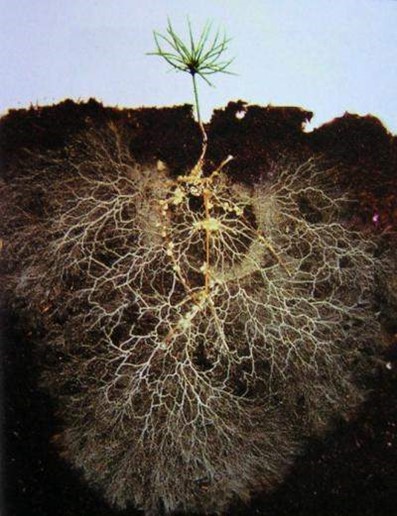
What has become increasingly clear is that these mycelia form connections between plants. These systems have been more scientifically named Common Mycelial Networks (CMNs). These networks can cover large areas – individual mycelia can be up to 10 meters long – and information flows between plants using this underground internet.
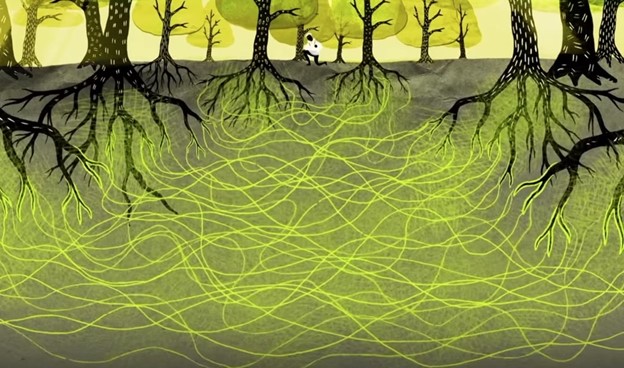
Connection to CMNs enables plants to adapt and respond to the environment as a community rather than an individual and, therefore, increase the success of the community. They can share nutrients (especially nitrogen and phosphorus) and water through this network. One plant in a nutrient-rich location can share with a plant in nutrient-deficient location enabling both plants to thrive – a win for the community. Water is also shared via CMNs, distributing life-giving water throughout the plant community.
What gets particularly fascinating is the recent knowledge that plants can also use this underground wired network to communicate “warnings” to other plants that they are being attacked by insects or pathogens. They relay signaling molecules through the CMNs to the nearby plant community. The receiving plants can then boost their own defenses and gain protection. Thus, the CMNs provide a dynamic, flexible defense system for plant communities.
Garden plant examples of this communication via CMNs are tomatoes and beans. Tomato plants infected with a pathogen were shown to induce a defense response in nearby tomato plants by signaling the infection through an underground mycelial network. Likewise, broad beans have been shown to induce a defense response in a neighboring broad bean through CMNs when attacked by aphids.
Any plant that forms root associations with fungi (mycorrhizae) – and about 80% of land plants do – has the potential to tap into the Wood Wide Web. It seems likely that many (dare I say “most”?) of the plants in our garden have this capacity.
Armed with this new and still emerging knowledge of the Wonderful World of the Wood Wide Web in our garden, some of the new things we are hearing about best garden practices make more and more sense. Because the CMNs enhance plant health by enabling a community-wide adaptation to water, nutrient and pest stress, we want to protect and enhance them for beautiful and resilient gardens.
Today’s gardening best practices are to 1) disturb the soil as little as possible, 2) feed and protect the network with natural materials and 3) avoid harming the soil ecosystem with excessive or unneeded synthetic pesticides.
Digging up the soil breaks the mycelial connections, just like a broken internet cable in your neighborhood will seriously disrupt modern family life. We now dig just enough to plant our shrubs, trees and annuals, leaving as much of the mycelial network intact as possible.
Unlike our internet cables, the CMNs are living and need food and protection. Adding a layer of compost to your garden soil feeds the fungi forming the network as well as a host of other living organisms making up a healthy soil ecosystem.
Adding a layer of coarse natural mulch on top of the compost provides needed moisture and oxygen to the living CMNs as well as the other living components of our dynamic garden soil ecosystems.
Finally, we don’t want to damage the CMNs with synthetic pesticides. Thoughtfulness and moderation will reduce the risk of harm to our precious garden internet.
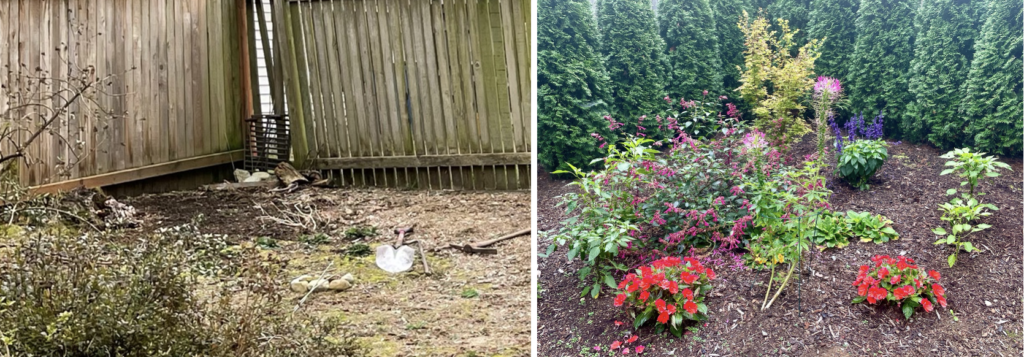
We live in a disturbed urban environment. Sometimes our gardens have highly disturbed areas. We can leverage our new understanding of the Wood Wide Web to restore damaged garden beds. Adding mycorrhizal fungi, a layer of compost and topping with mulch is a good start to restoring the plant health-enhancing CMNs in your garden.
OK, so now we know that my tomato plant really does “talk” — using chemistry as its “language” — and it transmits helpful information to neighboring plants via wireless and wired pathways. We can now appreciate this fascinating component of our garden plants and do the right things to help them thrive. There is still a lot to learn about our communicating garden plants. I, for one, still need to know where my tomato plant picked up that cheesy mobster accent. Happy gardening!

Joel Ream grew up in Spokane and earned a Bachelor of Science in botany at the University of Washington and a Master’s in botany at Michigan State University. Joel spent 37 years as a plant biologist at Monsanto, using plant physiology, biochemistry, and analytics to increase the efficiency of crop production. He also worked on new weed control technologies, regulatory studies to support the safety of new products, greenhouse and field evaluation of new crop varieties, increasing the nutritional value of animal feed, and developing methods to measure grain composition. Joel retired to Edmonds in 2018.


Real first and last names — as well as city of residence — are required for all commenters.
This is so we can verify your identity before approving your comment.
By commenting here you agree to abide by our Code of Conduct. Please read our code at the bottom of this page before commenting.