
Will you chip in to support our nonprofit newsroom with a donation today?
Yes, I want to support My MLTnews!
My Neighborhood News Group (MNNG) is publishing a series of stories on how local governments are funded and the financial challenges facing both elected officials and residents. You can read Part 1: Introduction here.
“The mayor, who is an accountant, just doesn’t understand you can’t get blood out of a turnip. She thinks everyone has unlimited money.” Nov. 16, 2025 My Lynnwood News comment section.
Nearly every day, someone on some social media site repeats a popular refrain: Our local mayor/council/workers are squandering/wasting/being irresponsible with our money.
Misuse of funds can happen and is usually uncovered through state audits – and there are repercussions. However, the more significant financial deficit cities face is the result of forces outside their control and decades in the making.
1955 was a great year
1955 seems to be the quintessential “golden year” of America, the year many folks have in their mind when they think about good government.
In 1955, the top marginal U.S. tax rate was 91% for single filers with taxable incomes over $200,000. (That’s $2.3 million in 2024 dollars.) The effective tax rate at the time, due to factors like loopholes and deductions, was about 42%-45% for the top 1%. Our population was 166 million.
An Edmonds home in 1955 was valued at about $7,000 or about $37,000 in today’s dollars.
In 2025, the top U.S. tax rate is 37% for single filers earning over $626,351. The effective tax rate is 26-28%. The U.S. population is 340 million.
The average home price in Edmonds is $950,000 or about $78,000 in 1955 dollars.
The year 2025 looks nothing like 1955 – not for taxes, not for prices, not for population. This rosy expectation that cities would be magically funded started a long time ago. The reality now is completely different.
Local tax revenue (or lack of it)
Washington is one of nine states without a state income tax. Others include Alaska, Florida, Nevada, New Hampshire, South Dakota, Texas and Wyoming.
Because there is no state income tax, public projects and programs must be funded through four main sources: property tax, consumption tax, fees/fines and grants.
This is what the state funding scheme looks like, in general, for all 281 Washington state cities and towns.
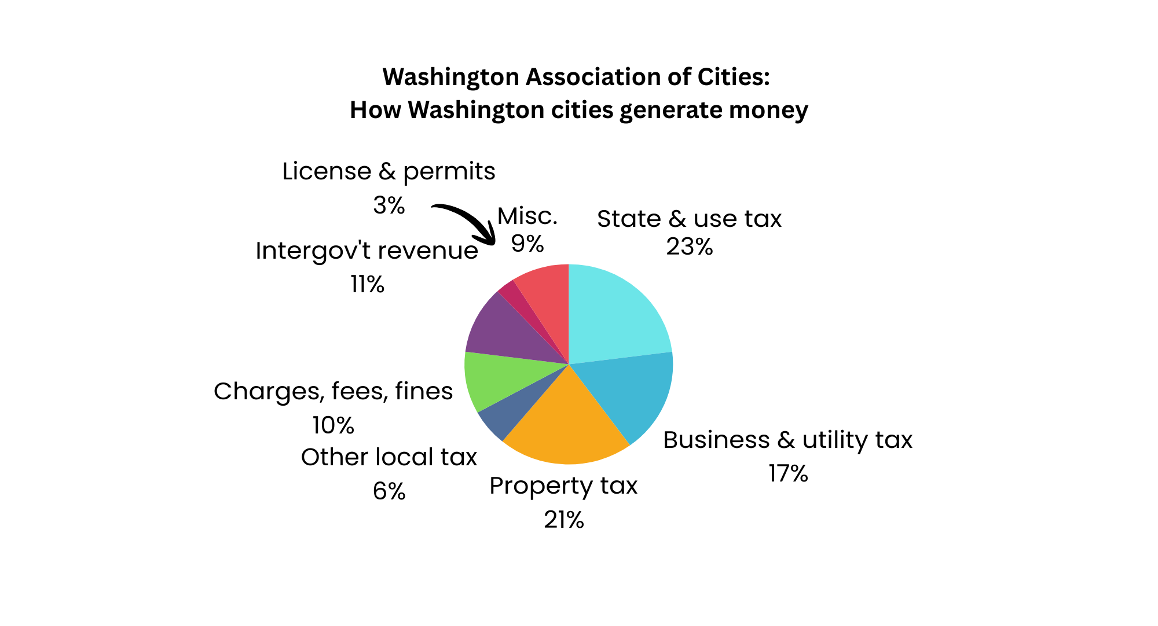
Fun fact: Texas has one the highest property taxes in the country. A $1.3 million house in Austin gets a $20,000 property tax bill. A similarly priced house in Snohomish County is about $6,000.
Because there is no income tax, some argue that Washington’s tax system is regressive because the proportional financial burden is heaviest for low-wage earners.
An example of disproportionate burden looks like this: A $200 dinner for a family that makes $60,000 represents a larger share of income than for a family that makes $600,000. The same disproportionality applies to fines, fees and sales tax.
Income-tax free states must rely more heavily on other sources of revenue like property tax, sales tax, fees and fines, and state and federal grants.
I-695 – the $30 car tabs initiative
For decades, the most reliable tax in Washington State was the motor vehicle excise tax (MVET). That tax linked road repairs to vehicles that used roads.
In the late 1990s/early 2000s, Snohomish County-based anti-tax crusader Tim Eyman entered the picture. The tech bubble had popped, and people were feeling the financial pinch. Eyman tapped into that financial stress and anti-tax fever across Washington state and got enough signatures to put two key measures on the ballot – Initiative 695 and Initiative 747.
In 1999, I-695 was known as a “$30 car tab’” measure. Car tabs are the motor vehicle excise tax we pay when we register our vehicles. Prior to 1999, those fees were high. It was not unusual to pay $600 car tab fees every year. Calculation was 2.2% of vehicle value so a $50,000 car would pay $1,000. The pricier the car, the higher the tax.
Those fees funded state and local road projects like paving and bridge building and road-related safety work.
I-695 passed. Tabs went back to $30. The State Supreme Court later threw out the initiative because the initiative violated the single-subject rule for an initiative, but it was so popular that the Legislature approved a bill, which then-Gov. Chris Gregoire signed, setting tabs at $30. This legislation effectively ended the multi-billion dollar road improvement revenue generator called car tabs.
And yes, our $30 tabs are no longer $30 because new fees have been added on to make up for the loss. However, current fees are no longer the revenue generator prior to 1999.
Here is how the Office of Financial Management described the impact of I-695 in 1999:
“Under current law, the state MVET is expected to generate approximately $1.5 billion in revenues during the 1999-01 Biennium.
- Approximately 47% of that amount is designated for state transportation programs,
- 29% for local transit districts,
- 24% to local governments for transportation, criminal justice and other purposes.” – Office of Financial Management Analysis.
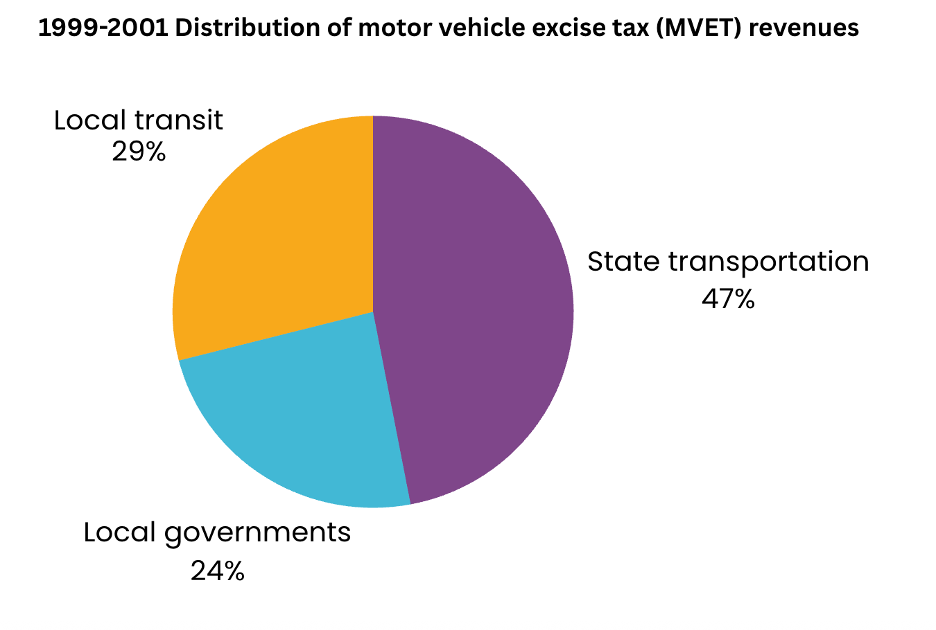
Most of that money ($1.5 billion in 1999-2001, which translates into nearly $3 billion in 2025 dollars) went away almost overnight.
Roads didn’t stop falling apart. Cities, counties and states just stopped having a reliable, consistent and predictable revenue source to fix them. Roads got worse and they got worse faster because small cheap repairs that got ignored turned into big expensive problems that could no longer be ignored.
To use a personal economy analogy: You buy a house knowing you will have to fix things over the years.
Ten years in, the water heater breaks. You buy a new one. Twenty years in, the roof leaks, but you don’t have the money right now so you hope for the best, maybe put up a tarp. It doesn’t completely work. The leak damages the drywall, maybe the floor. Now you have a mold problem. It just got a lot more expensive and you wish you’d found the money to just replace the roof before all the new damage was done.
Your house is like a city road. The longer it goes without a fix, the more expensive it becomes. I-695 took the roof money and now roads have holes and leak more every day. Every freeze/thaw cycle widens the cracks. That leak looks like potholes or chunks of concrete coming out the bridge or more chip seal or gravel which can damage a vehicle.
One alternative for road repairs was an increase in gas tax, but that paled in comparison. With electric vehicles, more fuel-efficient cars and better transportation systems like buses and light rail, fewer people are buying gas.
There is no major funding replacement in the pipeline.
The billion-dollar funding loss 25 years ago has had a big impact on the state, which has even less to give cities.
City solutions? Bring a small teaspoon to bail buckets of water or ask taxpayers for help in the form of a road tax.
On the local level
Lynnwood is a growing, increasingly transient city with a mix of residential and business and thousands of people each day traveling to the new light rail or shopping at Alderwood Mall. It means more maintenance — more traffic on local roads in desperate need of repair and replacement.
“Our biggest expenditure in the next few years is maintaining infrastructure,” said a City of Lynnwood spokesperson. “We have several mega-projects on the horizon. A wastewater treatment plant ($250 million), Poplar Way bridge ($45 million for construction).” That doesn’t include regular maintenance like filling potholes and other street and signal repairs.
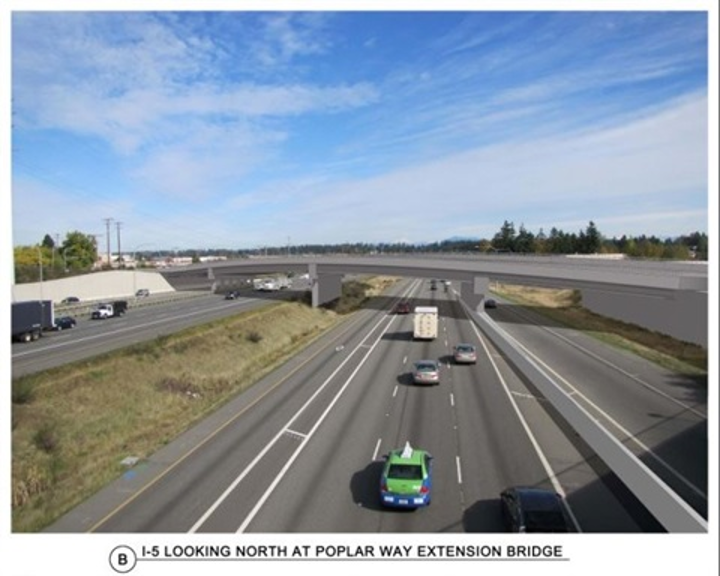
Snohomish County sees the same problem.
When MNNG asked each city and county to share a single number to sum up their economic issue, Snohomish County chose the number 6, as in 6 cents.
“Our Public Works Department roads budget receives about 60% of its funding from the road levy portion of the property tax,” said County spokesperson Kari Bray.
Here’s the Snohomish County Assessor’s office link. You can see how much you pay for road services. MNNG ran a sample property with a 2024 assessed value of $800,000.
A house worth $800,000 pays about $600 per year to Snohomish County Public Works. According to the County, the price of 1 linear foot of sidewalk that is 4 feet wide is $1,500. This includes the cost to design and construct a new sidewalk along an existing roadway. It does not include the cost of any needed right-of-way purchase or environmental mitigation.
In 2024, you just bought 2 feet of sidewalk. That’s it.
“That’s crazy!” you say. “It shouldn’t cost $1,500 for 4 square feet of concrete!” You are right. If you were to do it yourself, it wouldn’t cost you that much, but a government agency has to follow rules and has overhead. You just have to feed your brother-in-law — who comes to help you – and agree to watch his kids next Saturday night.
For those living in unincorporated Snohomish County, another 4 cents goes specifically to the County’s road fund, which is a dedicated funding source for more than 1,600 miles of road, 210 bridges, numerous crosswalks, sidewalks and bike lanes, and more than 200 traffic signals.
Again, planning and scheduling repairs or putting projects out to bid is one thing. The second part of the equation is anticipating how much it will cost and putting that anticipated cost into a budget that is made more than a year in advance.
In the last five years, budgeting has become significantly more difficult.
“In recent years, the road fund has increased 2% annually while the cost of materials, equipment, services and labor have increased 6% annually and the four-year (2020-2024) Seattle Area Construction CPI (Consumer Price Index) is up 39%,” Bray said.
One small-scale solution? An increase on car tabs. The state currently caps the total at $50. The fee is attached to car registration. The fee in Edmonds and Lynnwood is $40 while in Mountlake Terrace it’s $20.
For Lynnwood, that fee generated $1.2 million in 2024. The money pays for pavement, miscellaneous transportation projects, new sidewalks, sidewalk maintenance and ADA upgrades, and rebuilding traffic signals. For Mountlake Terrace, it generated $315,000 in 2024. For reference, in 2025 Mountlake Terrace paved a quarter mile of one road. The contractor, the lowest bidder, bid $2 million for the project.
That’s where the impact of I-695 is felt the most.
Infrastructure is the first leg of the revenue-loss journey. Government buildings and schools are also government infrastructure with no historically dedicated funding. That comes, in part, from property taxes. But Eyman had a plan for those too.
Next up: Property taxes


“Because there is no state income tax, public projects and programs must be funded through four main sources: property tax, consumption tax, fees/fines and grants.”
And therein lies a huge solution to explore–a *state* income tax. The more you make, the more you pay. Makes sense to me. Sales taxes and even property taxes are regressive. With this worsening budget crunch, it is time to finally explore some equitable alternatives to our current taxation.
This is an excellent article, Jamie, thank you for taking the time to research this topic so well and explain it to your readers! Happy holidays!