
Will you chip in to support our nonprofit newsroom with a donation today?
Yes, I want to support My MLTnews!
- Mountlake Terrace’s city manager presents revised budget packages to close the City’s $4.2 million gap.
- A Housing Authority of Snohomish County representative describes why there is a delay in building affordable housing
- Mountlake Terrace police officials provide a 2025 report on crime statistics and introduce a special division dedicated to dealing with child exploitation online.
- The Council makes two proclamations: For Local News Day and Arbor Day.
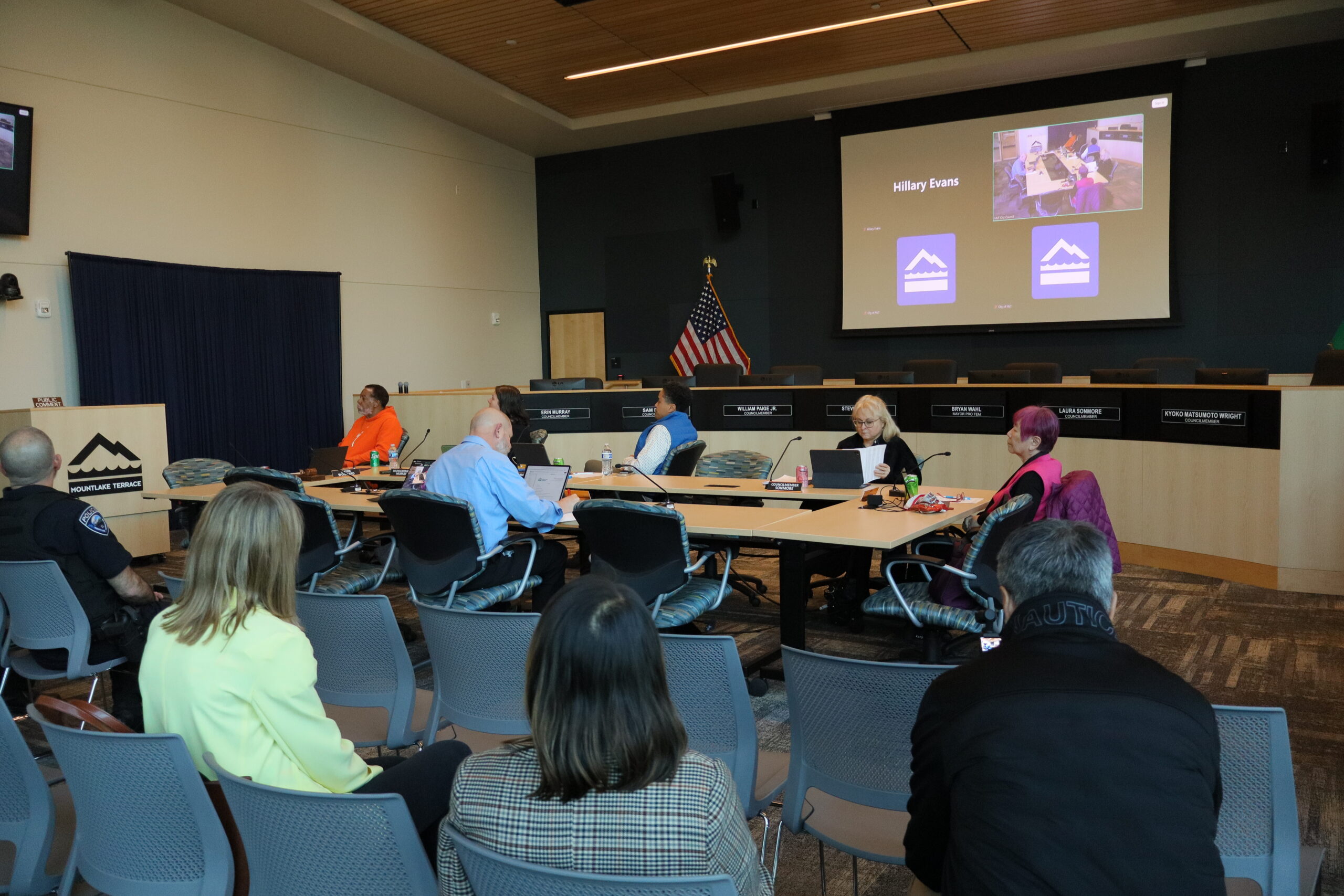
Mountlake Terrace City Manager Jeff Niten presented revised budget packages to City Council during its April 9 work session. The packages, proposed by the City’s Fiscal Sustainability Taskforce, aim to close Mountlake Terrace’s $4.2 million budget gap. Niten and Deputy City Manager Caroline Hope had presented several “what if” scenarios to Council on March 12.
Mayor Pro Tem Bryan Wahl and Councilmember William Paige, Jr. were absent from the meeting.
Niten listed the following ways the City could – or already has – cut costs and generate revenue.
Internal cost allocation
About $50,000 could be saved from refining how internal costs are allocated, such as having more accurate time-sheet coding for utility funds. Niten said the City has already found an additional $50,000 in savings, with more refinement planned as part of the 2027-28 budget development.
Software subscription savings
By changing vendors – including a switch from Granicus to CivicPlus – along with cancelling some Adobe subscriptions and removing laptop hotspots, the City has exceeded the task force’s $50,000 savings goal by $49.
Historical budget savings
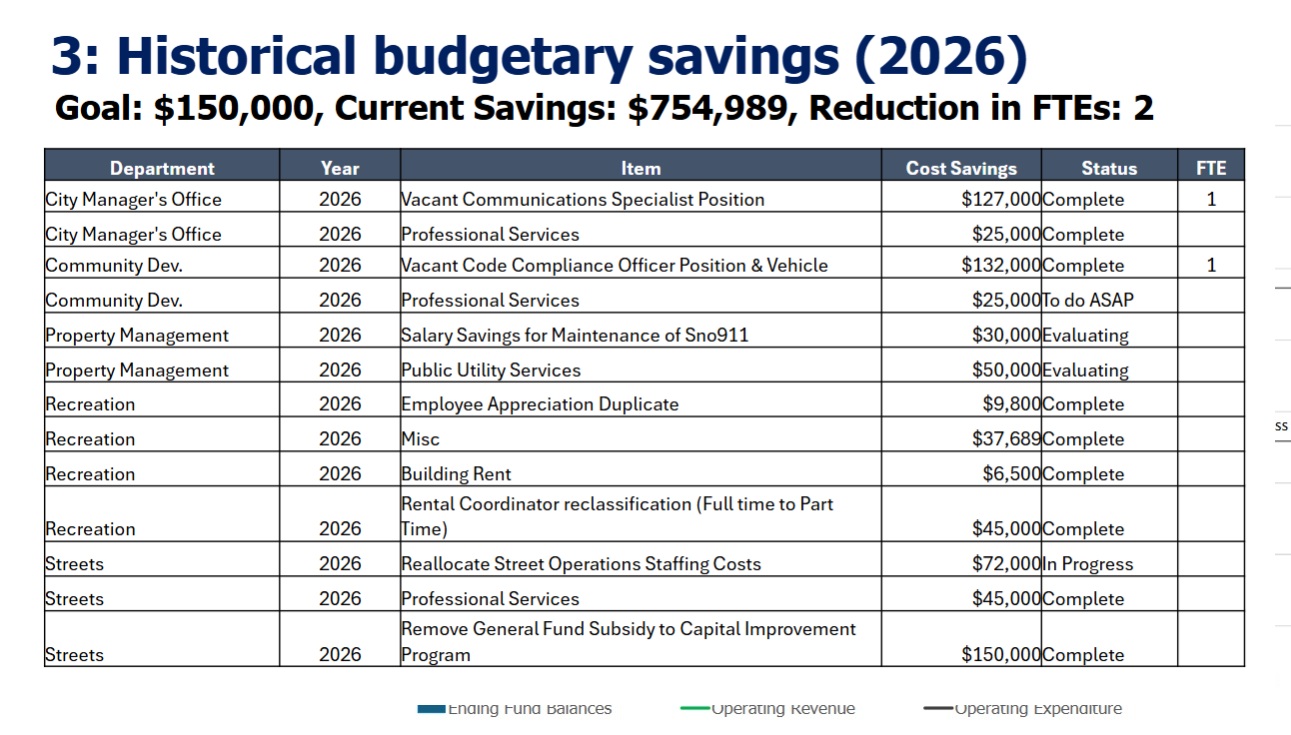
The City has cut a vacant communication specialist position from the city manager’s office and a vacant code compliance officer position from the community development department, which saved $259,000 total.
General fund expenses
Niten said the City has historically over-budgeted for some items like facility repairs and utilities. He said tightening these assumptions generates substantial savings and reduces the original $1 million two‑year reduction target to nearly $444,962. With one full-time employee layoff and removal of a vacant police officer position, the City is saving $266,786.
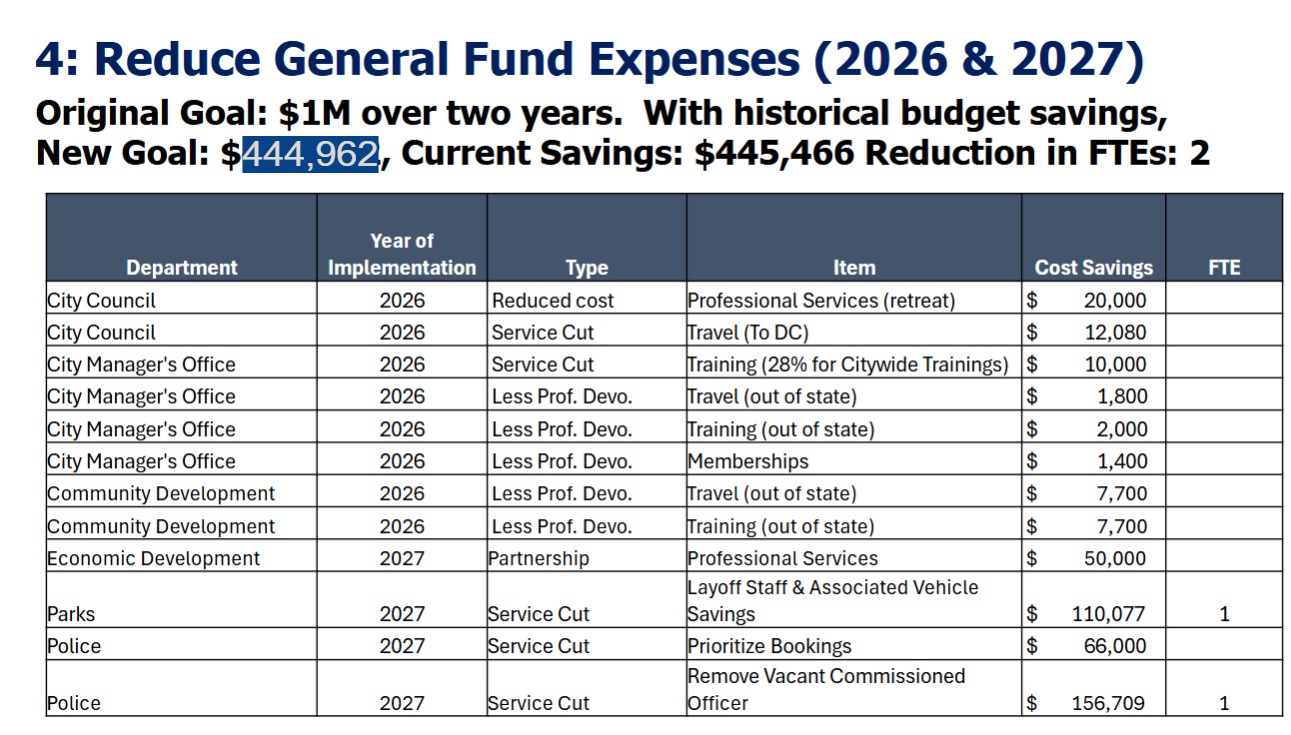
With additional cuts in out-of-state training, traveling, memberships and similar expenses, the total general fund savings is $445,466.
Banked capacity
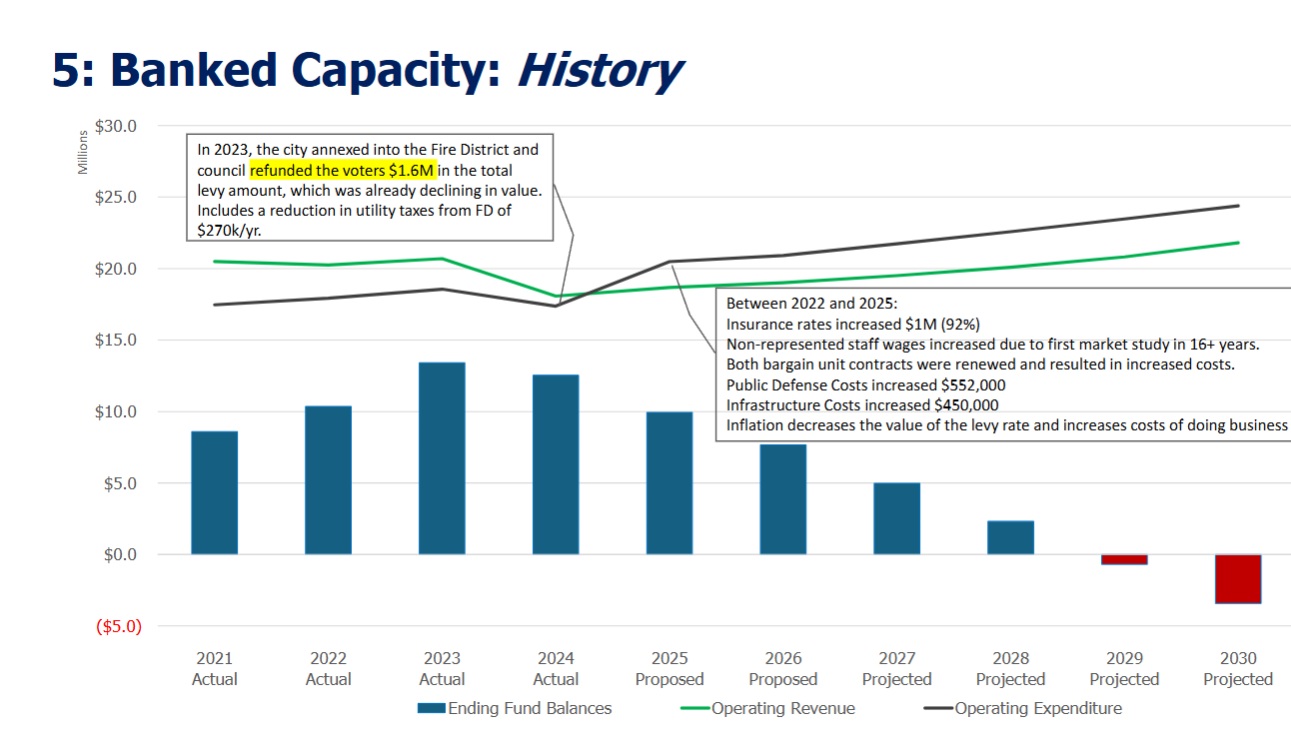
Niten said that banked capacity is property tax revenue that the City is legally allowed to collect but has not taken in the past few years. He said it does not behave like a “savings account” until it is actually levied and put into reserves, where it can then earn interest and be used for emergencies.
The City has about $2.465 million in banked capacity, which exceeded the goal of $2.4 million. Niten said using it would cost the owner of a Mountlake Terrace home with an average value of about $591,400 about $142 a year in 2027 and another $142 a year in 2028. He said if banked capacity isn’t used, 16 city staff would be laid off. This would mean City Hall will have reduced hours and end passport services. In addition residents will experience longer wait times for permits and business licenses, and less maintained parks and streets.
Transportation benefit sales tax
Niten said a transportation benefit sales tax would raise about $835,000. The first 0.1% could be imposed by the Council, and the next 0.2% would require voters’ approval.
Vehicle license fee
Niten said increasing the vehicle license fee from $20 a year to $40 would bring about $315,000, assuming the number of vehicles registered stays the same. The Sustainability Task Force’s Proposal 1 would implement this in 2027, while Proposal 2 would delay it until 2033.
Metropolitan Park District
Niten said the task force recommended a City-only Metropolitan Park District (MPD) to maintain recreation and parks, replacing a current $700,000 general fund subsidy for these services. Based on the average home value, this would cost homeowners about $242 per year or $40 a month. Niten said the goal is to reach $2.15 million by 2030. This amount would maintain full operations at the Recreation Pavilion, including child care, along with current parks services and events.
If this isn’t approved, he said the City would cut about 43 full-time equivalents (FTE), or more than 120 staff members – many of those part-time instructors.
Increase fleet partnership fees
While Niten didn’t say specifically how much the fee increase would be for fleet vehicle maintenance to other cities, he said the goal is to bring in $30,000 per year. He said the city staff currently spends about 500 hours a year serving the Shoreline’s fleet. If more hours are spent serving there, Niten said Mountlake Terrace would need to hire an additional mechanic to service the City’s fleet and equipment.
Increase park rental fees
Niten said the increase inpark rental fees would bring in about $30,000 per year. These would apply to picnic tables and shelters and events at the Civic Plaza. If those increases are not adopted, the City will have to cut that same amount from elsewhere in the budget, he said.
Increase recreation fees
Increased recreation fees, such for classes and child care, at the Pavilion would bring in about $100,000 per year. If this is not increased, Niten said the City will have to look elsewhere to cut $100,000.
Increase development service fees
Niten said increased permit fees would bring in about $200,000. He pointed out that many neighboring jurisdictions have significantly increased their fees in the last 18 months. Even after the increase, Mountlake Terrace expects to be on the lower end regionally, he said.
Transfer some REET from streets CIP to operations
Since state law allows limited use of real estate excise tax (REET) for city operations, Niten said transferring about $175,000 from the street capital improvement program (CIP) to operations would backfill general fund subsidies for street operations. He categorized this as a one-time, limited funding that would also reduce available dollars for long-term street maintenance.
Niten said that none of these proposals indicate service growth. They are strictly about maintaining current service levels and preventing a downward trajectory in the city budget.
Throughout the presentation, Councilmember Laura Sonmore repeatedly asked for deeper cuts. She said the banked capacity and Metropolitan Park District fees would stack costs onto homeowners. This would translate into about $283 more per year “for just the banked capacity, which people aren’t getting anything more for,” she said.
“We told [residents] that we wouldn’t use that when we did our [Regional Fire Authority],” Sonmore said.
The addition of car tabs, sales tax and a potential park district would cost about $1,083.92 per year, and this is on top of “the general property tax already,” she added.
Sonmore also suggested the Council should decline a trip to Copenhagen, Denmark. That was proposed at last week’s meeting when Denmark’s ScanDesign Foundation invited Mountlake Terrace to join the City of Shoreline on a summer tour to learn about environmental sustainability, housing and urban design.
“We could always talk to [Shoreline] when they came back…but right now, we just saw our budget, and we’re looking to save everything we can, and I think that no cost like that is beneficial to our city at this time,” she said. “We have to look at the total cost of what it means to our citizens.”
Mayor Steve Woodard noted that “I can’t think of a single city in the state of Washington that is talking about growth; they’re talking about maintaining.”
He acknowledged that the City is “broke” but mentioned a lesson from his professional life where a colleague once warned, “Don’t cut your budget so much that you can’t do your job.” He said the trip to Denmark could help the City learn from “experts who have done very [similar things]” and skipping this opportunity could end up costing the City more if they later choose to pursue a similar study trip.
Niten and the Council will review the increased fees in development services and recreation at the Council’s next meeting on April 23. If approved by the Council, the public would vote on the property tax levy in November 2026.
For more details, the presentation starts at 2:02:32 on the City’s YouTube video.
HASCO
The Housing Authority of Snohomish County (HASCO) is facing rising costs and capacity issues, which is delaying construction and land development for more housing, according to HASCO Government Relations Director Chris Collier.
He said the core issue is the lack of any guaranteed operating funds, which forces HASCO to either earn its own revenue from properties or chase limited subsidies. Early in the presentation, Collier said housing authorities cannot rely on taxes or built‑in funding.
“What we cannot do is tax…[HASCO] revenue comes exclusively from their operations. There is no guaranteed local, state or federal source of money that pays for [that and] keeps the lights on at the Housing Authority, period,” he said.
Collier said that reality pushes HASCO to focus on self-generated revenue through its properties or tax-funded programs, such as vouchers and tax credits.
“There’s increasing difficulty in development across all sectors, including HASCO… whether it’s financing and subsidies, national interest rate, interest in lending rates, the cost to build, land, lumber and materials, all of those are increasing in price, making it harder to build,” Collier said, adding that that there is “big math” involved before workers can do groundbreaking.
When Councilmember Kyoko Matsumoto Wright asked about the cost of building, Collier pointed to HASCO’s 200th Street Southwest project in Lynnwood. “We’re looking at about $500,000 to $550,000 a unit,” he said. Even with 0% interest, he said HASCO would still have to charge about $1,300 to $1,500 a month just to break even.
And that’s just the base cost, Matsumoto Wright said. “And people can’t afford that, then we have to look at vouchers. And now we have a limited amount of vouchers, with less coming in with the federal government the way it is,” she said.
Collier said HASCO’s voucher “lease‑up” or utilization rate is already high, at or above about 90%. He said that it’s “very hard” to create units that are below $1,500 a month without additional subsidy to fill the gap.
“If you want to rent it for $800, the question then becomes, where does that gap come from? The answer is, it doesn’t exist right now. And that’s our problem to solve,” he said.
Regarding subsidies, Collier said that these sources are already “tapped out,” and HASCO is limited to 20% of its total voucher allocation to be project based. “We’re at that maximum limit…and no other replacement really exists locally or in Washington state,” he said.
The federal government “is leading to funding uncertainty” and is “sending out a lot of mixed signals,” he said, which makes planning even harder.
Collier said there is a seven- to nine-year waitlist for seniors and those who are disabled, and that list is closed until 2027 or 2028. By then, he estimated between 200 to 300 households would be put on the waitlist. He said there are about 96,000 households in Snohomish County that would qualify as very low income or below 50% of the area median income (AMI).
“We can serve about 25% of them at any given time, leaving 77,000 very low-income households,” he said. “We need 44,000 units of just 0% to 30% AMI housing to meet current projected needs by 2044. We currently have 1,200 [such] units active in the entire county. That’s all that we’ve produced…to keep the lights on. It’s really hard math to make work.”
Amid all this, Collier said HASCO is trying to maintain organizational stability while incrementally growing its portfolio and partnerships, such as the recent purchase of the Allegro apartments in Lynnwood. He said that HASCO needs to focus on the 50-80% AMI housing to keep the company solvent, which leaves a large gap for those at 0-50% AMI, especially seniors.
“And so who’s looking out for them? There’s no good answer to that question,” Collier said.
Despite the grim housing reality, Collier said that he is optimistic. He reflected on his prior work for Gov. Jay Inslee, where he “saw the worst of the worst” with people losing housing and health care, and facing homelessness and mental health crises. That showed him the consequences of inaction, he said.
“What brings me joy is that as much as this presentation sucks…this is opportunity, right? Taking action, taking any action…everything that we do is something positive,” he said.
~~~~
Police report
Mountlake Terrace Police Chief Pete Caw said crime and police activity trends were “pretty consistent” in 2025 when compared to 2024. He noted there are no dramatic rises or falls in crime, just some spot increases in certain areas while others remain stable year over year.
Caw also said Washington state ranks last in the U.S. for police-to-population ratio. In 2000, Mountlake Terrace had 32 officers for a population of 20,450. With the current population of about 25,100 people, the department now has four fewer officers.
Cmdr. Mike Hayes gave a rundown of the crime statistics for 2025:
- There were about 2,700 more incidents in 2025
- Officers issued 1,094 citations in 2025, or about one for every seven traffic stops.
- There were 782 arrests in 2025, slightly above the 775 arrests in 2024.
- There were 242 citations issued, compared to 380 in 2024. Haynes said the reduction is due to a shift from treating driving with a suspended license as a misdemeanor crime to a noncriminal infraction.
- Vehicle prowls continued a downward trend due to increased patrols.
- DUIs have continued to increase since 2021.
- Violent crimes have increased by 30% each year since 2022. The most common type of violent crime is domestic violence.
“[Domestic violence] calls are a priority for patrol from the initial response to the investigation process and the support our domestic violence coordinator [who] provides to the victims during the court process and getting their lives back on track,” Haynes said.
He added that Mountlake Terrace had an increase of about 6,000 people in the last few years, which likely led to the increase in domestic violence and DUIs.
“A lot of the times that we go out to domestic situations, vulnerable people are under the influence,” Haynes said. “So I think that is a huge contributor to that problem.”
Additional statistics can be seen on the City’s website.
Haynes said that the police department has a “very conservative” approach to vehicle pursuits. Under state law and policy, officers “must be trained in at least one method of pursuit intervention,” because their goal is “to end the pursuit safely and as quickly as possible,” Haynes said. “The longer the pursuit is allowed to continue, the more likely it will have an unfavorable outcome.”
Haynes showed a video of a pursuit of a DUI driver in a red pick-up truck on Highway 99, which ended with the officer doing a pursuit intervention technique (PIT). The result had zero injuries and minimal property damage, Haynes added.
Cmdr. Scott King said Mountlake Terrace detectives received Internet Crimes Against Children (ICAC) training in 2025 and are part of a national network of 61 task forces and representing more than 5,400 agencies focused on online child exploitation.
He said in 2024, the National Center for Missing and Exploited Children received 20.5 million reports containing 62.9 million images and videos, and Washington State received 15,304 cyber tips. Mountlake Terrace Police is an affiliate of the Seattle Police Department’s ICAC Task Force. King said Mountlake Terrace detectives receive cyber tips tied to activity in the City, then work to identify suspects and victims and determine if the material is legally classified as child sexual assault material.
Other business
The Council voted 5-0 to adopt the Lumen franchise agreement, which covers how Lumen will perform its work in the City. The company is a subsidiary of AT&T and connects networks to home-based systems using fiber or broadband technology.
Mayor Steve Woodard proclaimed April 9, 2026 as Local News Day, with My Neighborhood News Group CEO Teresa Wippel and Se Habla Media CEO Jaime Méndez and COO Diana Oliveros receiving the proclamation.
Woodard said that local news means a lot to him because his first job was delivering newspapers when he was a kid in San Diego in the 1980s. He added that newspapers exposed him to the real world when he read about San Diego’s first mass shooting at a McDonald’s in 1984.
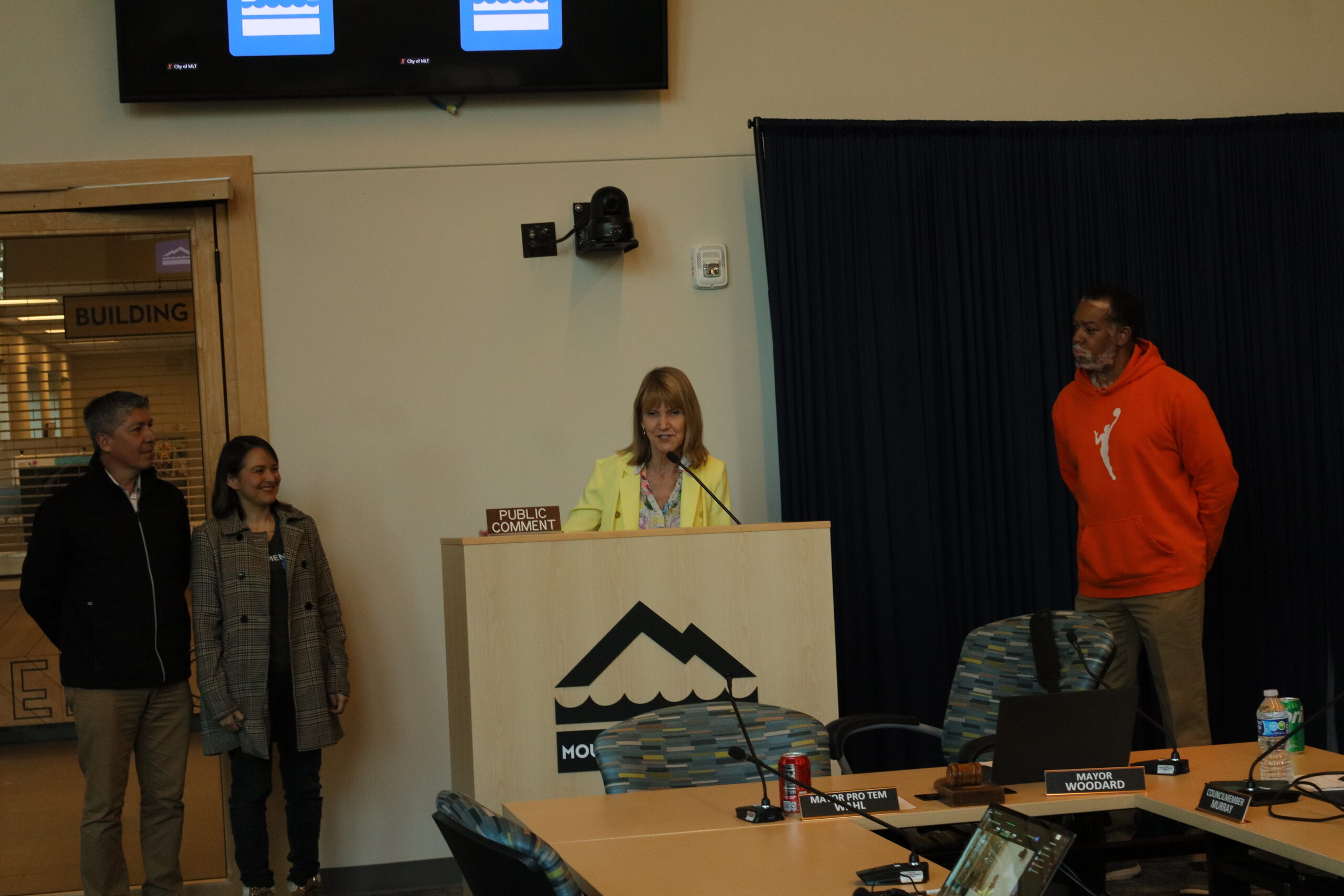
Wippel said that My MLT News is the only news that covers Mountlake Terrace regularly. “We have taken great pride in that over the years. And I also want to thank all of you, especially the elected officials, for your patience with us,” she said. “We know we don’t always get it 100% right, but we really value the fact that you are there to help us and to correct us when we make a mistake, and also to give us praise when praise is due. So thank you for your support.”
Méndez said that Se Habla Media is the only daily Spanish-speaking news broadcast left after Univision Seattle ended in 2023. “We care very much about our community,” he said. “It’s important that the Spanish-speaking community in the area and the region gets real news, news that come from also their own community, and we are part of this community.”
Councilmember Erin Murray proclaimed April 24, 2026 as Arbor Day, which originated in Nebraska in 1872 as a day dedicated to planting trees. Recreation and Park Advisory Commissioner Audrey Meyer and Parks Supervisor Celina Williams accepted the proclamation.

Meyer invited the public to help remove invasive plants, such as the English ivy, from public parks once a month every Saturday at 9 a.m.
“I look forward to seeing everyone at Arbor Day in Action on April 25 at Ballinger Park,” she said.
There will be no Council meeting on April 16.
The entire meeting can be viewed on the City’s YouTube channel.


Some quick Internet searching says that 53% of the current city budget is spent on law-enforcement and that costs are increasing 4% per year on average. Which means in 25 years the police budget will be 100% of the city budget or dang close.
So here’s a really hard question to deal with: can we afford to have this extremely expensive police force as it is?
We already use a combined school district, fire department, utilities, and water treatment.
Instead of cutting services and raising all this tax money with layer upon layer of taxation there is another option.
Let us consider amalgamating our police force with say Edmonds and Lynnwood or other Neighbours such that we can lose the excessive costs of redundant upper management while maintaining the critical number of units on patrol.
What we are looking at is how do we balance our needs as residence with the limited taxation, authority, and amount that can be or should be imposed on residents.
I am glad to see the City is finally calling the question of the cost overruns at the Pavilion. If we, the voters don’t approve a Metropolitan Park District at $40.00 a month, the 50 year old pool will close. And save $700,000 a year. Remember in 2009 the Council accepted the recommendations of a facilities task force to replace the pavilion with a new 72,000 square-foot aquatic center. So for the last 17 years, the Council had planned to demolish the Pavilion. The $40 a month MPD won’t replace the pool. Aquatic centers cost $1,000,000 a thousand square feet. That’s $72 million, plus that $40 a month. Where is the $72 million going to come from? How about we create a Metropolitan Pool District that does not include our wonderful park system and refurbish the Pavilion? Don’t hold our parks hostage by not moving and blame it in pool cost overruns.
If a stand alone Metropolitan Pool District is created, maybe it should have its own board of directors and staff, not the city’s. Should a third party, like the YMCA run the pool? Think Comcast, Waste Management and Puget Sound Energy as examples. We are a town of just 4 square miles and only 25,000 people, with limited income.