
Will you chip in to support our nonprofit newsroom with a donation today?
Yes, I want to support My MLTnews!
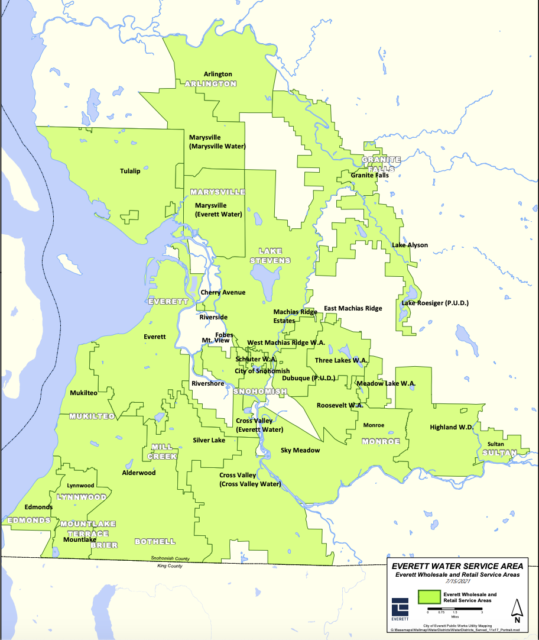
The Everett City Council’s approval of a new 12% utility tax is poised to send financial ripples across Snohomish County, driving up utility bills for nearly 75% of the County’s businesses and residents. Everett’s wholesale customers are expected to take up the bulk of the increase, including the Alderwood Water and Wastewater District (AWWD), which provides water to most of South County.
Since the 1980s, Everett collected a 6% payment in lieu of taxes on its utility bills, according to the City’s website. In May, the Everett Council voted to replace the 6% charge with a 12% utility tax, effective in August. This is expected to generate an additional $7.5 million for the City’s general fund amid a projected $15 million budget deficit for 2027, The Everett Herald reported, but not for Everett’s water utility fund.
According to documents provided by the City of Lynnwood, Everett also proposed raising its wholesale water rate from $1.0033 per CCF (2024 rate) to $2.4403 (2026 rate) – an increase of roughly 143% for Lynnwood and Edmonds, including the 12% utility tax.
View the proposed 2026 rates here.
In Lynnwood, this could increase the average homeowner’s bi-monthly utility bill by over $16. Exact figures weren’t provided for Edmonds and Mountlake Terrace.
AWWD provides water to roughly 300,000 people, including the cities of Lynnwood and Edmonds and Mountlake Terrace. AWWD is in the middle of disputing Everett’s proposed increases and is paying the 2024 rates until an agreement is reached, according to Lynnwood staff.
AWWD’s attorney Joe Bennett warned the Everett Council of legal consequences if it pursued the utility increases.
“This is a pure case of taxation without representation,” Bennett said at the May 28 Everett Council meeting prior to the vote. He argued that the majority of people affected by the rate increases don’t live in Everett and will receive no benefit since the money will go into Everett’s general fund.
“If adopted, Alderwood will consider all of its legal remedies to oppose this unlawful tax,” Bennett said. “Alderwood will have no choice but to pass this tax on to its own ratepayers as well as its municipal wholesale customers.”
The City of Edmonds also chimed in in opposition. At its June 16 meeting, the Edmonds City Council approved a letter to Everett Mayor Cassie Franklin, asking her to reconsider the tax.
Lynnwood Public Works Director Jared Bond at the July 6 Lynnwood Council meeting said the City’s general fund is protected from the increase. Since 2024 Lynnwood has proactively banked approximately $1.5 million in an interest-bearing account in the case Lynnwood owes Everett money retroactively if the courts don’t side with AWWD, meaning bills won’t increase suddenly for Lynnwood’s customers.
Further driving Everett’s wholesale increase is an $80 million capital project to replace Everett’s 100-year-old, in-ground “Reservoir 3,” which is co-run by Everett and AWWD. The project will replace the current reservoir with two new concrete reservoirs holding 8 million and 15 million gallons. Everett unilaterally determined that wholesale customers like Alderwood should cover 80% of the project’s costs, leaving Everett’s direct retail customers to pay just 20%, Lynnwood staff said earlier this month.
A large portion of AWWD’s dispute is the way the project is funded. Everett is paying for the project using long-term bonds paid over 25 years, but is not bonding AWWD’s portion. By law, AWWD can’t legally issue bonds to fund another agency’s infrastructure project and is therefore being asked to pay its share in cash. Bond said this violates standard generational equity practices — where large infrastructure costs are spread out over decades rather than being front-loaded onto current ratepayers.
Meanwhile, the 12% utility tax was implemented specifically to close a projected $15 million deficit in Everett’s 2027 general fund budget. Everett has struggled with a structural deficit for over a decade, which City leaders attribute largely to a 1% state cap on annual property tax increases. After voters rejected a property tax levy lid lift in 2024, the city was forced to lay off 31 employees and cut library hours, per The Herald.
Despite the opposition from AWWD and other customers, Everett Councilmembers felt they had no other option to keep their city afloat.
“Yes, we haven’t raised the rate since 1983,” Everett Councilmember Judy Tuohy said in May.
“I say shame on us for not being businesslike and reasonable.”
Councilmember Erica Weir agreed, noting, “Nobody wants more taxes, I know that, but also that’s what pays for the services that we all enjoy.”
— Contact Ashley at [email protected].


Real first and last names — as well as city of residence — are required for all commenters.
This is so we can verify your identity before approving your comment.
By commenting here you agree to abide by our Code of Conduct. Please read our code at the bottom of this page before commenting.