
Will you chip in to support our nonprofit newsroom with a donation today?
Yes, I want to support My MLTnews!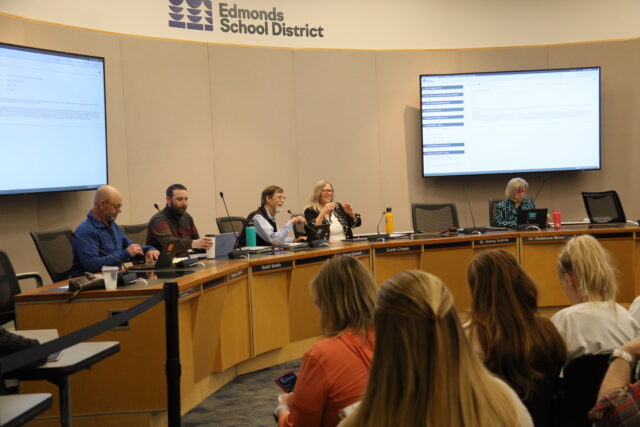
The Edmonds School District Board of Directors officially approved a $470 million budget for the 2026-27 school year at its meeting Tuesday, preceded by calls from parents and community leaders to reintroduce police officers in schools. The Board also approved the District’s 2026-2031 capital facilities plan.
A call for the return of SROs
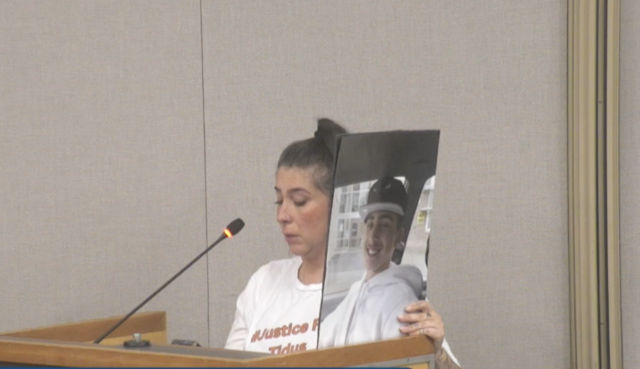
Parents, students and community leaders packed the board room Tuesday, including the parents of two Lynnwood teens who were killed in shootings in recent years. The speakers urged the Board to reintroduce School Resource Officers (SROs) in high schools after the District eliminated the program in 2020.
The comments accompany a recent push from local youth-centered nonprofit organizations – The ACCESS Project and Jaguars Community – to bring a reimagined SRO program back to the District.
“A reimagined SRO program should not be about criminalizing students,” said Wally Webster, founder of The ACCESS Project. “It should be about building trust, positive relationships with students, providing a safe and approachable adult students can turn to in times of need, and supporting preventive and early interventions before behaviors escalate.”
Tidus Linville, 15, and Jesus Sanchez Camunas Jr., 16, were killed in a drive-by shooting in Lynnwood in 2022. Linville’s mother appeared at the podium Tuesday with a photo of her son in hand.
“My son was killed in 2022 because of gang violence,” she said. “He was an amazing person. If there was an SRO in the school, they could have helped identify that my son should not have been around such poor influences, and the kids that were under the poor influences possibly could have had a chance at straightening their life up.”
A more in-depth look at SROs and the push for their return will be published in My Lynnwood News soon.
May business and finance report
Executive Director of Business and Finance Lydia Sellie presented the District’s May 2026 financial report. Finances were stable for the month, but Sellie noted that the end balance increased because the District recently learned it will receive a $8.8 state special education safety net award for the 2025-2026 school year. The award comes from money the state set aside for districts that demonstrate a greater need for special education funding beyond what the state and federal governments can provide.
Capital facilities plan
The Board unanimously adopted the 2026-2031 capital facilities plan, a state-mandated document projecting student enrollments as far as 20 years ahead and what facility needs are required to meet state laws.
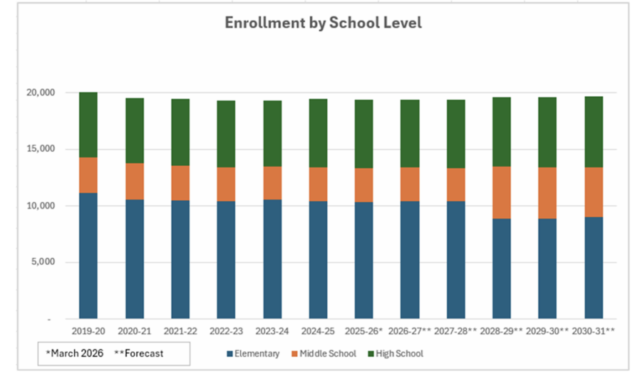
According to the plan, District enrollment has decreased by about 4% since the 2017-18 school year. The District enrolled approximately 20,000 students throughout the 2010s, until enrollment decreased by about 477 students in the 2020-21 school year, largely due to the COVID pandemic. Enrollment increased in the 2025-25 school year before falling by 327 students in 2025-26 – the largest decrease since the pandemic.
As of March 2026, estimated enrollment was 19,380 and is projected to reach 19,688 by 2031.
To address future growth, the District is relying mainly on a $594 million bond approved by voters in 2024 for construction of new buildings and upgrades of existing ones. Most projects funded by this bond are underway, with the new Oak Heights Elementary School reaching “substantial completion,” according to a July 8 District project update. Construction for the new College Place Elementary and Middle Schools and Salish Middle School began this summer, and Westgate Elementary construction is slated to start in 2028.
The District also introduced a series of boundary changes and other restructuring efforts – including moving 6th grade to middle school – to shift enrollment evenly among schools.
Plans are also in place to introduce another levy in 2028 to support further renovations. According to the plan, at least 12 other schools require upgrades to meet enrollment needs and state guidelines by 2031. These schools include Alderwood Early Learning Center and, Beverly, Brier, Brier Terrace, Edmonds, Hazlewood and Woodway Elementary Schools.
In the report, the District notes it has enough land to support enrollment through 2044, partly because of declining birthrates.
Read the full capital facilities plan here.
2026 budget
The Board also unanimously approved a resolution to adopt the budget for the 2026-27 school year. The budget is generally balanced, with $470,160,000 in expected revenues and $470,075,000 in expenditures.
Despite a balanced budget this year, the District still continues to financially recover from a $25 million shortfall caused by a lack of state funding three years prior, Director Nancy Katims said.
“We’re staying even – though we would like to do a lot more in terms of adding programs, lowering class size and all the other important things,” Katims said. “Nevertheless, I think this is a sound budget that is stable and gives us what we need for another year.”
The District ended 2025-26 with a $2 million surplus, thanks to an unexpected boost in state funding following last year’s legislative session. However, that was preceded by years of multi-million dollar deficits and over $20 million cuts made since 2023.
Voters’ consistent approval of education levies in recent years has also helped the District stay afloat. On Tuesday, District Superintendent Rebecca Miner thanked voters for passing the latest $361 million educational programs and operational (EP&O) levy in February by 63%.
“Had we not passed our EP&O levy, we would be having very, very difficult and different conversations about the budget,” she said.
But budget challenges still lie ahead. The District is seeing an increased need for special education services among elementary students, driving up costs. Interest and insurance rates are also spiking, with the District facing a 51% ($2.6 million) insurance premium increase.
In closing, Directors Katims and Thom Garrard said the District will continue to lobby and advocate for more state support to fully meet students’ needs.
View the full budget here.
The meeting agenda and recording are available on the District’s website.
— Contact Ashley at [email protected].


Real first and last names — as well as city of residence — are required for all commenters.
This is so we can verify your identity before approving your comment.
By commenting here you agree to abide by our Code of Conduct. Please read our code at the bottom of this page before commenting.