
Will you chip in to support our nonprofit newsroom with a donation today?
Yes, I want to support My MLTnews!
Key takeaways
- State Sen. Jesse Salomon told the City Council during its work/study session that Washington faces a severe public defender shortage that could leave most criminal cases unfiled unless the state dramatically increases funding and staffing.
- City staff outlined major updates to Mountlake Terrace’s critical area ordinance, including wider buffers, new tree-replacement rules and stricter protections for wetlands, aquifers and habitat areas.
- The Lodging Tax Advisory Committee recommended allocating $45,000 to four community events expected to drive tourism and overnight stays, with a Council vote set for Dec. 18.
- The City reviewed updated prosecution and public defense contracts, noting steep cost increases, especially for public defense, which will rise to $40,000 per month in 2026.
State Sen. Jesse Salomon (D-Shoreline) met with the Mountlake Terrace City Council Dec. 11 to discuss the shortage of public defenders in Washington state and the potential use of paralegals to reduce attorneys’ workloads. He said that if the state does not hire three times the amount of public defenders, two-thirds of the cases would not be filed or be diverted elsewhere.
“The locals are asking the state to fund it. We don’t have money in the budget right now to sustain our services,” said Salomon, who represents the 32nd Legislative District that includes Mountlake Terrace. “AWC [Association of Washington Cities] said it would be $80 million conservatively. I think it’ll be more than that.”
Mayor Pro Tem Bryan Wahl said that even after the City had increased public defenders’ pay, the contracting attorneys told the City that it had to raise compensation further or the attorneys would walk.
In response to the costs, Salomon said that when he was in law school, there were loan‑forgiveness programs for attorneys who went into public service and served for 10 to 12 years. But with the Legislature having previously increased tuition at the state’s only public law school (University of Washington School of Law), he is not sure loan forgiveness still offsets the much higher debt loads students now carry.
“I think there’s a question of whether we are diverting people who would like to go into public service into private law practice,” Salomon said. “And so we might look upstream, and there are some things we’re doing there in terms of internships and things like that in rural areas.”
Councilmember Erin Murray said even before the recent change in public defender caseload standards, cities were seeing a serious workforce shortage in public defense. She noted there isn’t enough competition in the market for public defense, which drove up costs and impacted city budgets.
“My understanding is there [are] less applicants per law school slot, and I don’t really know why that is so we’re trying to figure that out,” Salomon said. He also mentioned a larger number of attorney retirements, which affects the shortage.
Speaking about his other priorities during the upcoming legislative session, which starts Jan. 12, Salomon said he planned to revive legislation on “clear and objective” development regulations. His idea is to draw on Oregon’s model but try to avoid the 30 years of litigation and “weird court interpretations” that Oregon experienced. He said if the State Department of Commerce could publish a model code with clear, objective standards that Washington cities could adopt, the cities would gain some protection from lawsuits.
Regarding frontage improvements, which are mandatory upgrades on public streets near a new development, Salomon said that “one-eighth of a block of sidewalk” is required to be built. “I think the reality is that people look at that and say, you know, I’m not a major developer. I just want to have my grandmother live here in an accessory dwelling unit, and I can’t afford $100,000 for the sidewalk, and so I’m not going to do it. And so we don’t build the housing.”
He suggested that cities should explore more targeted, flexible standards, such as having stricter enforcement on arterials or transit‑oriented areas, and lighter enforcement on quiet, residential streets. Salomon said the next Legislative session will have limited money, so the focus will be on regulatory reforms and state-local partnerships rather than new spending.
Salomon said he will also be working with the Department of Children, Youth, and Families (DCYF) to gather data on what regulations are really needed and which might be streamlined since lack of child care is an “affordability issue.”
Critical area updates
Mountlake Terrace Senior Planner Sara Pizzo reviewed the City’s critical area ordinance that focuses on five critical areas: Wetlands, aquifer recharge areas, flood zones, geologically hazardous areas, and fish and wildlife habitats. Key changes include:
- Increasing buffer zones for low habitat scoring wetlands
- Requiring vegetated buffers with native plants
- Adjusting tree replacement ratios to align with neighboring cities’ practices
Pizzo proposed lowering the 10-to-1 tree replacement ratio to a tiered ratio, such as 2-to-1 for smaller trees and 4-to-1 for larger or significant trees. She said that Edmonds has a 2-1 replacement ratio for hazard trees within a critical area, and Shoreline has a 1-to-1 replacement for smaller trees up to 6 inches in diameter.
Other general provisions that apply to all critical areas include:
- Expand the regulatory application areas from 200 feet to 300 feet when critical areas are next to bodies of water, including streams and wetlands.
- Expand the regulatory application areas from zero to 200 feet at critical aquifer recharge areas (CARA).
- Require wider buffers equal to the size of the area being worked on, retain native plants whenever possible and require replanting any areas that get disturbed.
- Add a non‑conformance section allowing maintenance, repair, rebuilding or resuming legal nonconforming uses/structures after a fire or other disasters.
- Increase fines and enforcement for unlawful removal or damage of trees in critical areas to match zoning and landscape code penalties.
- Added a fee‑in‑lieu option for tree replacement.
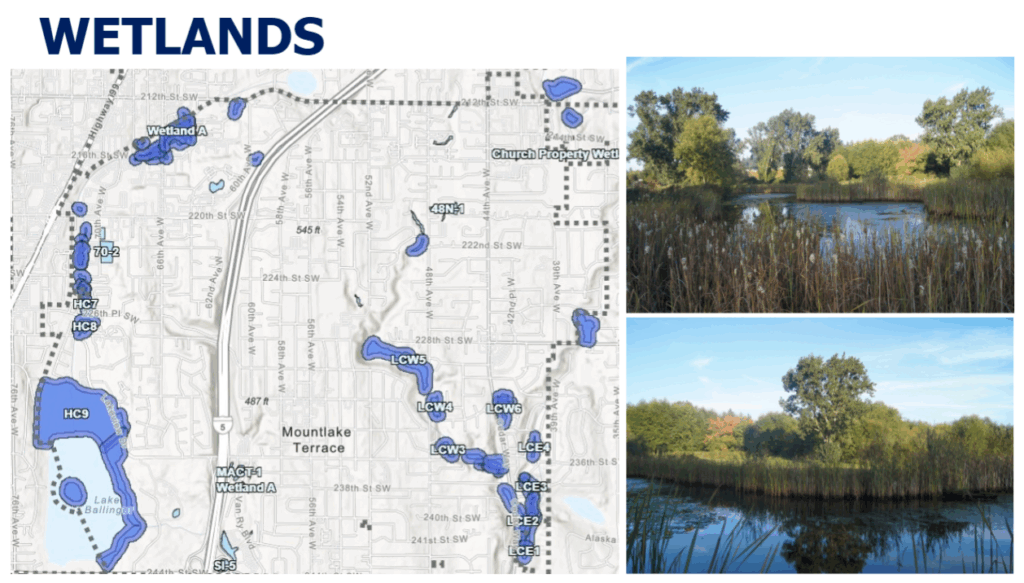
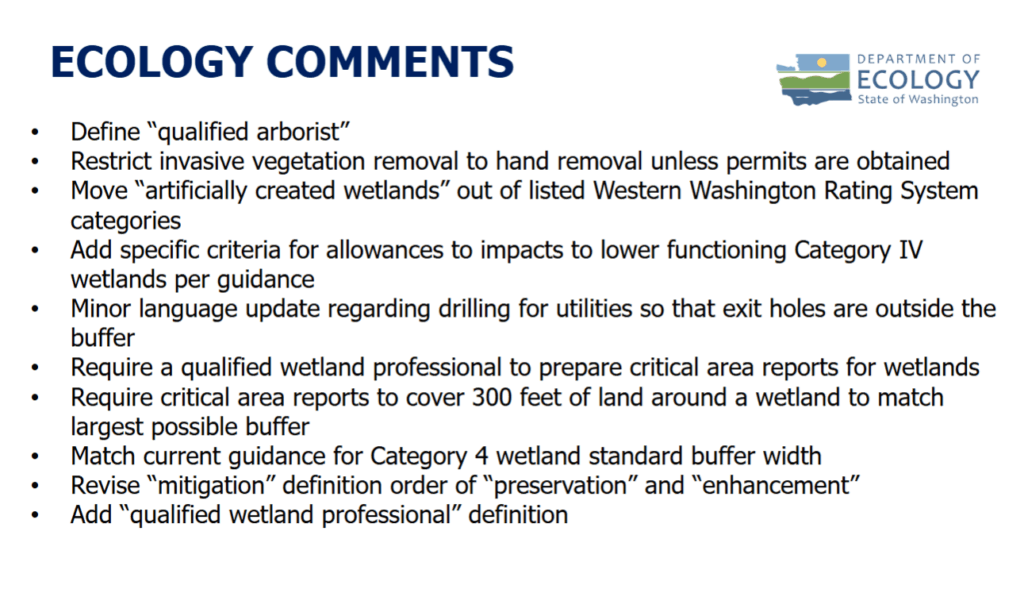
Pizzo said the State Department of Ecology suggested some changes, such as:
- Define “qualified arborist”
- Restrict invasive vegetation removal to hand removal unless permits are obtained
- Move “artificially created wetlands” out of listed Western Washington Rating System categories
- Revise “mitigation” definition order of “preservation” and “enhancement”
Pizzo said the Muckleshoot Tribe recommended strengthening habitat and water resource protection and stricter regulations beyond what was in the draft. When Councilmember Laura Sonmore asked about the specifics of what the tribe wanted, Pizzo said their recommendations included having tighter buffer zones and stronger aquifer safeguards and protecting wetlands in key drainage basins for salmon recovery and beaver habitats.
Pizzo added that the State Department of Health (DOH) recommended that CARAs should have different regulations than other critical areas. She said that DOH was concerned that the general “no net loss of ecological functions” standard used for critical areas does not fit with CARAs because even a small amount of degradation can contaminate drinking water.
“[DOH proposes] cleaning up some of the language for clarity and easier implementation, and also making sure that we only require hydrogeologic reports when necessary and not simply across the board,” Pizzo said.
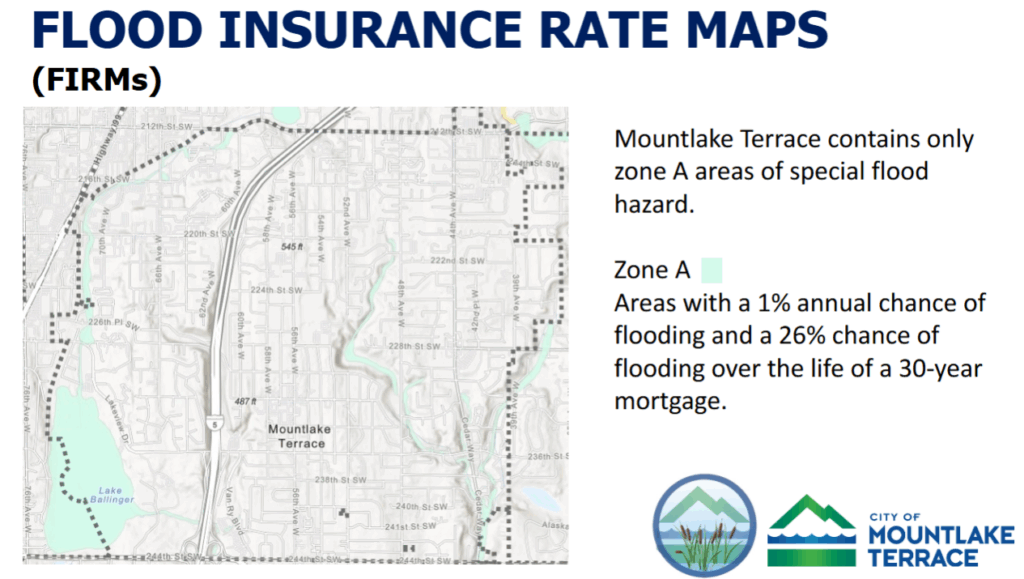
Regarding the floodplain ordinance updates, Pizzo said that Mountlake Terrace only has Zone A special flood hazard areas with a 1% annual chance of flooding and 26% chance over a 30‑year mortgage. New construction-related standards include:
- Having the lowest floor at least 1 foot above base-flood elevation in residential buildings with utilities elevated or floodproofed to the same level.
- Having the lowest floor of non-residential buildings to be at least 2 feet above the base-flood elevation or adjacent grade.
- Limiting enclosed areas below the lowest floor to parking, access and storage only.
- Requiring openings in enclosed areas that allow floodwater to enter and exit.
After the presentation, Pizzo asked the City Council to give direction on whether to adjust the draft critical areas ordinance to:
- Lower the tree replacement ratio, as recommended in the staff report.
- Update the draft to incorporate all of the Department of Ecology’s comments.
- Provide guidance on which Muckleshoot Tribe draft edits the Council wanted incorporated, since staff felt many concerns were already addressed but some suggested language went beyond Growth Management Act and best available science requirements.
- Adopt the Department of Health’s suggested changes specific to critical aquifer recharge areas.
Pizzo and the City Council will hold a public hearing on the updated critical area ordinance, and Council will vote on it on Dec. 18.
Lodging tax
Mountlake Terrace Events Coordinator Andrew Appelwick presented the Lodging Tax Advisory Committee’s (LTAC) recommendations for allocating the 2026 hotel–motel tax fund. He said the committee recommended distributing $45,000 of the city’s $50,000 hotel–motel tax budget for 2026 after reviewing four eligible applications that support events expected to generate overnight stays and community benefits.
The recommended 2026 allocations are:
- $10,000 to Friends of the Arts for the Arts of the Terrace juried art show
- $20,000 to Making Local, LLC for Wag Fest
- $5,000 to Making Local, LLC for the Get Sauced! hot sauce festival
- $10,000 to the City of Mountlake Terrace for the 3rd of July family celebration
As for the extra $5,000, Sonmore suggested that amount could be used for the 2026 World Cup event in the City.
Appelwick recommended the Council approve the LTAC’s funding recommendations and authorize City Manager Jeff Niten to sign a Tourism Promotion Agreement with Friends of the Arts, Making Local LLC (for both events), and the City of Mountlake Terrace for the 2026 programs. The City Council will vote on this on part of its Dec. 18 consent agenda.
Prosecutor and public defense contracts
City Manager Jeff Niten presented two professional services agreements – one for Zachor, Stock & Krepps, Inc. for city prosecution and one for Feldman and Lee for public defense.
For prosecution, Niten said the proposed contract runs from Jan. 1 to Dec. 31, 2026, at $204,000, increasing to $216,000 in 2027 with an option to extend through 2028 and 2029 at 4% annual increases if both parties agree.
Wahl said that several South Snohomish County cities have discussed sharing a city prosecutor to save money.
For defense, Niten said the proposed contract with Feldman and Lee would run for two years with no built-in extension, requiring a new request for proposal or renegotiation afterward. Monthly costs have risen from $18,500 in 2023 to $26,500 in 2024, and the new contract sets the rate at $40,000 per month starting Jan. 1, 2026, which is nearly double the 2023 cost.
Sonmore asked about repeat offenders using public defense and how many cases involved the same individuals multiple times per year. Niten said he would try to get that number before the public hearing on Dec. 18.
The full meeting can be viewed on the City’s YouTube channel.


Real first and last names — as well as city of residence — are required for all commenters.
This is so we can verify your identity before approving your comment.
By commenting here you agree to abide by our Code of Conduct. Please read our code at the bottom of this page before commenting.