
Will you chip in to support our nonprofit newsroom with a donation today?
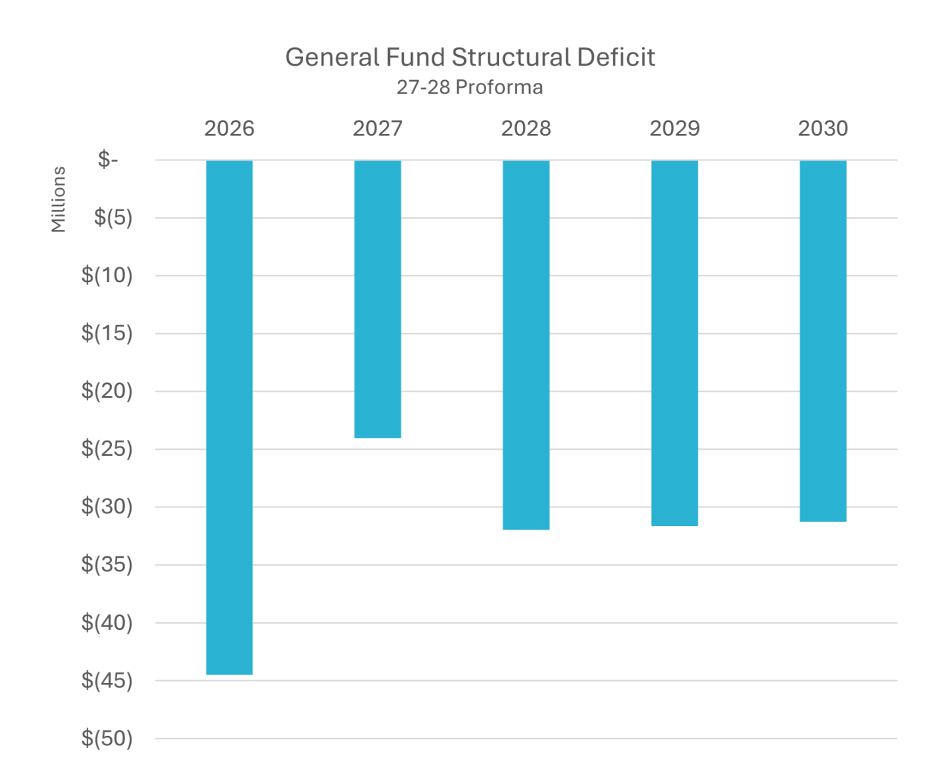
Yes, I want to support My MLTnews!Snohomish County government faces a $56 million shortfall for the 2027-2028 biennium. That’s just the start. The long-term outlook for the County’s operating budget (general fund) is nearly as dismal.
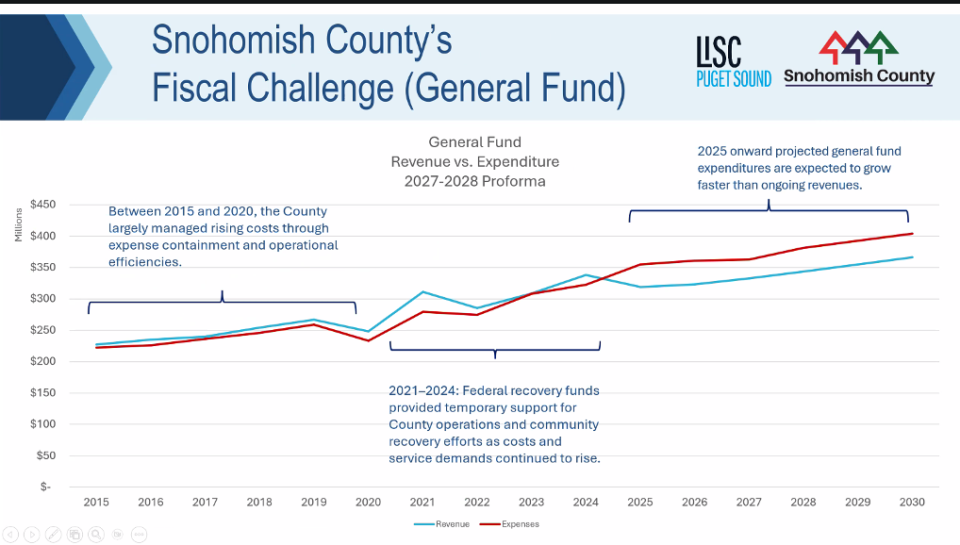
“[From] 2027 onward, we see a structural deficit between $25 and $30 million per year,” Snohomish County Chief Budget Officer Kara Main-Hester said during a July 10 Zoom meeting.
“It will just keep growing if we continue to do what we’ve done in Snohomish County,” she said. “So, we need to make some decisions now. Waiting is not an option.”
County staff are talking to a cross-section of county organizations and residents to guide the decision-making process. It will be a combination of cuts and tax increases because the budget gap is so large. County staff have already submitted proposals that total $22 million in cuts.
Local nonprofits and social services community partners with a focus on housing, workforce, behavioral health, higher education, County fair, immigrants and refugees, libraries and media were the sectors represented at the July 10 Zoom roundtable. Attendees included: Stilly Valley Health, Volunteers of America Western Washington, Cares of Washington, Center for Human Services NW, the Youth and Family Resource Center and Own Your Shine.
Main-Hester wanted perspective from the front lines of social services which support the county’s most vulnerable residents.
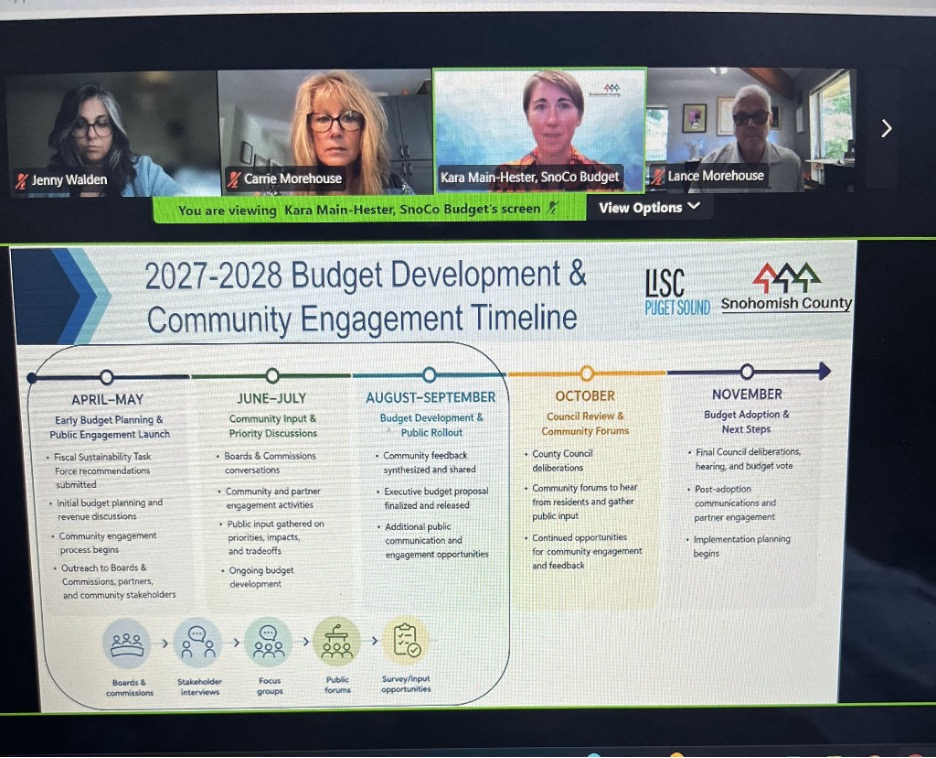
“We understand that every option we have carries real trade-offs, and we’re really trying to make some thoughtful decisions to preserve our essential County services,” Main-Hester said.
As a group, representatives of the services in the Zoom meeting cautioned against short-term cuts with lasting downstream impacts.
Hard decisions
The County has a list of potential fiscal impacts and shared those that would most impact this group and the people they serve.
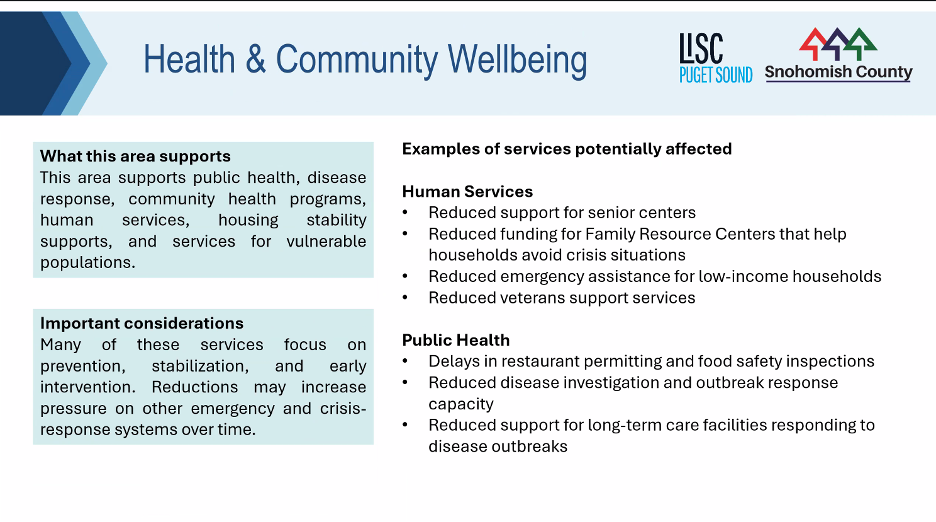
Main-Hester asked what values should be used for decision-making.
“Minimize cuts to the most vulnerable,” said Erika Coghill, director of finance, Stilly Valley Health.
“The greatest need may exist primarily in urban areas. However, practical reality serves the county as a whole, meaning rural areas cannot be overlooked entirely,” said Tanya Laskelle, CHS Northwest Associate executive director, speaking specifically of small communities in north and east Snohomish County.
“Are we centering on the well-being of every family to the extent we can? It’s a low bar we are trying to meet,” asked Stephanie Sarantos, co-director of the Well Being Community Center, Youth and Family Resource Center.
Main-Hester asked which programs the meeting participants’ clients relied on the most.
“Early childhood programs, after-school programs, mental health and substance abuse treatment,” Cares of Washington CEO Lars Nowack wrote in the Zoom chat.
Laskelle at CHS Northwest agreed, adding it’s important that “mental health services and substance use interventions are community-based.”
Other services on the list included: transportation, eviction prevention and move-in assistance, food, housing and education.
The group had their own cost-cutting ideas.
“Are there alternative state or private funds that also cover some of those health and well-being categories?” asked Aaron Olsen from Volunteers of America Western Washington.
“Getting input on the kinds of services that are only taken care of by the County or not supported by private or state funds [would be useful]. We would have a really hard time finding private dollars or state dollars for our agency,” added Olsen.
Another idea: Service organizations could contract directly with the state and eliminate the County as a pass-through for grants and other costs.
“Is it cheaper to send a crisis responder versus a law enforcement officer to some emergency calls?” one person asked. Main-Hester said more local governments are doing that.
Not the first feedback session
In November 2025, the County created a financial sustainability task force to get these conversations going. In 2026, County staff gathered facts and advice from dozens of similar listening sessions with business partners, stakeholders, nonprofits, boards and commissions and the public.
The “why” behind Snohomish County’s growing general fund deficit is the same as every local government.
- The population has increased, and demands for local services have increased.
- The cost to repair roads, bridges, and deliver services have increased.
- Inflation and labor costs have increased.
- State and federal funds have decreased.
- Property tax increases are limited to one percent a year.
Snohomish County is looking at:
- Spending reductions
- Operational changes
- New revenue options
- Strategic prioritization
- Long-term sustainability planning.
Snohomish County provides services like road repairs, park maintenance and the County sheriff for all residents of unincorporated Snohomish County. It also supplies services for cities within Snohomish County. These include the jail, the courts and public health. Snohomish County gets about 11 cents from every property tax dollar. About 4 cents of that goes to roads and bridges.
The County is funded by other taxes and grants, but those funds are earmarked for certain programs and projects and cannot be shared with the general fund.
My Neighborhood News Group wrote about this ‘color of money’ concept in the Government and You series n late 2025.
What’s next
In August, County staff will synthesize all the feedback, make recommendations and turn it all over to Snohomish County Executive Dave Somers. By Sept. 4, the County Council will receive the county executive’s budget, then hold more public hearings and forums. The public is encouraged to attend these discussions.
A final balanced budget must be delivered by the end of the year.
Snohomish County’s entire budget presentation can be found here.
You can read the entire “Government and You” series – exploring how local government works and why we are in this financial fix – starting with Part 1 here.


Real first and last names — as well as city of residence — are required for all commenters.
This is so we can verify your identity before approving your comment.
By commenting here you agree to abide by our Code of Conduct. Please read our code at the bottom of this page before commenting.