
Will you chip in to support our nonprofit newsroom with a donation today?
Yes, I want to support My MLTnews!
Key takeaways:
- The South County Fire Board reviewed a new redistricting proposal — Option 5 — that keeps Edmonds in a single voting district.
- The Board also will delay a redistricting vote to give residents more time to weigh in.
- Commissioner Micha Rowland announced his resignation at the end of July.
- The Board also received a cautious preliminary revenue forecast for 2027.
The South County Fire Regional Fire Authority Board of Commissioners on Tuesday reviewed a new alternative redistricting proposal that would keep all of Edmonds in a single voting district. Commissioners also heard a cautious preliminary revenue forecast for 2027 that leans heavily on modest property tax growth and reduced dependence on federal transport reimbursements.
Other highlights included delaying the redistricting vote beyond the Board’s July 21 target date and a resignation announcement from Commissioner Micah Rowland.
Option 5 keeps Edmonds whole, adds potential future questions
Commissioners spent a significant portion of the meeting reviewing Option 5, the latest option in the ongoing commissioner redistricting process.
Board Chair Jim Kenny said the new map responds to earlier board direction to ensure Edmonds remains intact within a single commissioner district while retaining the current slate of commissioners.
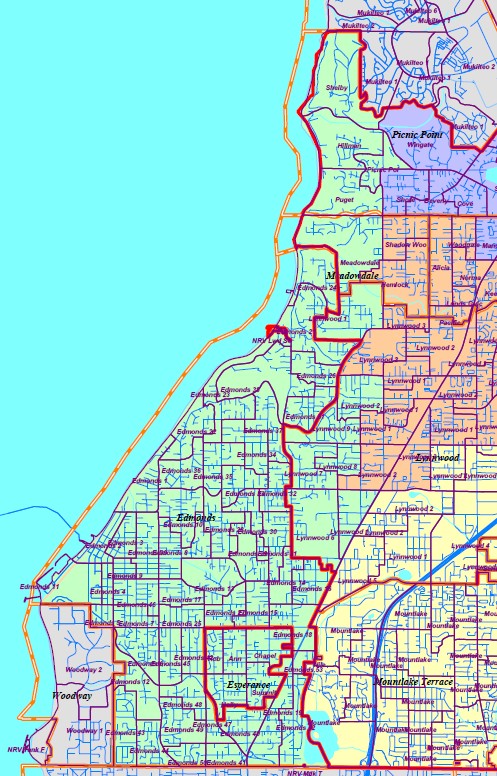
This cropped section of the latest proposal, above, shows Edmonds all in a single district along with parts of Lynnwood. See the complete Option 5 map and related details here. See the other four proposals on SCF’s redistricting page here.
Option 5 “elongates District Two to take in all of Edmonds and adjusts District Four and District Three so that the populations are roughly equivalent [as required by state law],” Kenny explained. He also noted the proposed District 2 boundaries allow Commissioner Michael Fearnehough to retain his seat on the board.
Commissioner Rowland urged colleagues to think beyond current boundaries and consider what future annexations — such as Mukilteo or even Everett — could mean for long-term district lines and board structure.
Rowland noted that South County Fire currently has five districted and two at-large commissioners, with an ethos that “all the commissioners represent the entirety of the RFA.”
He warned that if additional cities join the authority, “drawing the lines at that point is going to get much more complicated if we stick with five commissioners that are districted and two that are at large.”
Rowland also questioned whether at-large seats are still appropriate.
“I don’t think that they’re a necessity anymore, and I think they create two classes of commissioners: one that have privileges that the others don’t,” he said, clarifying that at-large members “can move wherever they want in the district,” while districted commissioners are geographically constrained to live in the district they represent.
Rowland used this opportunity to announce his imminent resignation from the Board due to an upcoming move.
“I will be stepping down as a commissioner effective at the end of the month. I have bought a property outside of the district, and so I will no longer be qualified to serve in my capacity,” Rowland said.
An 18-year resident of Snohomish County, Rowland was first appointed to represent District Four on the Board of Commissioners in 2022. He was subsequently elected for a six-year term in 2023.
Commissioner David Chan, who had opposed an earlier redistricting option, said he is now prepared to support Option 5, calling the differences “not that huge,” but cautioned against continual post-publication changes.
“From now on, I really do not like after you publish and send it out, and then you change it when people are already accepting that,” Chan said.
Kenny stressed that given these and other outstanding uncertainties, no vote is imminent and that more time is needed for public input, especially on Option 5. The Board had previously targeted July 21 to vote on and choose their preferred redistricting option, but Kenny opted to tap the brakes and take additional time.
“We should probably give it a little bit more opportunity to take in any comment about Option 5 or other options that may come up,” he said, adding that he is “not looking to push that forward to a vote next week.” However, he stopped short of offering a new target date.
According to SCF Communications Director Christie Veley, the next opportunity to decide on a redistricting plan would be at the Board’s Aug. 5 regular meeting. “I think it’s fair to say that a vote on the matter is at least three weeks away,” she said.
Edmonds Civic Roundtable planned FAQ
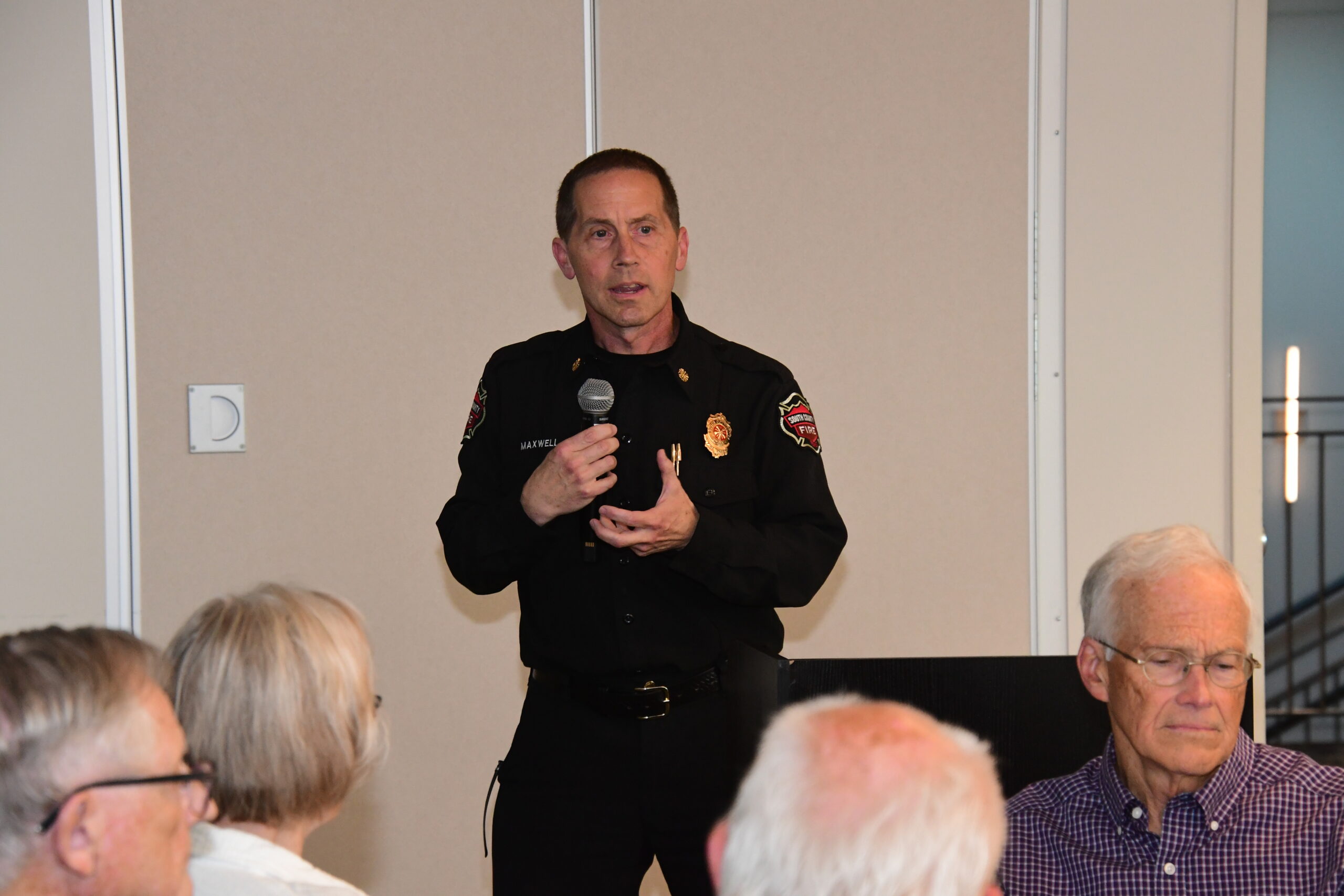
Fire Chief Shaughn Maxwell and Communications Director Christie Veley briefed the board on their recent bond and capital facilities presentation to the Edmonds Civic Roundtable (ECR), which drew about 60 people (read our coverage of that event here).
Maxwell described the setting as “a beautiful” venue and praised the turnout.
“We had a presentation overviewing our CFP, but also we focused on the Edmonds stations. We crafted it to meet their community,” Maxwell said, adding that table discussions afterward generated more questions than could be answered onsite.
Veley said that ECR organizers have asked SCF to respond in writing to unanswered questions.
“We are working to put together some information that answers those questions to submit to the organizers, and they will distribute it to the participants as they see fit,” she told the board.
Commissioner Chan said his conversations with attendees suggested generally favorable reactions.
Chan urged the district to turn the most common questions into an online FAQ resource.
Veley replied, “Yes, that is exactly what we’re planning to do.”
Bond explanatory statement due Aug. 4
Veley then walked commissioners through the latest draft of the 200-word bond explanatory statement that will appear with ballot language in the November general election.
“This will accompany the ballot language that people will see within their ballots in November,” she said, urging commissioners to review it closely. “We have been working on this in tandem with our bond council, Deanna Gregory, and I think we’ve been able to fit a lot of information in that 200 words,” she added.
The statement must be filed with Snohomish County by Aug. 4 along with the bond resolution and appointments to the pro and con committees. After that deadline, “we will not be able to make any further changes,” Veley said.
Veley said Gregory will attend next week’s meeting to answer questions, and while no formal resolution is required on the explanatory statement, staff want explicit board approval.
2027 revenue forecast: modest growth, less dependence on federal program
Chief Financial Officer Chris Bothwell delivered the first presentation of the 2027 preliminary revenue forecast, describing it as a “status quo” outlook that does not yet include long-range “roadmap” funding strategies or budget-balancing measures. See Bothwell’s PowerPoint presentation to the Board here.
Overall revenues are projected to rise by about 1.2%, or roughly $1.5 million.
“Most of our revenues are expected to increase modestly,” Bothwell said, noting that the projection already assumes a significant step-down in one key federal program, Ground Emergency Medical Transport (GEMT).
For existing property owners, the forecast assumes only a 1% increase stemming from the statutory allowed levy growth, with an additional 1% tied to new construction — the district’s historical average.
Bothwell explained that property tax remains the authority’s backbone, accounting for “nearly three quarters” of total revenue at just under $100 million in 2027. The estimate includes the prior-year fire and EMS levies plus the 1% statutory increase and the 1% new-construction factor.
Bothwell assured commissioners that a modest dip in assessed values, such as the roughly 1% decrease Snohomish County has signaled, would not immediately threaten the fire authority’s budget.
“Our levies will not be affected by a modest drop in assessed value,” he said, explaining that because Washington’s system is budget-based, “unless we’re bumping up against the statutory max… we wouldn’t be affected by a decrease by a small decrease in assessed value.”
The benefit charge — a separate fee based on a property’s risk and use — is forecast at about $15 million, or 11% of total revenues, with a 2% annual increase to mirror prior practice. Under state law, the RFA could place up to 60% of its operating budget on the benefit charge. Currently it is at 11%.
“We do have $63 million of capacity in the benefit charge,” Bothwell said.
The board continues to wean its operations off reliance on Ground Emergency Medical Transport (GEMT), a federal Medicaid reimbursement program that has been both lucrative and volatile. GEMT currently accounts for about 6% of revenues — around $7.5 million in the 2027 forecast — but that number is being intentionally cut back.
Bothwell said staff are reducing the GEMT line by 40% from a three-year average to prepare for changes in how capital costs are treated, uncertainty in Medicaid eligibility, and pending federal reimbursement reforms that “everybody says are going to be pretty dramatic.”
The RFA recently received its 2026 GEMT payment of $12.2 million, well above the $8.8 million it had budgeted as part of the step-down strategy, creating one-time resources for other needs.
Ambulance transport charges, now about 5% of total revenue at $7.1 million, are forecast using a three-year average plus an inflation factor. After a large one-time rate adjustment last year, a 2025 policy now requires automatic annual rate updates tied to inflation, to be implemented administratively.
Commissioner Rowland pressed for a clearer public-facing explanation of how far the district could ride out a significant drop in property values before maxing out its levy rates and needing to lean more heavily on the benefit charge.
“Knowing how close our head is to the ceiling gives us the ability to talk to taxpayers,” Rowland said, suggesting comparisons to the 2008 housing downturn.
Bothwell pointed to the board’s existing funding guiding principles, which cap levies at 80% of their statutory maximum.
“Our funding guiding principle leaves us with a 20% buffer effectively for any sort of drop that would happen,” he said, adding he will bring more detailed analysis back as budget talks continue.
Next week’s meeting will include additional budget briefings on economic data, expenditure forecasts and a “roadmap accountability” check comparing prior long-range projections to current conditions — but not the anticipated decision on redistricting.
As South County Fire edges toward a fall bond vote and a new political map, commissioners face a steep challenge: explaining a complex redistricting process alongside a $420 million bond issue to residents who want to know what it will mean for their tax bill, their level of service, and their ability to be represented on the board and be part of shaping its decisions.


Real first and last names — as well as city of residence — are required for all commenters.
This is so we can verify your identity before approving your comment.
By commenting here you agree to abide by our Code of Conduct. Please read our code at the bottom of this page before commenting.