
Will you chip in to support our nonprofit newsroom with a donation today?
Yes, I want to support My MLTnews!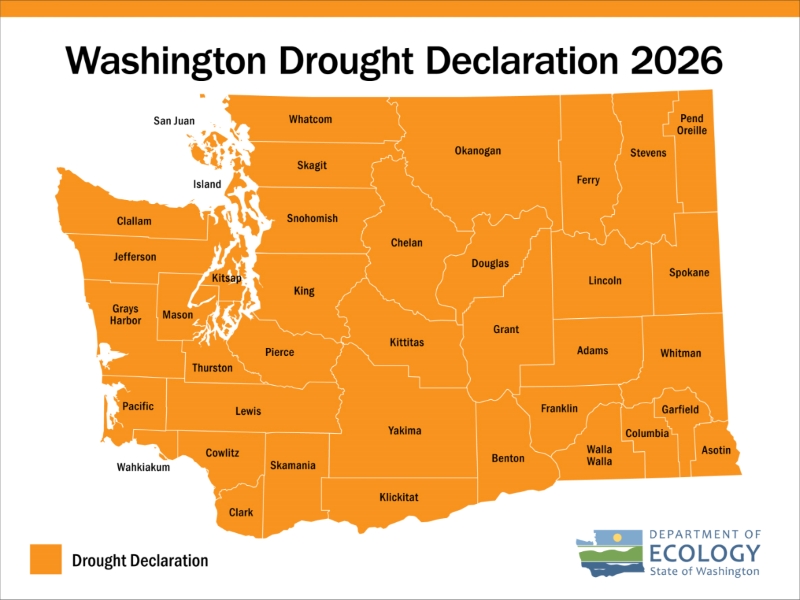
Once again, the Water Supply Availability Committee, a group of state and federal water supply experts, has brought news of the ongoing drought. According to an announcement from the Washington State Department of Ecology, it’s not over, and with the arrival of El Niño conditions, it likely won’t be over any time soon. The group meets monthly to advise Ecology on the current state of Washington’s water supply. The picture they paint can be characterized by two words — warm and dry.
Statewide, the average precipitation for the water year so far (October through May) has been near normal. But don’t be fooled, Ecology warns. December’s heavy rains inflated the average. Precipitation since January has been below normal. May was dry with about 66% of normal precipitation. It was also the seventh warmest May on record. The water year so far has been the third warmest on record.
June started a little wetter and cooler than normal, though it quickly got warm and dry.
All that heat resulted in a weak snowpack in the winter and an early melt-off in spring and early summer.
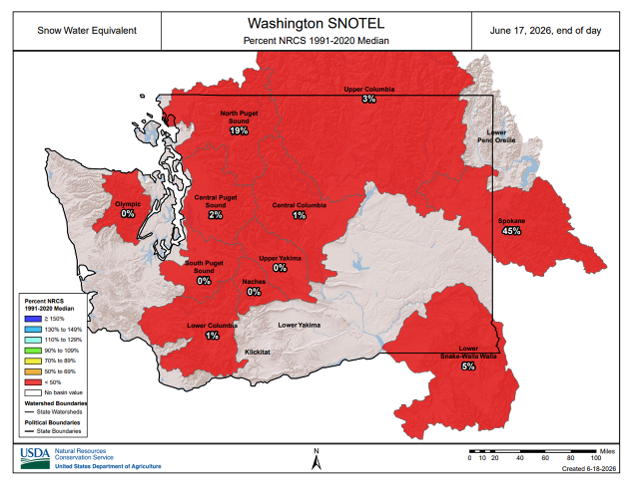
Yes, this is summer and snow typically melts in the summer. But the state is low on snow even for this time of year.
The early snowmelt resulted in higher-than-normal streamflows in March. Now that the snow is nearly gone (about a month earlier than normal in some basins), the Northwest River Forecast Service predicts lower-than-normal streamflows through September in all regions of the state.
The Washington State Climate Office also predicts a warmer and drier than normal summer. Winter might also be problematic, with long-term forecasts predicting a warm and dry winter, possibly exacerbated by El Niño conditions.
El Niño is here
The bad news keeps coming. As of June 11, we are in El Niño conditions, Ecology said.
El Niño is a climate pattern that occurs when trade winds in the Pacific Ocean weaken or reverse direction, pushing warmer water toward the Americas. This results in changes to the atmosphere and the weather.
El Niño doesn’t play a huge role summer weather, but in the Pacific Northwest it can result in warmer, drier winters.
According to Deputy State Climatologist Karin Bumbaco, there’s a 63% chance this year’s El Niño will likely be classified as a “very strong El Niño” by winter. A very strong El Niño occurs when sea surface temperatures in the central and eastern equatorial Pacific Ocean rise by at least 2 degrees Celsius (3.6 F) above normal. The effects of a very strong El Niño tend to be a little more extreme than those of the weak and normal varieties.
This doesn’t necessarily spell doom for hopes of a snowy winter. While it is true El Niño generally means warmer winter and poor snowpack, there is still uncertainty about what El Niño will mean for winter weather next year.
In recent history, Washington has experienced three very strong El Niño events: 2016, 1998 and 1984. All three of those years had normal to above-normal snowpack.
“When you look at those three very strong El Niño events, our snowpack actually fared pretty well in Washington,” Bumbaco said. “Is that a coincidence? It might be, so I wouldn’t hang my hat too much on it. So far those very strong El Niño events have behaved a little bit differently in Washington compared to our usual pattern that we see with El Niño events.”
Washington’s Water Future
Washington has experienced drought seven of the last 10 years. Communities across the state are facing water supply challenges. In May, the Ecology Department — along with Gov. Bob Ferguson — announced Washington’s Water Future, a statewide initiative designed to help prepare for the state’s growing water challenges. Ecology invites you to visit the new website to register for upcoming meetings for the public and for people that represent different water user sectors.


Real first and last names — as well as city of residence — are required for all commenters.
This is so we can verify your identity before approving your comment.
By commenting here you agree to abide by our Code of Conduct. Please read our code at the bottom of this page before commenting.