
Will you chip in to support our nonprofit newsroom with a donation today?
Yes, I want to support My MLTnews!
You can read Part 1 of the Sept. 11 City Council meeting here.
Key takeaways
- City Council hears a summary of six aging public buildings with infrastructures that have been operating beyond their industry lifespans
- It would cost about $7 million to repair or replace the parts to all buildings
- The Diversity, Equity and Inclusion Commission provided an update on Mountlake Terrace’s demographics, along with barriers and accessibility issues
Mountlake Terrace City Council during its Thursday work session heard a presentation about the condition of the city’s facilities, including City Hall, Recreation Pavilion, library, the city operations facility, the Mickey Corso Clubhouse and the police station.
Recreation and Parks Director Jeff Betz and Facilities Supervisor Floyd Garrigues presented the assessment, which included facilities that were found to be at or beyond their expected service life. The assessment recommended replacement in many cases, but repair or remodeling may be possible if cost-effective.
Highlighted concerns include HVAC systems, roofing, fire and life safety equipment, plumbing deficiencies, electrical capacity and general architectural deterioration such as leaks, cracked pavement and moss growth.
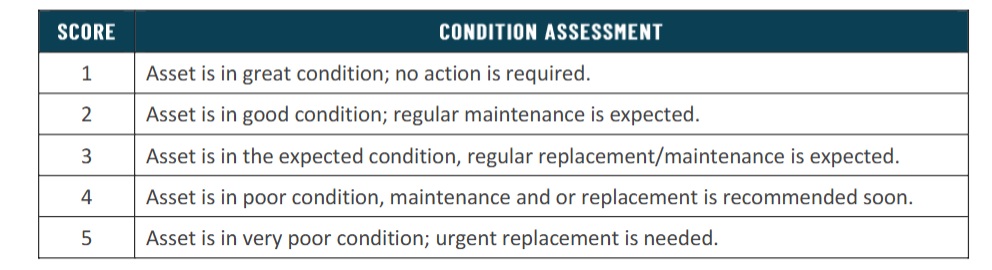
A total of 80 facility assets were assessed, including lights, fire sprinklers and roofing. Each asset was given a score of 1 to 5, with 1 being “great condition” and 5 being “very poor condition.” The following buildings are ranked as follows:
City Hall: 1.02
Library: 3.64
Recreation Pavilion: 3.55
Operations facility: 3.69
Mickey Corso Clubhouse: 3.67
Police station: 2.56
The assessment states that it would cost $2.4 million to repair the Recreation Pavilion, $1.2 million for the library and $1.4 million for the police station, if such repairs were made in the next five years. The total cost of all six buildings assessed is about $7 million.
Betz pointed out that some of the equipment is still running decades beyond their industry lifespan. For example, the Pavilion’s return fan in the HVAC system is 26 years old, and one of the air conditioning units is 36 years old.
The assessment states that the estimated costs are based on visual inspections, which assume replacing assets with like-for-like systems at the end of their useful life. However, the assessment does not account for potential technology upgrades, changing facility demands, funding alternatives or evolving energy regulations.
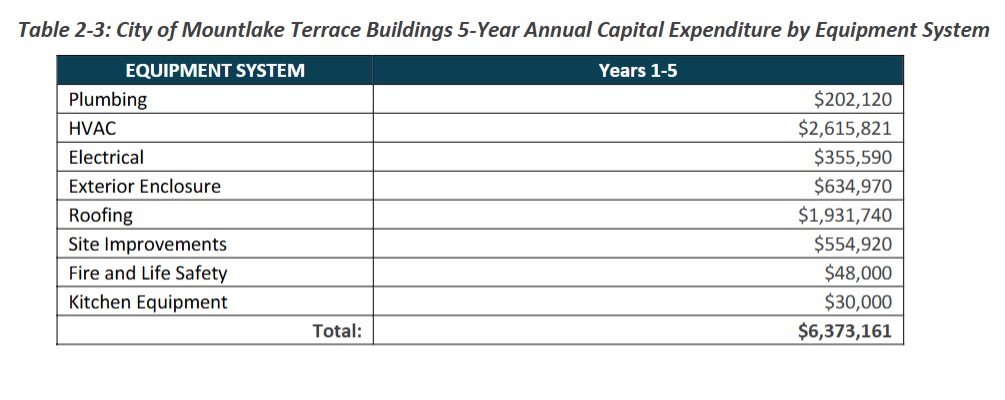
On average, the remaining life of the assessed systems is about 16.3 years. As equipment nears or exceeds its expected useful life, the risk of failure rises significantly — making planned replacements more cost-effective than emergency repairs, according to the assessment.
Betz suggested several things the city could do:
- Find and set up a computer program to help track city buildings and their repairs.
- Look for ways to get state and federal funding to help pay for big repairs
- Plan and set aside funding to fix and replace assets
- Change the way the city keeps track of its buildings and equipment by using bar codes and new software
Councilmember Laura Sonmore asked if the $7 million cost was included in the city’s 2025-26 budget.
“We have operating costs built into our budget that handles the smaller elements, but to handle that large dollar amount, that’s not possible with our operating budget,” Betz said. “We’ve had some large capital improvement projects that we’ve put forward, like the police station. That is one of the things that will knock off [$1.4 million from] that $7 million.”
“We keep things running. They’re old. We get parts. We pick some that we will keep them running as long as we can,” Garrigues said. “With a program like this that you guys are talking about, we’ll be able to track work orders when they’re finished. We’ll be able to even inventory of critical parts.”
Mountlake Terrace Mayor Kyoko Matsumoto Wright said during her time on the City Council, the city has faced ups and downs, such as the 2008 recession and the pandemic, which made planning difficult.
“You just can’t predict the future,” she said. “If you want a Pavilion, you have to do something about it. This is an eye-opener. We just can’t keep our heads in the sand.”
Details of the audit can be viewed on the city’s website.
~~~~
In other business, city staff presented the Mountlake Terrace’s Diversity, Equity and Inclusion (DEI) Strategic Plan. Led by Deputy City Manager Carolyn Hope, the staff outlined several action steps to reduce barriers to civic participation, provide multilingual and accessible information, promote financial aid programs, review policies for equity impacts, and tailor programs to community demographics. An update is planned for 2027.
DEIC member Vonita Francisco highlighted several changes to Mountlake Terrace’s demographics:
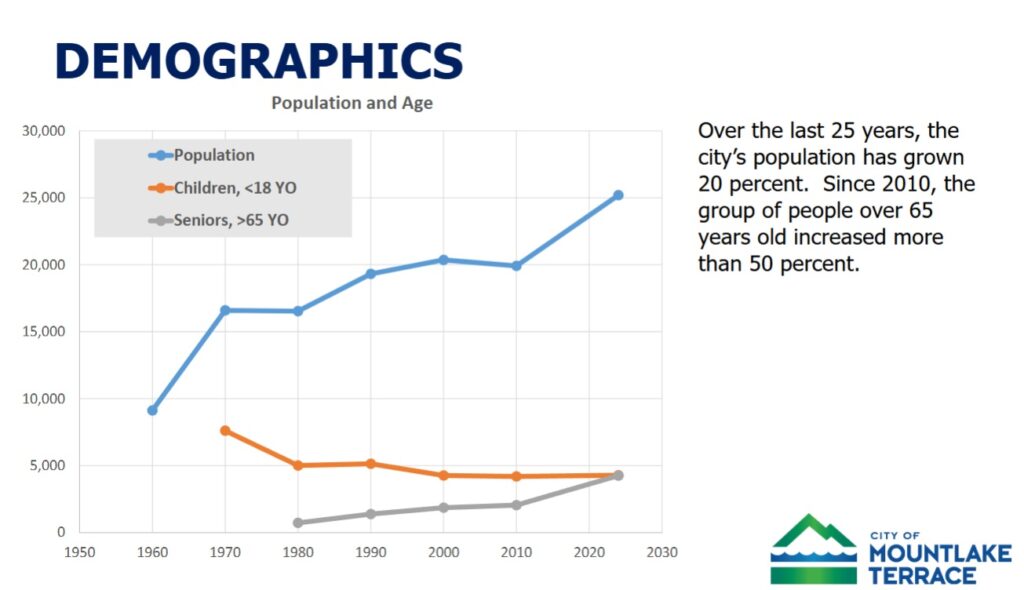
- The city’s population has grown by 20% since 2010.
- The foreign-born population has risen by 61% since 1990.
- The proportion of residents aged 65 and older has increased by more than 50%, while the number of children has slightly decreased.
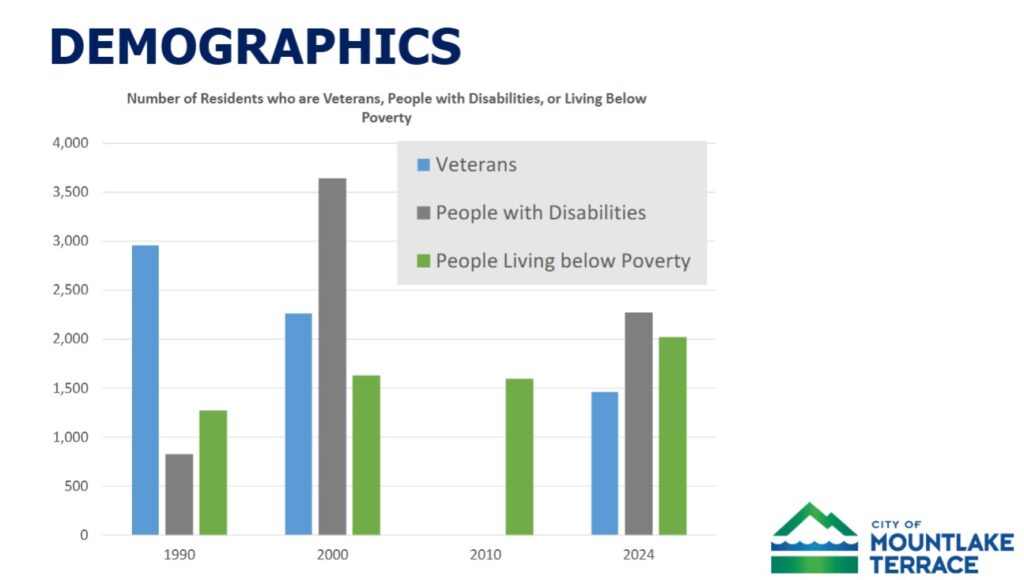
- The number of veterans decreased by 50% between 1990 and 2024.
- The number of people living in poverty has increased by 37% since 1990.
- About 24% of residents now speak a language other than English at home, and around 6% have limited English proficiency.
- Educational attainment has improved, with a 7% increase in residents with a high school degree or higher, and a 23% increase in those with a bachelor’s degree or higher since 1980.
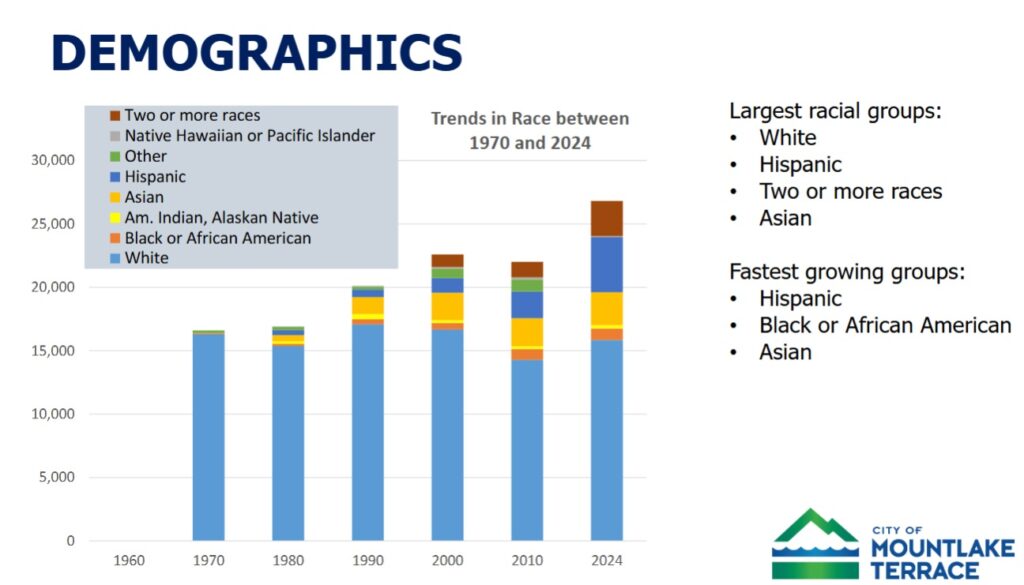
- Racial diversity has increased: White/Caucasian make up 39%, Hispanics are17% (the fastest-growing group), people of two or more races are 11%) and Asians are10%, the third fastest-growing group).
Based on a survey DEIC conducted, Hope reported that residents tend to view Mountlake Terrace as inclusive, welcoming, a safe place to live and accepting people with diverse backgrounds.
However, the survey identified several barriers, such as:
- Physical barriers to accessing places and buildings.
- Lack of access to computers, limiting participation in online meetings and engagement.
- Need for interpretation services at meetings and events.
- Inability to access city services during normal working hours.
- Demand for affordable housing and temporary shelters.
- Infrastructure improvements needed for safer walking, biking and transit.
Hope said that the actionable items do not require funding, but there may be funding requests in the next budget cycle.
Councilmember William Paige said that many people “are afraid of City Hall.”
“So many people are afraid to talk to the Council or come to the front desk,” he said. “There are people who won’t come into this building. They’ll stop at the [door] and drop their bills.”
Paige said he supports Mayor Pro Tem Bryan Wahl’s idea about having “cultural pop-up events” that allow residents from different cultures to understand each other better.
Details on the demographics data and actionable items can be viewed on the city agenda.


An easy way to save a bunch of money to cancel the flock contract. It will also increase equity in the city by not using mass surveillance on law binding residence.
Take that money in our water bills that you have been diverting away from promised pipeline upgrades.