
Will you chip in to support our nonprofit newsroom with a donation today?
Yes, I want to support My MLTnews!
Key takeaways:
- Snohomish County Council passes ordinance that prohibits housing funding from prioritizing Housing First projects and deprioritizing Treatment First projects
- Council will rework an ordinance that would have created a dedicated fund for behavioral health facilities
- Council passed an ordinance that would make it a gross misdemeanor to permit a child or dependent person to have contact with a controlled substance
After three-and-a-half hours, the Snohomish County Council during a Wednesday public hearing passed in a 3-2 vote an ordinance that would create a new section on the county code regarding housing funding.
Ordinance 26-019 would prohibit housing funding from requiring, incentivizing or prioritizing subrecipients or contractors that offer temporary or permanent housing that have little to no entry or participation requirements.
The ordinance would also forbid housing funding from prohibiting, discouraging or giving lower priority to those that offer housing with requirements for sobriety, treatment, counseling or illicit drug testing.
County staff said the County already does not incentivize or discourage certain housing project proposals, and that the County would only do so if the state or federal government requires it.
“These are open dollars with a competitive process to award the project that has the best outcomes and the highest-scoring metric, so what’s the problem that we’re trying to solve if we’re not currently rewarding Housing First?” Council Chair Megan Dunn asked.
The National Alliance to End Homelessness (NAEH) defines Housing First as a homeless assistance approach that prioritizes providing housing without requiring people to address all of their problems, including behavioral health, before getting housed.
Housing First does not mean housing only, according to the NAEH. There also needs to be supportive services, such as behavioral health services and substance use disorder treatment. Both need to be available and accessible.
Councilmember Nate Nehring, the main sponsor of the ordinance, said even if the County is not currently prioritizing one type of housing over the other, the ordinance aims to codify current practice for County-specific funding.

“I think … enacting a policy in place on where we stand, making sure that we’re open to providers that both use the Housing First model but also use more of a recovery-oriented or accountability-oriented model … is a good thing,” Nehring said.
Nehring, Councilmember Jared Mead and Council Vice Chair Sam Low voted to support the ordinance. Dunn and Councilmember Strom Peterson voted against.
Nehring said housing funding, in his perspective, is generally “tilted in one direction.” The ordinance provides an equal playing field, he said.
“If we look at most of the dollars that are used that are attached with state or federal grant funding … those are required, in large part, to have some of those strings attached, which may include Housing First or low barriers,” Nehring said.
Peterson said the state government does not only fund Housing First projects, and that the state has funded different types of projects. The Trump administration, he said, is moving away from the Housing First model and is changing the funding stacks for those types of projects, which is “troubling.”
“I haven’t seen a study yet that has shown the Housing First model is not broadly more effective than others,” Peterson said. “This does not mean that every type of housing should be Housing First, but the Housing First model is broadly the most effective model.”
Peterson said local housing providers like the Housing Authority of Snohomish County (HASCO) have “real concerns” that the ordinance will cost them more money and staff time to fill out more paperwork, among other things.
“I trust when they come to me and say because of the vagueness in this ordinance, that it’s going to be harder for us to do the work,” Peterson said. “I think every dollar is critical in this space.”
Nehring replied: “If it doesn’t change what we’re doing, then it shouldn’t cost more money. We’ve heard very clearly from [Snohomish County] Human Services … that this would not add staff time on their end. I think the idea that on the nonprofit side it would add staff time is just, frankly, incorrect.”
Nehring said the opposite – prioritizing a certain type of housing – would require more staff time and potentially more resources. The ordinance as written does not have any restrictions in place, he said, and makes things as flexible as possible.
Dunn said the ordinance has potential unintended consequences, and that it creates a “false binary” between housing stability and accountability.
“This ordinance isn’t offering results or solutions, and it’s relying on misinformation, so I am not comfortable supporting it,” Dunn said.
Mead said not everyone has the same housing needs. He also shared his personal experience, coming from a family that has struggled with addiction.
Mead’s mom is still here because of rehab, detox and doing the work to get sober. He said his brother is currently on Suboxone and is still trying to get sober.
Mead’s biological father left when he was a child. He said after he was 10 years old, he did not see his father for 21 years until a few years ago when he found him in a homeless encampment in southwest Washington.
Mead spent hours with his father, showing photos of his grandchildren. He said they cried together, shared stories and made plans to reconnect later in the year to meet Mead’s wife and children.
“Three months later I got a call from the King County Coroner’s Office, asking me if I wanted to come pick up his body. He had died of a fentanyl overdose. This was three years ago in a tent by himself in the woods,” Mead said.
Everyone’s story with addiction is different, Mead said. Housing First has shown results and helped people get off the streets and become productive members of society. There are also stories, he said, where Housing First did not work because people were not willing to access those types of services.
“Data points don’t tell the full story,” Mead said. “We should have a spectrum of services … with a policy like this, that’s all that is codifying.”
About 40 residents from across Snohomish County took turns speaking during the public testimony period, commenting not only on Ordinance 26-019, but also two other Nehring-sponsored ordinances.
The Council unanimously voted to refer Ordinance 26-018 back to committee. If passed as currently written, it would have amended the Affordable Housing and Behavioral Health (AHBH) Sales Tax by creating a dedicated fund that 20% of the revenue would go into. The funds would be used for purchasing, constructing or acquiring land for behavioral health facilities.
The Council also unanimously approved Ordinance 26-016, making it a gross misdemeanor for someone to knowingly or recklessly permit a child or dependent person to ingest, inhale or have contact with a controlled substance (unless it is in line with a prescription issued to them).
In an email to the County Council, Edmonds resident Erik Nelson wrote: “I’ve been sober for 23 years and I am active on an ongoing basis in the recovery community of Snohomish County. Giving someone a bed, without requiring them to commit to living clean and sober, is simply enabling addicts and alcoholics to have a more comfortable place to use and rest. We are not bad people, we are sick people who need help. That help does not come first in the form of a roof and a pillow. It needs to come first in the form of the opportunity to access treatment. Each of us who are living clean and sober had to hit our bottom. That bottom is different for each individual, but what is consistent after hitting your bottom is a willingness. A willingness to live differently, to acknowledge our addiction and to finally be willing to accept help.”

Edmonds resident Tamara Nelson said Housing First does not work and recalled a time when she and her sister wanted to put a family member into a hotel after they had been living in a car for years.
“It was my husband that said, ‘No, you cannot make her comfortable in her addiction, she has to have consequences,’” Nelson said. “It was incarceration that saved her life. She is now a productive member of society.”
Mountlake Terrace resident Steve Mosman said compassion is not allowing someone to continue in destructive behavior, not only for their own life, but for the lives of others as well.
“Housing First policies have continued to show that this method is not producing the desired results of lowering drug addiction rates, reducing the number of unhoused people or lowering the associated crime that allows the increasing use of drugs,” Mosman said.

In an email to the County Council, the Snohomish County Partnership to End Homelessness board wrote: “Housing stability is frequently the prerequisite that allows individuals to meaningfully engage in treatment, employment, recovery, medical care, and long-term stabilization. Conversely, treatment and recovery supports are often essential to maintaining housing stability. Effective systems therefore integrate housing, services, behavioral healthcare, and accountability mechanisms together rather than treating them as competing philosophies.”
Mary Anne Dillon, an Edmonds resident who has worked as a homeless housing and human services professional for almost 30 years, said Ordinance 26-019 solves a problem that does not exist.
“There is no county policy that either prioritizes low-barrier programs or deprioritizes programs that require sobriety or participation in substance abuse treatment,” Dillon said.
Dillon, who is also the vice president of programs for YWCA Seattle | King | Snohomish, added that housing providers only follow the Housing First approach when the federal government mandates it. The language in the ordinance is “overly vague” and adds red tape.
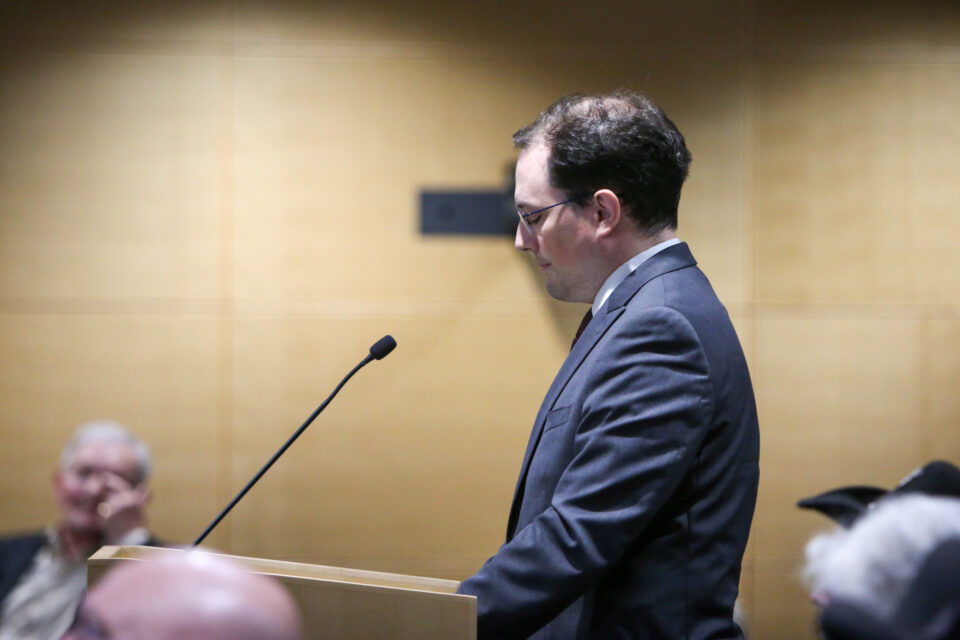
Chris Collier, HASCO’s director of government relations, said Ordinance 26-019 hinges on concepts, such as “minimal entry requirements” and “minimal participation requirements,” that are not clearly defined in Snohomish County Code.
“Someone will have to define these things, and so applicants will then worry if they meet the subjective definition, their funders will worry too, and projects will be put at risk,” Collier said. “If adopted as written, a slow process will slow further.”
Angelica Relente is a Murrow News Fellow covering housing and related issues in South Snohomish County for the My Neighborhood News Group. Contact her at [email protected].


Real first and last names — as well as city of residence — are required for all commenters.
This is so we can verify your identity before approving your comment.
By commenting here you agree to abide by our Code of Conduct. Please read our code at the bottom of this page before commenting.