
Will you chip in to support our nonprofit newsroom with a donation today?
Yes, I want to support My MLTnews!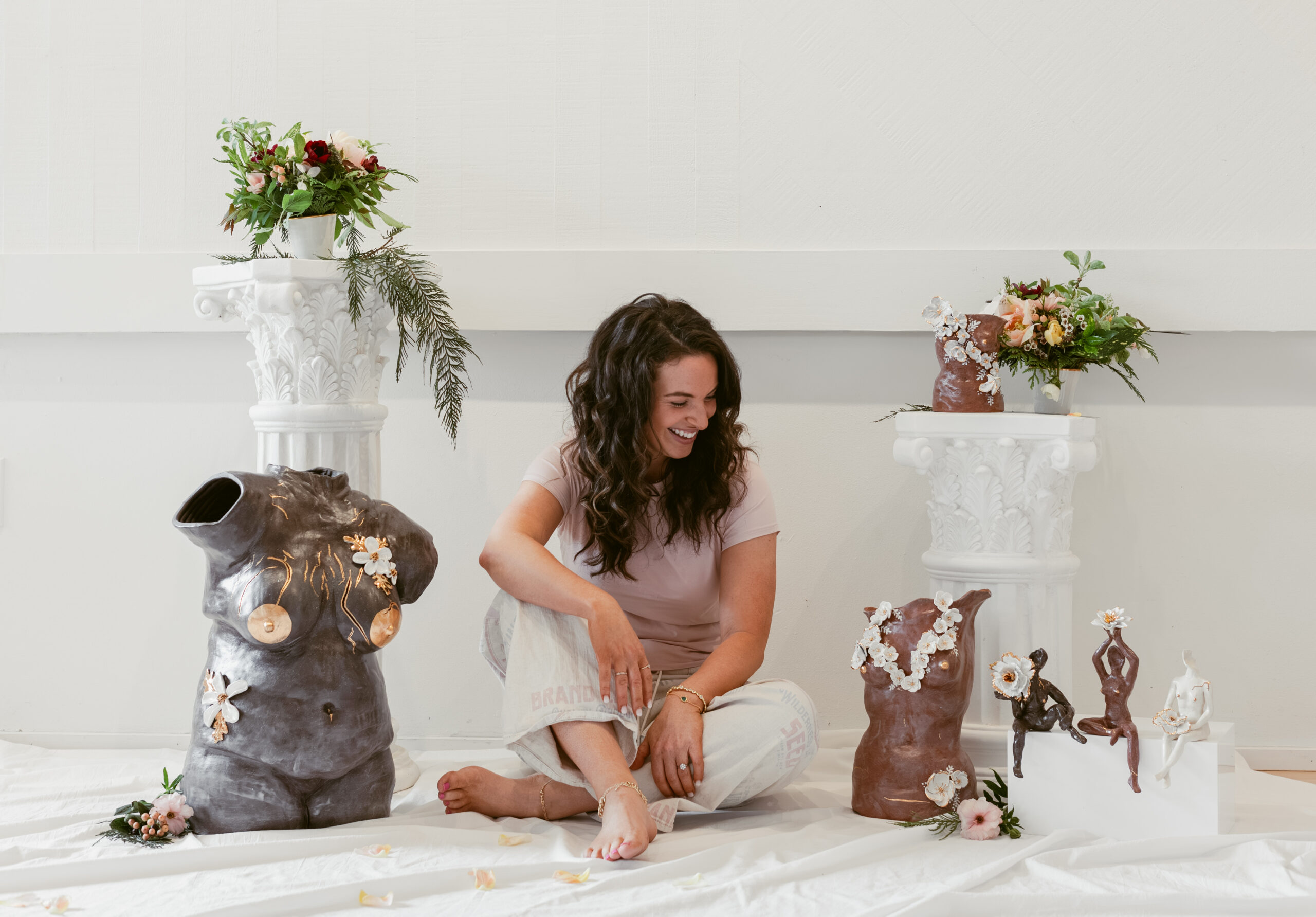
The first thing I noticed when entering Lynnwood potter Eleni Duffy’s garage studio was the flowers.
Bouquets from the recent private reception at Sunlight Gallery + Studio filled the space, echoing several glazed vases embellished with sculpted flowers arranged like corsages, and creating a visual thread between Duffy’s functional work and her newest sculptural collection, Strength to Bloom.
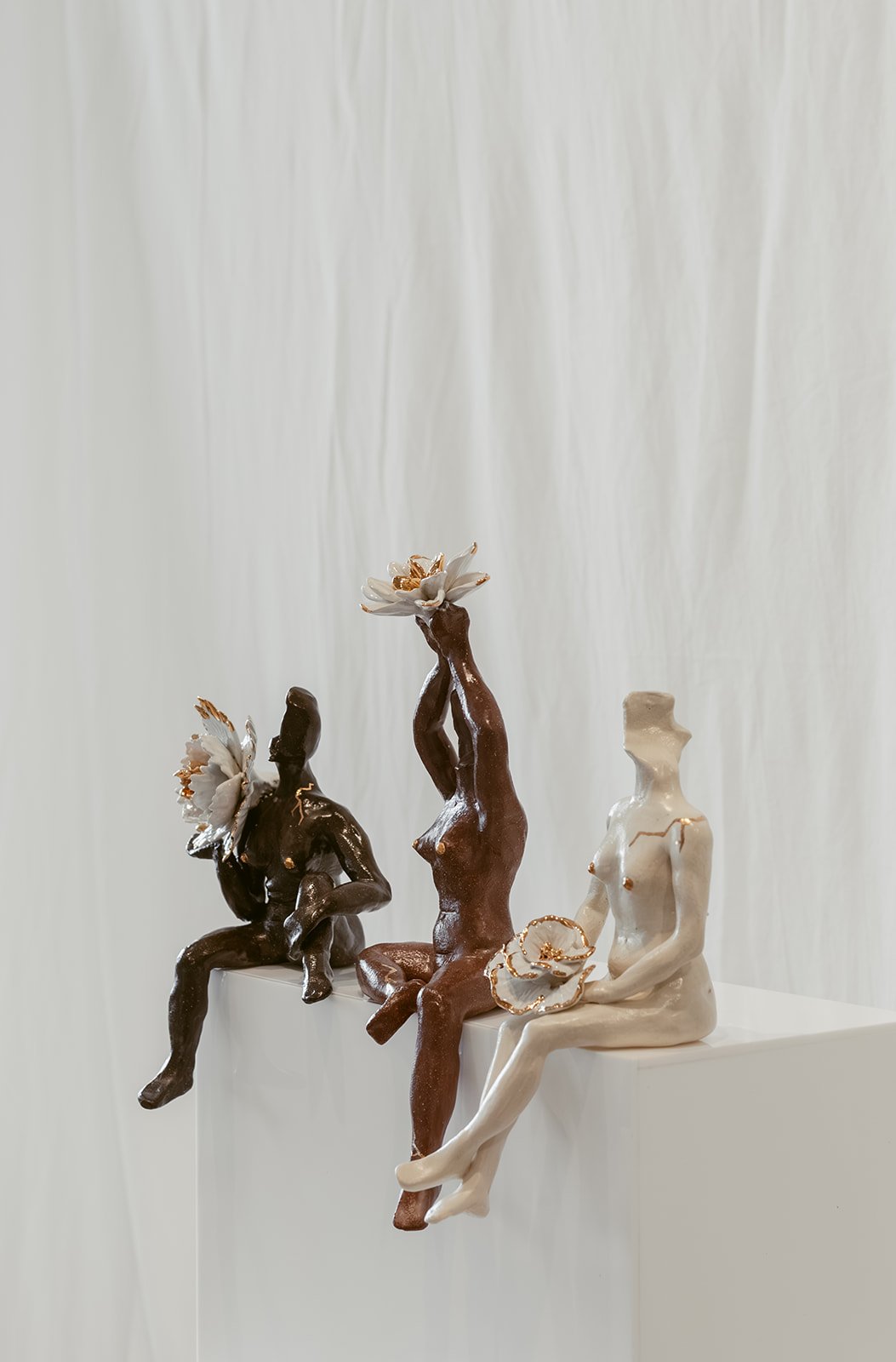
Festooned with white and gold flowers, Duffy’s new seven-piece collection of figurative work was displayed on Corinthian columns, evoking ancient goddess sculptures such as the Venus de Milo.
With Strength to Bloom, however, Duffy celebrates the imperfections, exploring themes of motherhood, femininity, vulnerability and the physical and emotional transformations women experience throughout their lives.
My Neighborhood News Group met with Duffy to discuss her transition from functional ceramics to figurative, the role of motherhood in shaping her collection and the process behind her work.
Gouin: What inspired you to move into figurative sculpture?
Duffy: My background is in fashion design. That’s actually what I went to college for, and then I worked as a costume designer for 14 years in the film industry, so I’ve kind of always seen the female torso as a blank slate. I found it very inspiring.
One thing that was unique for me is that as a dressmaker or illustrator I’ve always worked from the top down, and with coiling [clay] you work from the bottom up.
Gouin: How did your time in the film industry influence the themes that emerge in Strength to Bloom?
Duffy: My time in the film industry, while I loved creatively, was a different culture.
When I was coming to terms with a new body after childbirth, it made me have a bit of resentment for the culture that I worked in and how women were talked about and discussed and criticized.
It’s hard not to hear that when you’re feeling self-conscious. This collection redefines what’s beautiful.
Gouin: Motherhood seems central to this collection. Tell me more about how those experiences are portrayed in your figurative sculptures.
Duffy: It’s a kind of a chronological story of those major shifts that happen. It was a study of honesty. I wanted to try to make each piece as accurate as possible.
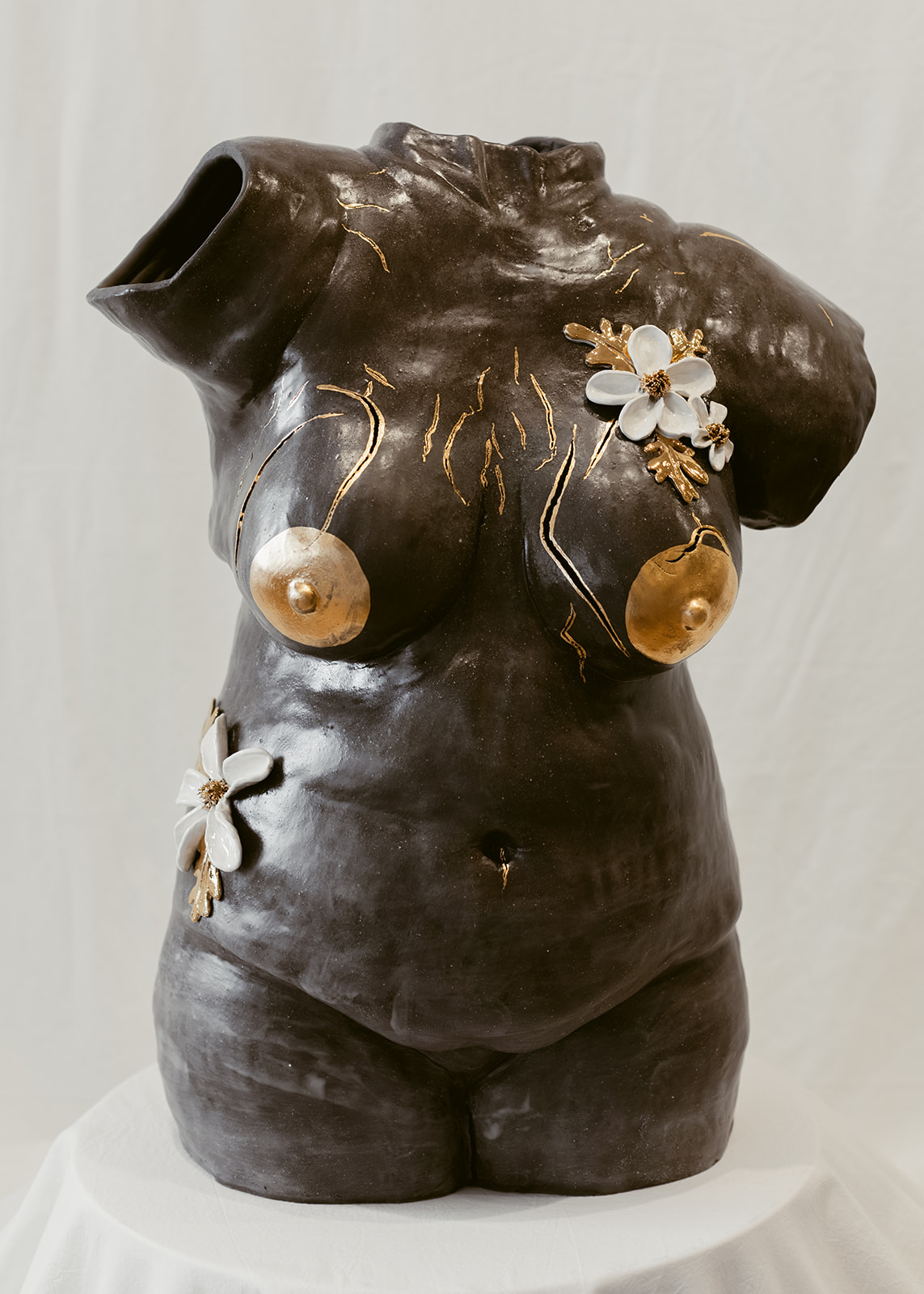
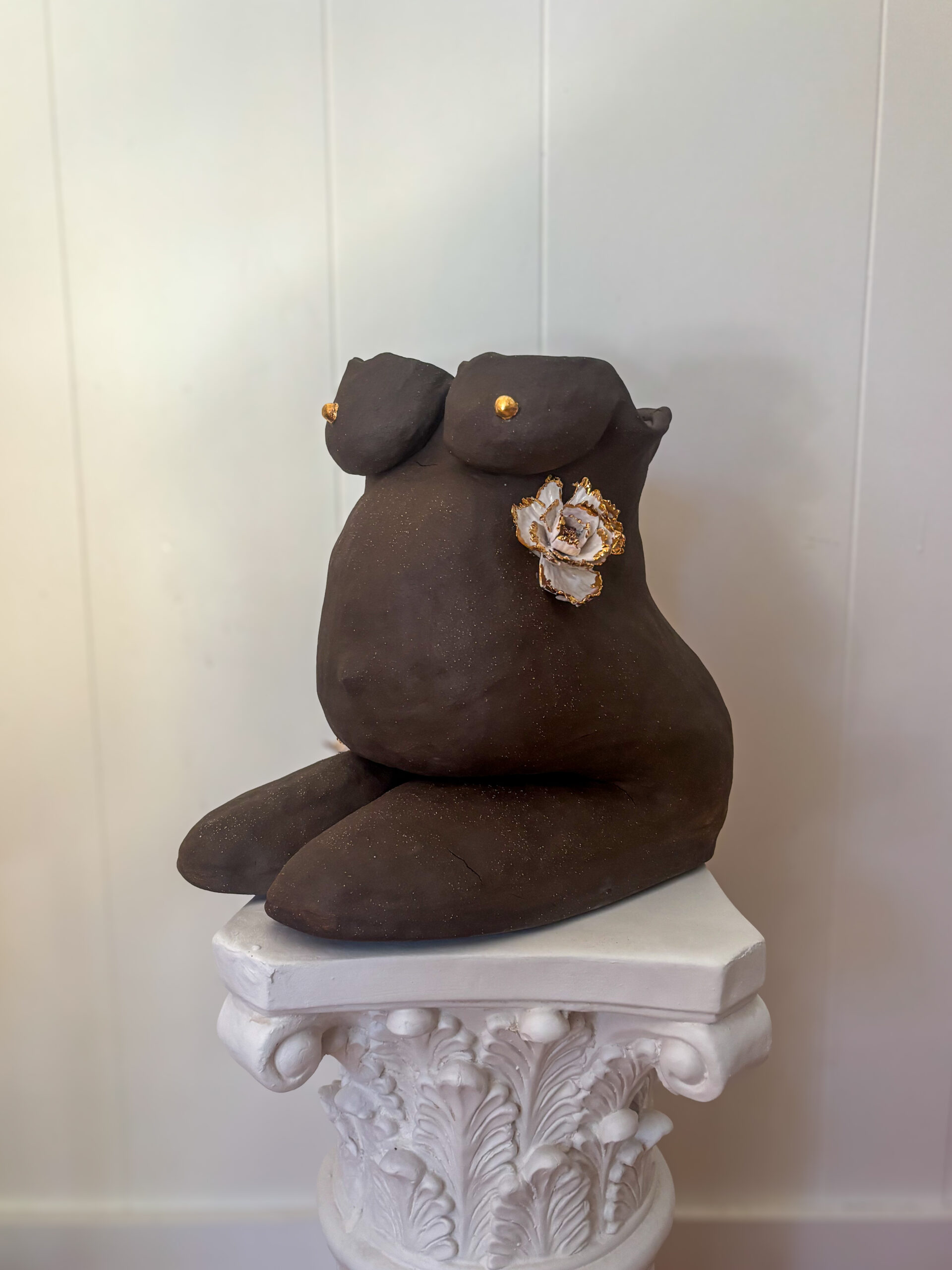
As a mother, I was drawn to Duffy’s different torsos. The classic C-section scar, the fold of skin above it, the stretch marks, the enlarged areolas and the protruding belly button of pregnancy. Each made with a different clay body. These are familiar and often insecure parts of our bodies. Here, Duffy honors the strength and complexity of women’s bodies.
Gouin: How did you model the different figures?
Duffy: I had a couple of friends who were kind enough to model for me. I think every artist uses themselves at one point or another. I also used photo references for specific postpartum moments that I wanted to capture, like for example, this effect that happens with loose skin. I really wanted to capture that, so I used a photo reference of that specifically.
Some of my models were inspired by how beautiful they felt the [sculpture] looked, even though something felt maybe insecure on their own body. The experience was not just empowering, but seeing the finished piece, I think, was healing for a lot of the women.
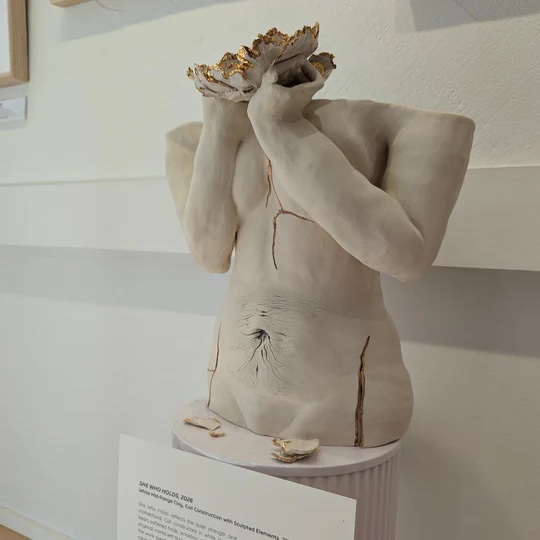
Gouin: For She Who Holds, did you add a stain and then wipe it off so the color stayed in the grooves?
Duffy: I did. I used slip staining, which isn’t something I did on the other pieces, but after I carved the texture, I really loved it and wanted it to be more pronounced, so I felt like that piece just needed a little something more to truly show what it’s about.
With She Who Holds, Duffy exaggerated the creases in the torso’s belly button area, like driftwood marked by time. Cracks, whether intentional or accidental, are exposed with gold luster, and the flower that Duffy said was originally going to be placed over the heart area is now being held up by two arms – perhaps suggesting beauty as a weight being carried.
Duffy explained that sometimes an original idea transforms through the process of working with clay in all of its stages. Working intuitively and openly is also part of the creative process.
One of the collection’s most personal models was Duffy’s mother, who taught ceramics for decades in the Seattle area and is retiring this year.
Gouin: I read that your mother taught ceramics. Did she influence you becoming a clay artist?
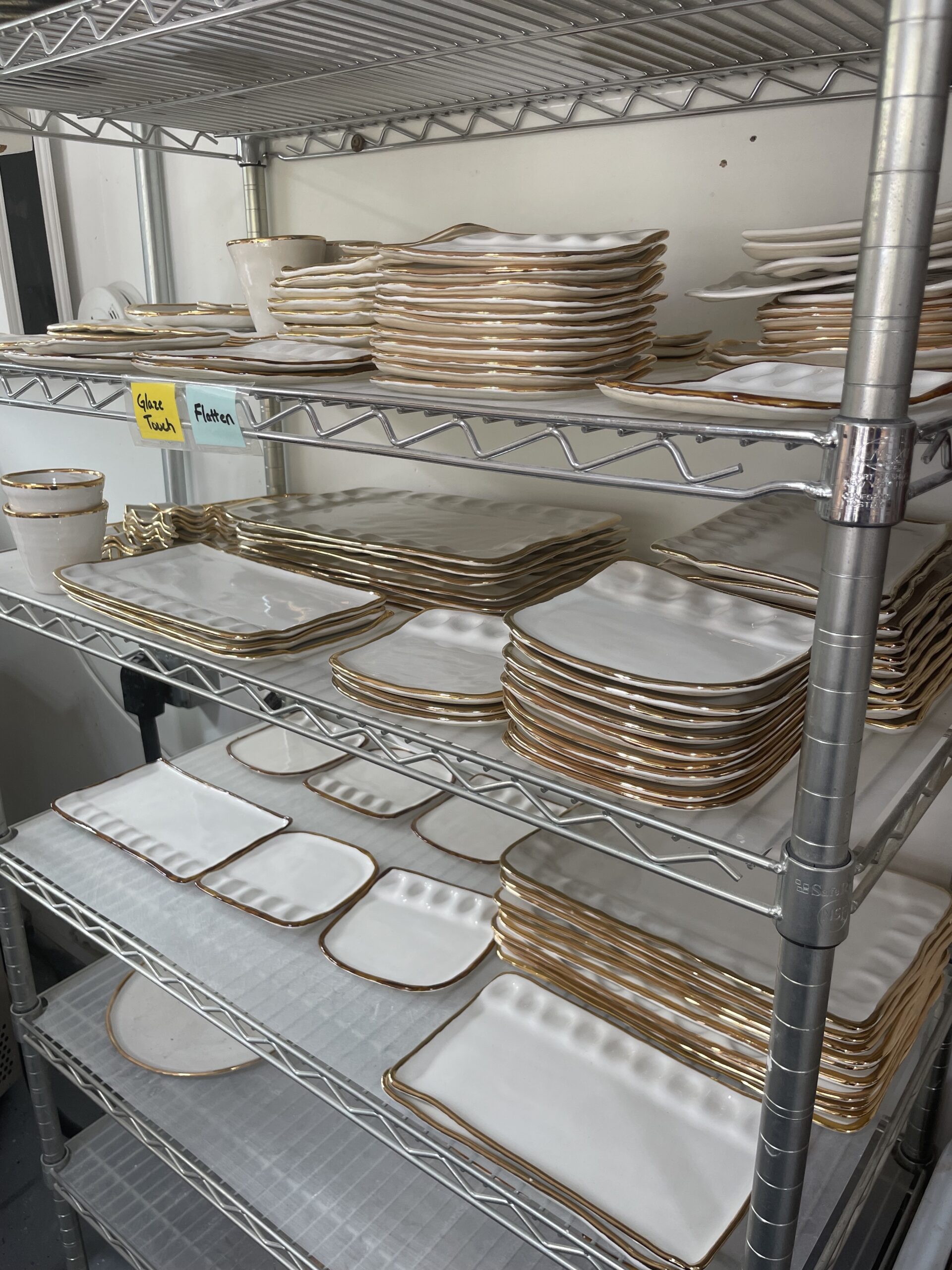
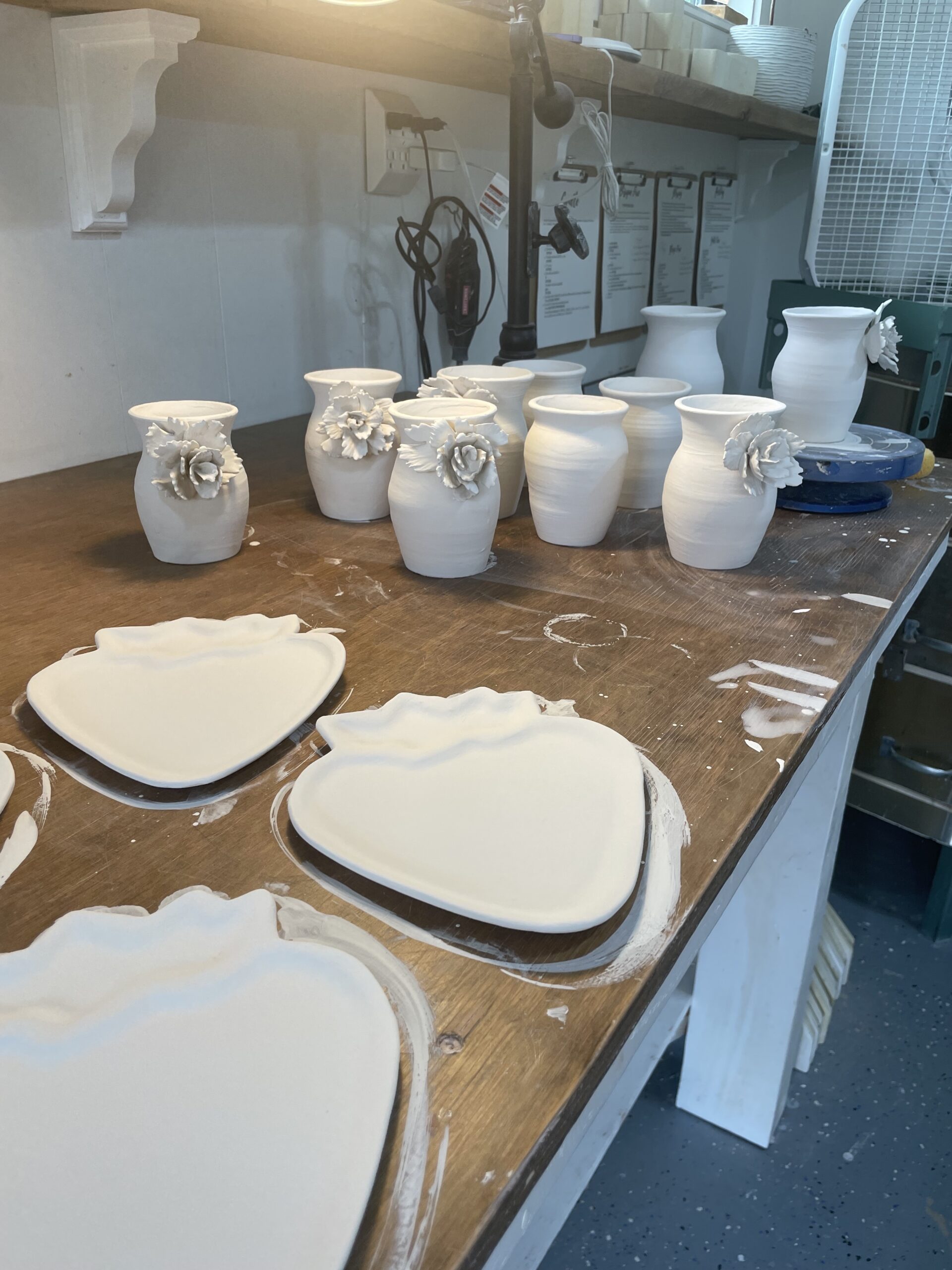
Duffy: Definitely. I never thought I should become a ceramic artist, but I knew this art form growing up. I did take it in high school, but I knew [ceramics] first from my mom.
My mom’s always been hugely supportive. She’s a very proud mom. It’s been fun having her in the studio, [she’s] always curious to see what we’re doing in here.
In an email, Duffy shared: Originally, [my mom] preferred to remain anonymous, but after attending the show at Sunlight Gallery she told me she felt proud to share that she modeled for the work.
Watching her step beyond her nerves, modesty and insecurities to do something so vulnerable and brave was incredibly meaningful to me.
Her willingness to trust me with that process was a gift.
There is also something deeply personal and visceral about creating from her form. As both an artist and a daughter, I cannot help but think of these sculptures as a way of preserving a small part of her. That realization carries a great deal of emotional weight for me.
Gouin: Is each petal made by hand or slab?
Duffy: I actually did different techniques as the collection grew, and I ended up liking these…let’s see if I still have it in here. Yes, I found these, which are made for cake bakers.
Duffy pulled out a container with different petal and leaf cake molds and shared how she uses them as press molds. She said the sculpted flowers recurring throughout the work symbolize the power of femininity.
The themes of fragility and authenticity are also embedded in the way each piece was constructed.
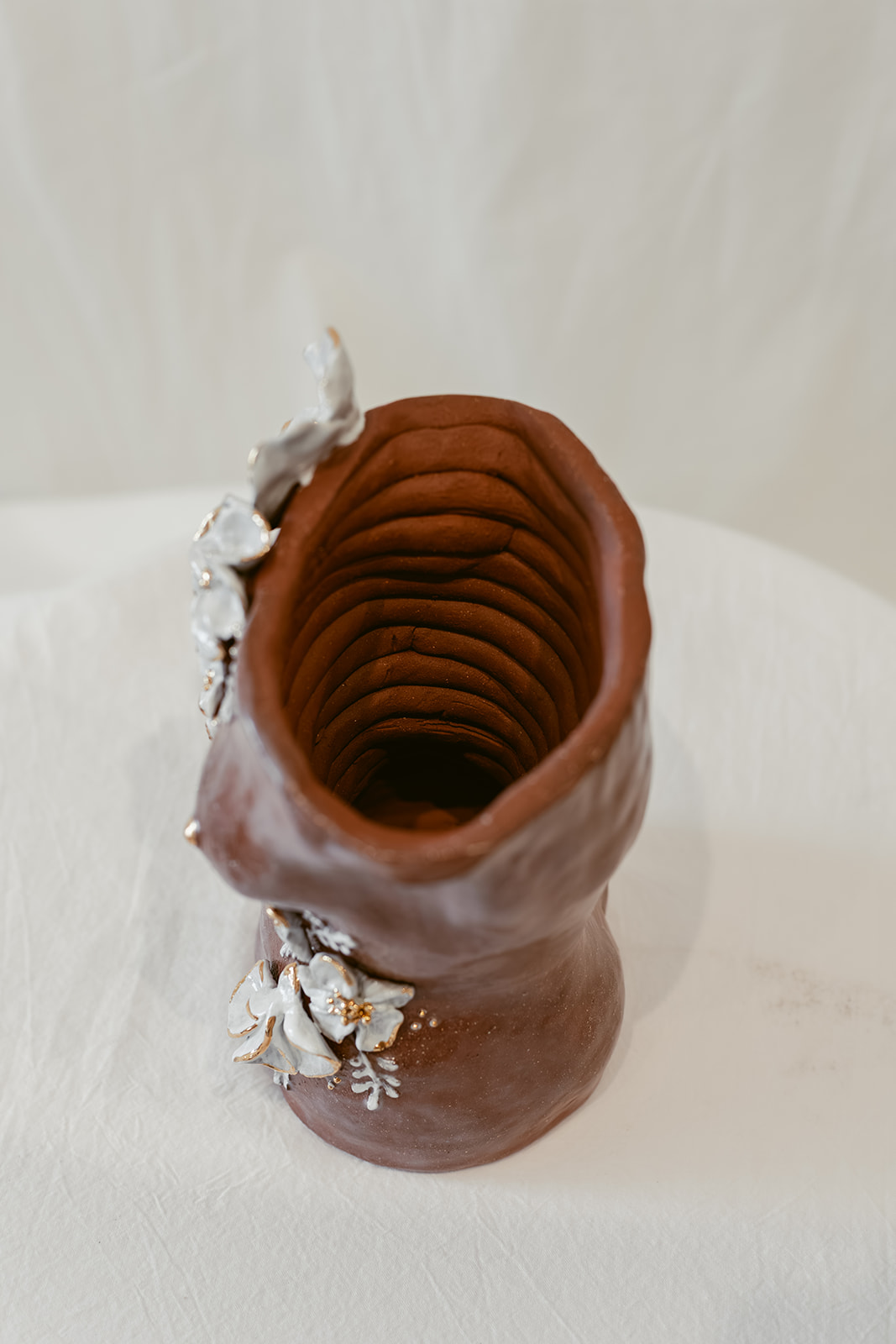
Gouin: Why did you choose coil construction?
Duffy: I liked the symbolism of building from the ground up and thinking of the figure one coil at a time. The base is also constructed from a coil.
With coil construction, you’re kind of creating a weakness every time the coils come together, so it’s embracing and allowing for those imperfections to organically happen when you fire.
Gouin: I saw that there are some smaller figures. Are those part of the collection as well?
Duffy: Yes. I have those three figures as one piece in She Who Gathers. They are not coil constructed, they were small enough that I was able to sculpt them solid, as you know, it has to be pretty small to do something solid, or else you risk blowing it up [in the kiln].
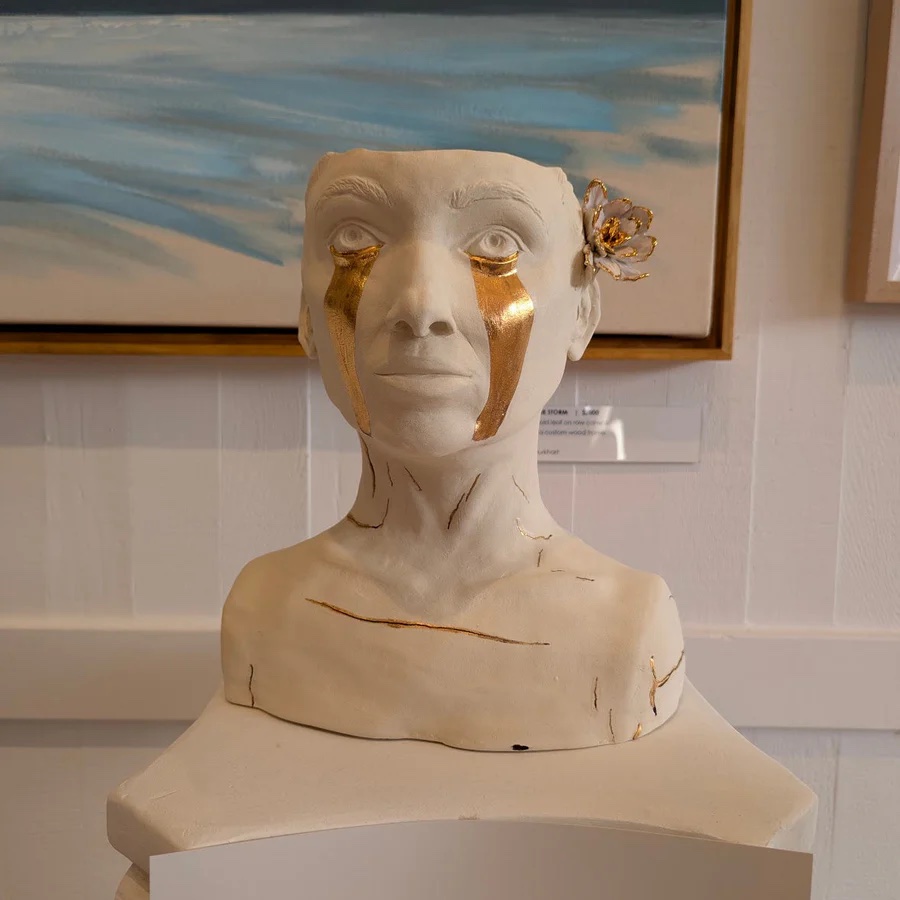
Gouin: So, tell me about this piece. This one is different. Is this a portrait of you?
Duffy: This whole process was quite emotional for me – embracing that it’s OK to be emotionally vulnerable. (Duffy shared through tears).
It was also coil-constructed. I think I really succeeded on the nose, which made me happy because that’s something I was always self-conscious about. I just looked at a picture of myself and used a mirror and tried to do what I could to represent myself.
Gouin: How did balancing motherhood and building large sculptures affect the process?
Duffy: Especially with the larger pieces, the clay gets heavy after four to five inches, so it kind of was perfect in a way when I could get away during a nap time or a little bit after bedtime to work a little bit more and build it up gradually. It was actually kind of nice having forced pauses in this process and was a lesson in patience, which added to this whole experience.
Gouin: I see gold luster being used to highlight imperfection, which makes me think of Kintsugi. Were you inspired by that philosophy of beauty in broken things?
Duffy: Definitely. Kintsugi and Wabi Sabi have always been something that inspired me. I love the concept of making imperfections beautiful, and I think in this collection I took that a step further.
After the studio visit and learning more about Duffy’s process and concepts behind Strength to Bloom, I, too, left feeling a little more seen and celebrated as a mother, and moved by the emotional honesty in her work.
The collection recently received recognition when two works were accepted into the juried Gallery Arts Exhibition at the Edmonds Arts Festival.
She Who Feels (the larger piece in a black clay body) and She Who Gathers (the sculpture composed of three figurines) can be found in the Gym of the Frances Anderson Center this weekend.

When asked what it meant to have her work included in the Edmonds Arts Festival juried exhibition, Duffy shared that the experience was especially meaningful because since the birth of her son, she has not participated in the festival as a vendor.
When she first started Pottery by Eleni, five years ago, she spent several years exhibiting in a booth on the field. Returning now as part of the juried gallery exhibition with her first Fine Art collection feels like a full-circle moment.
 Based in Edmonds, Nahline is a freelance writer, ceramicist and arts advocate with experience in art museums and performing arts centers. She continues to create with clay, homeschool her son and write as a creative practice. Contact her at [email protected].


Real first and last names — as well as city of residence — are required for all commenters.
This is so we can verify your identity before approving your comment.
By commenting here you agree to abide by our Code of Conduct. Please read our code at the bottom of this page before commenting.