
Will you chip in to support our nonprofit newsroom with a donation today?
Yes, I want to support My MLTnews!
Key takeaways:
- South County Fire Commissioners held a pubic hearing on a proposed $420 million fire and EMS construction bond.
- The measure would replace or renovate most fire stations, and add four new stations to meet growing demand and seismic safety standards.
- Older building layouts can significantly slow crew turnout time — the time from alarm to apparatus rolling, commissioners said.
- Those who testified expressed concerns about the measure adding an increasing burden to taxpayers.
- One resident suggested that South County Fire should propose smaller bond amounts over time instead of requesting a large amount at once.
- Commissioners are expected to continue discussing the bond resolution and other related items at upcoming meetings before making a final decision.
South County Fire Commissioners heard questions and concerns May 5 as they took public comment on a proposed $420 million fire and emergency medical services (EMS) construction bond that could go to voters as soon as the November general election.
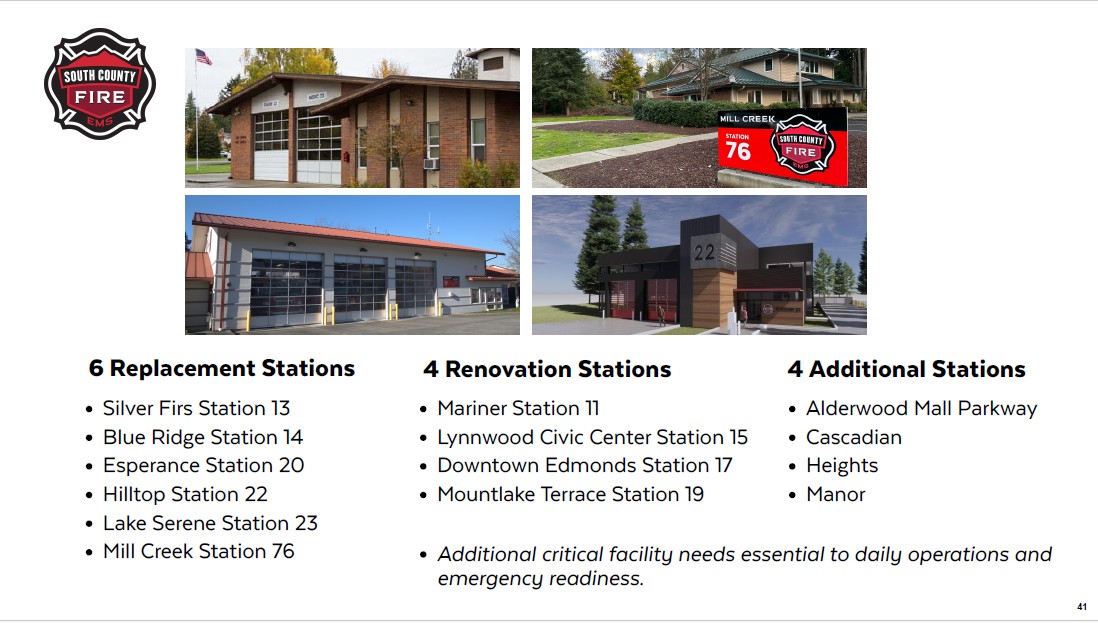
The proposal, based on the SCF Capital Facilities Plan, would replace or renovate most of the district’s aging fire stations and add four new ones to meet growing demand and seismic safety standards over the next 15–20 years.
During the May 5 meeting at the South County Fire Administrative Headquarters, Communications Director Christie Veley walked commissioners and the public through the history and scope of the plan, noting it was developed by an independent consultant a decade ago.
“The Capital facilities plan that is informing all of this work was created back in 2016,” Veley said. “Two-thirds of our 15 fire stations, 10 in total, would require replacement or significant repairs. Six of those stations were deemed to be in poor or critical condition.”
“At seven of those 10 stations, it was found that a major earthquake could compromise firefighters’ ability to operate safely and effectively out of those stations,” she added.
Veley said the fire authority has also “identified the need for four additional stations to address gaps that have been created by tremendous growth in our area over the last decade,” so “these improvements would affect virtually every community that we serve.”
The preliminary cost estimate for the full plan is approximately $420 million, she said, and staff are “continuing to evaluate what that would mean for individual homeowners.”
Veley emphasized that this is a long-term proposal, noting that it is “intended to meet the needs of the community over the next 15 to 20 years.”
“The $420 million encompasses every single aspect of the capital facilities plan,” she explained. “Six replacement stations, four seismic upgrades and renovations, and four brand new stations.”
The four new stations would be “Heights,” near 21558 Highway 99 in Edmonds; “Alderwood Mall Parkway,” near 170th Street Southwest/Alderwood Mall Parkway in Lynnwood; “Manor,” near 2224 Manor Way in Lynnwood; and “Cascadian,” near 200 146th St. S.E. in unincorporated Lynnwood. Veley noted that land has already been acquired for two of the four.
 After the presentation, Commissioners pressed staff on how these facility improvements tie directly to response times and service.
Veley answered one question by noting that a core goal of the plan is to “ensure that we can provide the same service that we’re providing today 15-20 years into the future,” despite growth and aging stations.
Commissioner David Chan stressed that many facility issues are longstanding.
He added that older building layouts can significantly slow crew turnout time — the time from alarm to apparatus rolling.
“Many of the crew living rooms [in fire stations] were far away from the apparatus bay, and therefore slows turnout time,” Chan said.
Chan also emphasized that “the $420 million is for all the cities and the unincorporated areas. It’s not just Edmonds residents that bear all this.”
Commissioner Mark Laurence raised the potential adverse impacts on recruitment and retention if living quarters remain substandard.
“The industry is experiencing labor shortages, and we have to compete for firefighters,” Laurence said. “We are known as a good organization that does great work. People want to work here, but if we have run-down living quarters it will hurt our recruitment and retention.”
Commissioner Micah Rowland framed the board’s upcoming decision as one of transparency with voters.
“The decision that we’re making when it comes to going to the voters is whether to tell them everything, put everything on the table, let them make the decision whether to go forward or not,” Rowland said.
“At the end of the day, we’re not making the decision to spend any money tonight,” Rowland continued. “We’re making the decision to put forward a plan to the voters, showing them a need, showing them the money that it’s going to take to meet that need, and it’s up to them how they want to invest their tax funds into their community.”
Rowland argued that “the only responsible thing” would be to present the full need.
As an example, he cited earthquake retrofits.
“The chance of an earthquake might be in the 10 or 15% range,” he explained. “But if it happens and one of our stations collapses, the public will ask — and rightly so — why we didn’t tell them that earthquake retrofit was needed. We need to honestly present the situation at the outset and then let the public decide.”
Edmonds residents share concerns
Public comment during the hearing was presented by two Edmonds residents — Sherwood Sage and Roger Pence — both of whom expressed concern about the scale and timing of the proposed bonds.
“I want to start out by saying that I am angry, very angry,” said Sage, who emphasized he was speaking as a citizen, not in any official capacity. “For every person that says something, there are 50 that will say nothing. So in that sense, I represent 50 people from the city of Edmonds.”
“We’re talking here of a half a billion dollars,” Sage said, rounding up the $420 million estimate. He pointed to recent or looming increases from other local governments and utilities, estimating that the combined tax hit to private citizens would be in the neighborhood of $1.5 billion.
“I have a problem with that,” he stressed. “A major problem.”
Sage said his own property taxes are going up 22% this year, and “exactly half of that goes to you [SCF].”
He questioned whether Edmonds residents would have voted to annex into the Regional Fire Authority in 2025 had they known a bond of this size was coming, opining that if they had, many would have voted no on annexation.
“We’re tired of every entity in government asking us for more funds, period,” he said.
Pence said much of the capital plan is “all new” to Edmonds residents, who were not part of the fire district when the 2016 plan was created.
“We did get regular briefings on fire district operations when we were under contract, but when the contract ended, the briefings ended,” Pence said. “So this is all new to us.”
He also called SCF out on lack of communication around the bond issue, stressing that while brief mention was made of an upcoming capital program bond measure in December, it’s been “radio silence” up until last month.
“It would have been nice to have had some community engagement during that period where we could learn about the issues with the fire stations and why they needed to be rebuilt,” he said. “There is just no general public awareness of any of that right now.”
Pence also echoed Sage’s concerns about the bond’s size.
“This is big money, $420 million,” he said, questioning why some of the costs couldn’t be “paid out of capital reserves,” especially after Edmonds’ annexation “expanded your tax base by … 30%.”
“Responsible capital planning does involve at least some of those needs being accommodated out of reserve funds,” he said.
Pence likened the approach to a school district trying to rebuild all its schools at once.
“If the Edmonds School District had come to the voters and said, ‘We want to rebuild all our schools,’ we would probably say no,” he said. “Better to take the most important ones and run those first as a separate and smaller bond issue.”
“When we look at the 14 stations on your list now, we don’t know which ones are most important and which ones are least important,” Pence added. “There’s got to be some priorities in there that we don’t know about.”
He urged commissioners to direct staff to bring back alternative, smaller bond options.
“Pick the most important projects out of that vast array that is on your table,” Pence said. “Allow the voters to vote on a smaller and more defensible and more reasonable tax package. That would be my suggestion going forward.”
Fire Commissioners respond to speakers
Commissioner Michael Fearnehough thanked both speakers and acknowledged changing conditions since the capital plan was drafted.
“We know that this is something that was birthed 10 years ago in a much different political climate,” Fearnehough said. “Even a year ago, when we started down this path of discussion, we did not have the geopolitical strain that we do currently. So many things have changed, and your public comment is on point.”
“Your comments about poor timing, excessive taxes are not falling on deaf ears,” he continued. “This gives us an opportunity to go back and have a dialogue as a group to figure out what is the best course of action.”
Commissioner Joseph Wankelman also thanked the public for speaking up. “I just wanted to say thank you for the public comments. I appreciate them,” he said. “I am listening to them, and I will definitely take them into consideration.”
In a subsequent email to My Edmonds News, Wankelman expanded on this.
“I understand what any financial request means to people, and I do not take it lightly,” he said. “Households across our region are already carrying real cost-of-living pressure, and any new ask deserves real scrutiny.”
“I also struggle with the fact that six of our existing fire stations were rated poor or critical by an independent engineering assessment, 10 years ago,” he continued. “We know these stations may not be able to operate and serve surrounding communities if a major earthquake happens, and it is our responsibility to tell our residents when we have needs that could affect their critical fire and emergency medical services. The need is clear, and we believe it’s time to ask our residents for their input on how we should proceed.”
The board is expected to continue discussing the bond resolution, explanatory statement, and pro/con committee resolution at upcoming meetings before deciding whether to place a measure on the November ballot and in what form.
See the full document package, including the draft bond issue resolution, the draft voters’ guide explanatory statement, and the resolution to appoint pro/con committee members in the May 5 Board of Commissioners agenda packet here.


Real first and last names — as well as city of residence — are required for all commenters.
This is so we can verify your identity before approving your comment.
By commenting here you agree to abide by our Code of Conduct. Please read our code at the bottom of this page before commenting.