
Will you chip in to support our nonprofit newsroom with a donation today?
Yes, I want to support My MLTnews!
After nearly three hours of discussion about Mountlake Terrace’s new Flock license plate reader system approved by the council in June – and a proposal to reinstate the city’s Community Policing Advisory Board to oversee the system – the City Council decided to table the issue for now.
The council instead directed City Manager Jeff Niten to revise the ordinance’s language, written in 1996, and bring it back for future consideration.
Flock is designed to help find missing or kidnapped people and stolen vehicles by taking a photograph of the vehicle’s rear. This allows for the identification of its color, license plate and any badges that identify the make and model.
System proponents point to its potential to assist in locating missing children (Amber Alerts) and seniors (Silver Alerts), as well as potentially reducing violent crime.
But those opposing the system say they fear that the Flock system could be a potential observation tool and would be accessible to anyone, either directly as a subscriber or indirectly through another agency, thus being accessible by ICE or other federal agencies.
The council on Aug. 7 had discussed the possibility of using the policing advisory board to provide oversight for Flock. But councilmembers decided during the Sept. 25 meeting to table the idea for now because they had questions and concerns about the board’s composition, such as which groups should be represented on the board and what specific requirements there should be.
“I think there is a lot of value to reinstating the Community Police Advisory Board, and not just in relationship to the oversight of Flock,” Councilmember Erin Murray said. “My understanding is some of the challenges in the past were that we had folks who were not as engaged as they could be. What we have traditionally done with our boards and commissions is we’ve cast a wide net, and folks come and they share their experience and their interest.”
The City Council discussed several possible amendments to the Community Policing Advisory Board:
- Broaden the eligibility of board members
- Consider requiring a student board member
- Expand the duties of the board beyond Flock, such as new police technologies
- Determine how audits would be conducted and how metrics would be reviewed
Councilmember William Paige, Jr., who had voted in June to support Flock’s implementation and later changed his mind, said during Thursday’s work session that he now thinks the council should cancel the contract. Paige said he was concerned about Flock’s relationship with the U.S. Department of Homeland Security and the company’s lack of transparency and honesty about their activities.

He compared the relationship between Flock and Homeland Security to hiring a general contractor to do work on his home – then discovering the contractor was secretly working with another subcontractor that Paige did not want to be involved with.
“That was the drop-dead deal breaker,” Paige said.
Councilmember Laura Sonmore said that she would like to review information from other cities’ Flock cameras. “We’re kind of doing this blindly…and we heard today that we’re going to not put [the Flock cameras] in right away,” she said. “We’re trying to learn from that, but there are other cities who have them, and I would love to hear some testimony from them on what’s going on.”
During the Aug. 7 council meeting, Niten explained that the city’s Community Policing Advisory Board was discontinued in 2017. It now meets on an as-needed basis although has not met since 2018. He also said that the city staff didn’t find any jurisdictions in the nation with oversight or review groups for Flock systems.
Public comments
During the public comment period, Mountlake Terrace residents gathered in person and virtually to oppose the Flock system.
Gillian Levine compared the Flock system to historical injustices to Indigenous Americans and urged the Council to cancel the contract.
“This day is such an important time to remember our country’s dark history of kidnapping and murdering the people who were indigenous to this land,” Levine said. “I can’t help but see echoes of the past and our current political climate, which is why I think it’s so ironic that our town can acknowledge these past crimes against human beings while also moving forward with a flat contract that could put people at risk of kidnap and murder by agencies. The mayor said that the city is working to build a community that is safe and inclusive. If that’s true, let’s start with a very concrete step to make that happen.
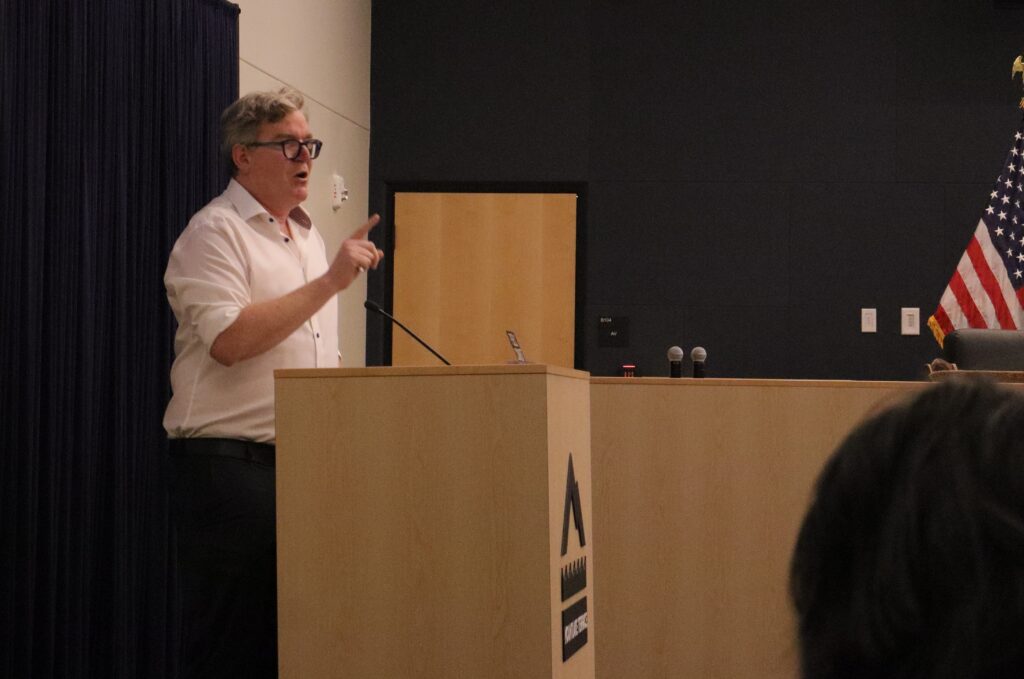
Theo Moriarty said Flock “unconstitutional” because of its violation to the Fourth Amendment, which protects a U.S. citizen’s right to privacy by prohibiting the government from conducting unreasonable searches and seizures.
He highlighted a recent lawsuit in Norfolk, Virginia, where a Norfolk resident sued the city and Flock after he found out Flock had tracked him 526 times with the city’s 176 Flock cameras. Moriarty said that the state of Illinois found that Flock was sharing its data with federal agencies.
“No number of working committees, policy amendments or anything else will ever put this genie back in the bottle because it does not care what you as a city council thinks, and it does not care what we think,” Moriarty said. “I don’t want to be tracked. Don’t track me.”
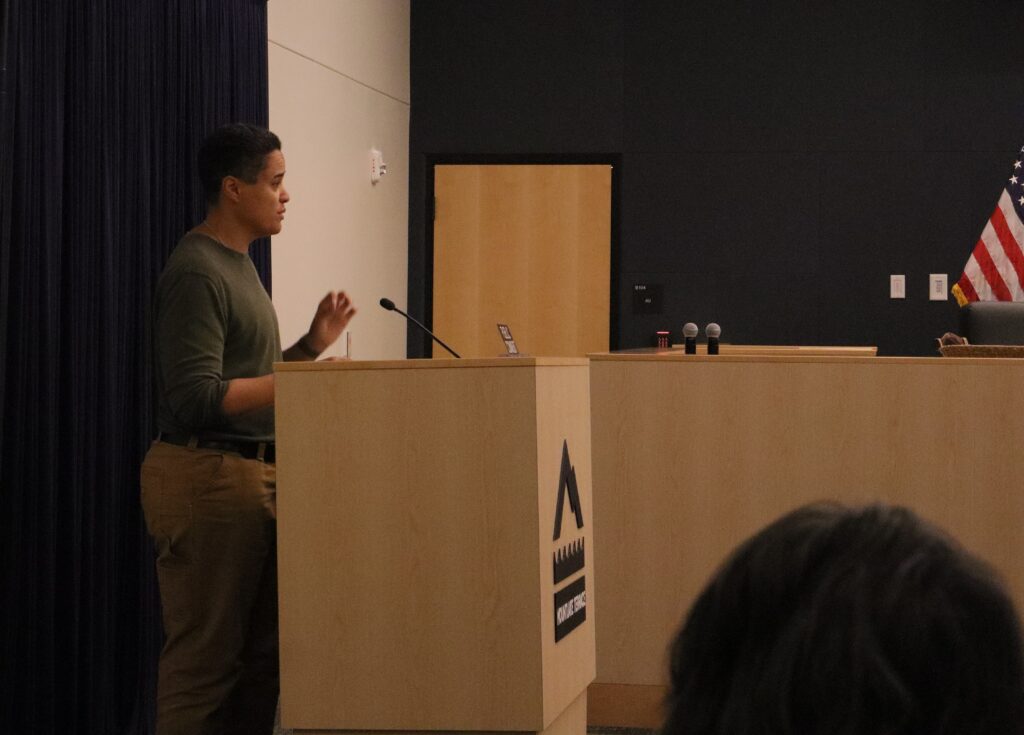
Sam Doyle said that Mountlake Terrace is not a “crime-ridden city” and vehicle thefts have gone down since 2024.
“We’re a postage stamp. We’re a tiny city,” Doyle said. “It also gets the city an invitation to litigation. There’s no way this is going to get installed and that you don’t get sued. You also get an opportunity to continue damaging the relationship with us. We’re the ones who voted to put you in office. You can continue to erode that relationship, or you can back out now.”
In other agenda items:
- The City Council proclaimed Sept. 30 as Every Child Matters Day or Orange Shirt Day. Mountlake Terrace High School Indigenous Student Union representatives Riley Guthrie and Elizabeth Herrmann were among those who accepted the proclamation.

- The city’s Public Works staff presented an update on the traffic impact fee (TIF) program, which funds new road and transportation infrastructure improvements, such as sidewalks and bike lanes. The City Council was asked to review and adopt the proposed ordinance updating the TIF program, including the new $6,051 per peak-hour trip rate for 2026. The City Council will review the updated TIF and meet with Public Works at its Oct. 2 meeting.
- Recreation and Parks Director Jeff Betz asked the City Council to review an amendment to the interlocal agreement with the Edmonds School District so the city can meet state grant requirements and secure reimbursement for the Evergreen Playfield #5 lighting project. After the project was completed, the Washington State Recreation and Conservation Office (RCO) required changes to the interlocal agreement before reimbursing the city. The state wanted the agreement to run through Dec. 31, 2048 to prevent early termination without cause. Betz added explicit language that would let the city plan build, and maintain improvements on school property. The City Council will review and consider approval of the recommendation at the next meeting.
- Betz also presented an update on the city’s park impact fee and asked the Council to provide direction or feedback so the staff can prepare the necessary ordinance changes to comply with a new state law.
Betz said that the city’s park impact fee system has been updated several times since 2007 with changes to service areas, discounts for developers and the calculation method. A new state law (SB 5258) now requires cities to base fees on the actual impact of different housing types, ensuring that smaller units – such as studios and one-bedroom apartments – pay less than larger ones. Cities can calculate fees either by square footage or by “sleeping quarters.” After working with a consultant, parks and recreation staff recommended a per-sleeping-quarters method, which assigns fees based on the number of bedrooms to better reflect the likely number of residents.Betz added that staff is planning to conduct an impact fee study in 2027 that would take about 12 to 16 months, with a consultant cost of about $120,000. No date was set for a future City Council review.
The entire Sept. 25 meeting can be seen on the city’s YouTube channel.


Real first and last names — as well as city of residence — are required for all commenters.
This is so we can verify your identity before approving your comment.
By commenting here you agree to abide by our Code of Conduct. Please read our code at the bottom of this page before commenting.