
Will you chip in to support our nonprofit newsroom with a donation today?
Yes, I want to support My MLTnews!
Key takeaways
- Edmonds School Board reviews new high school curricula.
- Lynnwood High School principal gives an update on its graduation rate goal.
- Board directors hear the latest legislative update about high school class credits.
The Edmonds School District Board heard a presentation during its Tuesday business meeting about updates to three high school curricula: science, health and social studies.
Science
For physical sciences, K-12 Science Content Lead Jennifer Hageman said the instructional materials have not been updated since 2004, and there was no prior adoption for Earth and space science since that course started in 2016. After the Materials Review Committee examined 36 different materials and piloted some classrooms with about 820 students total, Hageman said the committee recommended Pure Physics, Living by Chemistry, and Gizmos as a supplemental resource. For Earth and space science, the committee recommended New Visions open educational resources as the core, with Biozone and Gizmos as supplements.
“For Pure Physics, 67% of students agreed or strongly agreed that the phenomena, storylines and questions were engaging to learn and sustain their interest,” Hageman said. “Sixty percent found them to be relevant, with similar percentages for New Visions materials.”
She added that the climate change section in New Visions should be revised with a Pacific Northwest context to make it relevant to ESD student learning.
For the supplemental resources Biozone and Gizmos, Hageman said all teachers either agreed or strongly agreed that computer simulations “help students investigate science concepts that cannot be directly observed, and relevant science video clips effectively connected learning to the real-world events and people within the core instructional materials.”
High school health
For health, K-12 PE, Health and SEL instructional coach Jenni McCloughan said the committee recommended the Board adopt Live Well: Comprehensive High School Health as the new core curriculum for grades 9-12. This replaces two longstanding programs adopted in 1999: Flash, a sexual health curriculum; and Glencoe Health: A Guide to Wellness.
“These new recommended materials will align with our Washington State Learning Standards for Health and the National Health Standards from SHAPE America,” she said.
McCloughan said students in the pilot program compared Live Well with Health Smart and preferred Live Well because the materials were more engaging and “less boring.”
“There’s a real-life relevance with real-life health situations [in Live Well],” she said. “[Live Well] was age appropriate and [provided] relevant content to our students in our classrooms right now. [It has] strong representation of our students in the photos in both the textbook and the online lessons. [It has] Inclusive language with multiple perspectives… students said that the Live Well materials help them understand key concepts in health.”
Social studies
For social studies, Executive Director of Student Learning Jason Aillaud recommended the Board adopt materials from Savaas Learning Company, which are World History Interactive: The Modern Era, Reconstruction to the Present, and Civics Interactive. These will replace Prentice Hall materials that were adopted in 2007.
He added that social studies adoption should comply with state law and District policy related to tribal sovereignty education and with Since Time Immemorial curriculum in collaboration with the Tulalip Tribes.
“[This] helps to ensure that tribal sovereignty education is meaningfully integrated into instruction, rather than treated as a separate or isolated component,” Aillaud said.
Based on feedback from more than 1,100 students in a pilot program, Aillaud said students “consistently rated the Savvas materials more positively than the McGraw Hill materials…students described the Savvas materials as easier to navigate, more visually engaging and more supportive of understanding key concepts and perspectives.”
However, Aillaud said the committee was not satisfied with any single core textbook for ethnic studies, so they recommended curated supplemental resources instead. These include So You Want to Talk About Race?, Why Are All the Black Kids Sitting Together in the Cafeteria?, Race and Racisms: A Critical Approach, and Rethinking Ethnic Studies (teacher resource only).
The committee unanimously approved the ethnic studies recommendation, he added.
Aillaud said the committee used a 10-stage adoption process for all three curricula, emphasizing standards alignment, equity, piloting in real classrooms and broad stakeholder input before bringing final recommendations to the Board.
He said the Committee had gathered broader input from students, families and staff, including review tables and QR codes at School Board meetings so “anyone coming in” could examine materials and submit feedback.
Costs and budget
For high school health, the District budgeted $60,000 for the first year of the new Live Well curriculum and came in under that amount at $58,000, including teacher training. Ongoing digital licenses for students and teachers are expected to cost about $51,000 a year.
For science, the three-year implementation of new materials is projected to cost just under the District’s $225,000 allocation. That total covers materials, professional development and teacher release time.
For social studies, the District plans to buy a five-year bundle of Savvas print and digital materials, along with professional development and ethnic studies supplements, for slightly less than the $750,000 budgeted for the adoption.
Board Director Hawk Cramer asked about the sustainability of renewing digital access given a tight District budget.
“Considering that we have social studies materials that have been around since 2007… and we’ve got an adoption that’s now going to give us five years, are we going to have money after five years?” Cramer said.
Aillaud said the five-year bundle would be the digital licenses, which would then need to be renegotiated, “But teachers would still have the physical textbooks in their classrooms,” he said. “Generally speaking, it’s hard for me to know what the future will hold, but the text within the digital resources would stay aligned with the physical textbook.”
Board President Nancy Katims asked if other school districts are also doing the updates. “My guess is the publisher keeps updating it each year, and other districts are buying it in its newer version,” she said. “Am I envisioning this? It’s a weird setup, it seems like to me.”
Aillaud said publishers don’t update their materials every year; instead they do it every six to seven years. “It’s fairly new material. I wouldn’t expect a complete overhaul in the near future. I’ll say a five-year bundle is a pretty common number of years for districts to buy into,” he said.
The Board will vote on the adoption at a future meeting.
Lynnwood High School
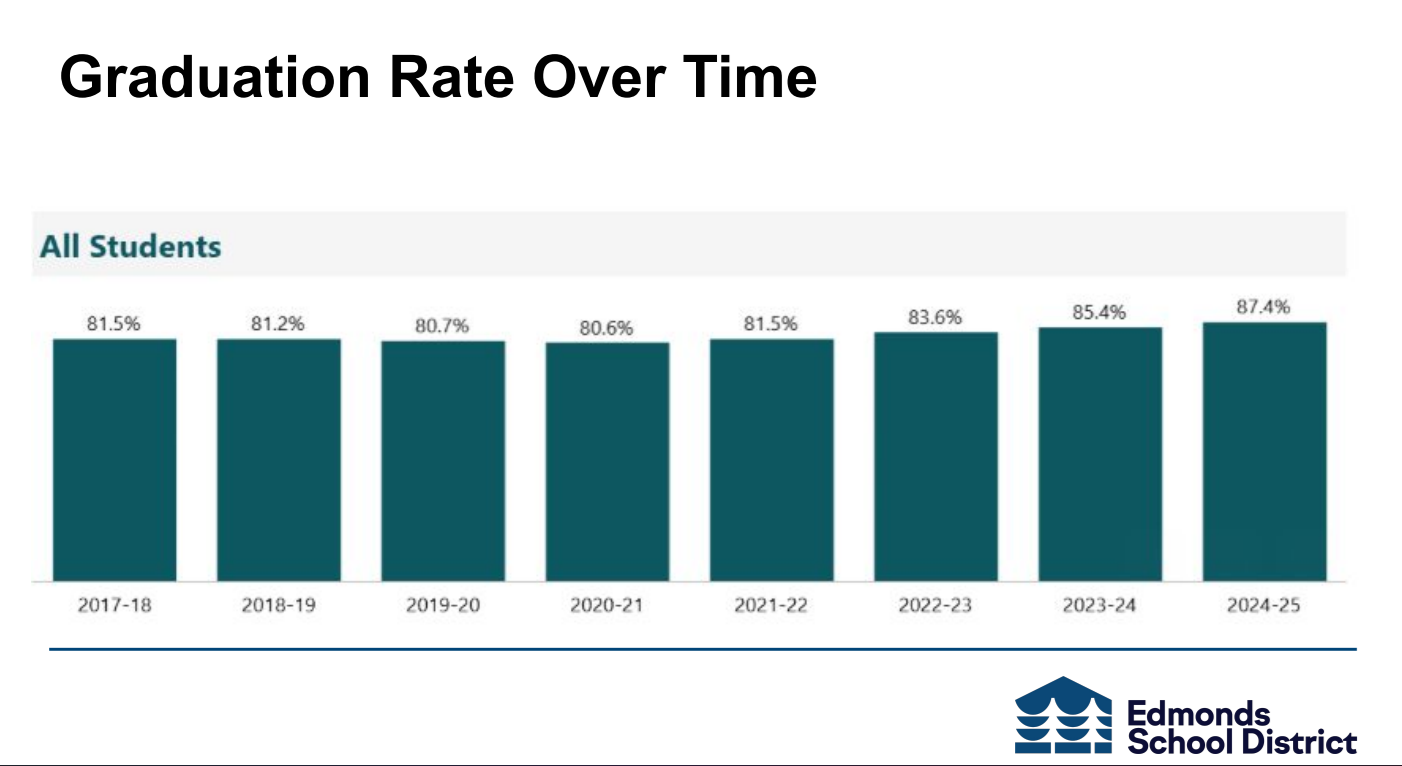
Lynnwood High School Principal Jesse Goodsky presented a School Improvement Plan (SIP) update focused on graduation rates, targeted supports and individualized student monitoring. He said the school has extended its three‑year SIP goal and is aiming to raise the overall graduation rate from 87.4% to 90% by the end of 2025-26 school year, with a longer‑term goal of 95% by the end of the 2026-27 school year.
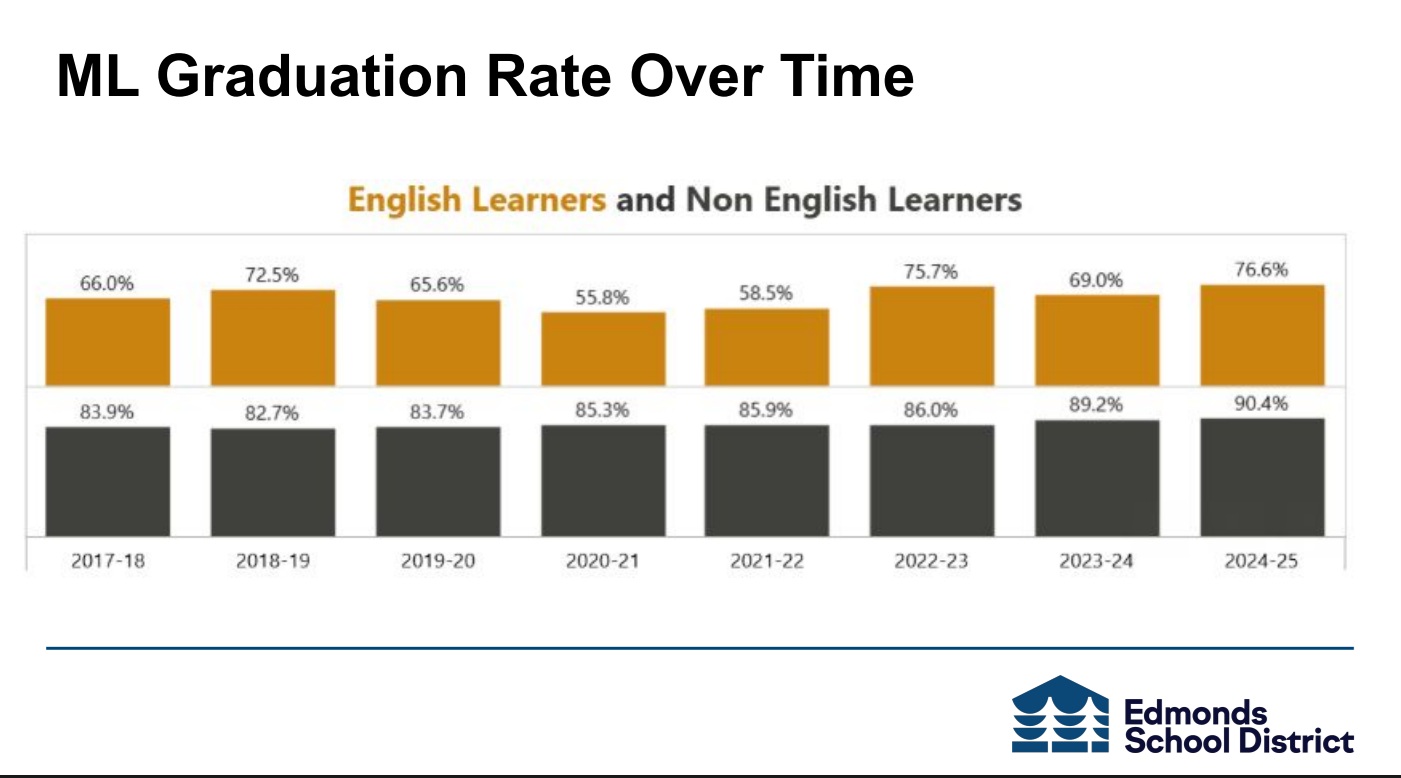
For multilingual students, Goodsky said the school wants to raise the graduation rate from 76% to 80%.
Goodsky said a “theory of action” system monitors student progress, provides timely and individualized interventions, reviews graduation pathways with students regularly, and uses data to improve instruction and credit attainment. The goal is to help students stay on track, recover credits when needed and graduate from Lynnwood High School on time, he said.
Goodsky showed a graph that depicted a steady climb in graduation rates since he first worked at Lynnwood High – from 81.5% in the 2021-22 school year to 87.4% now, with a 2% gain per year.
For some seniors and at-risk students, Goodsky said that the school gives them priority scheduling to get “credit-recovery opportunities.”
“We have a student intervention team as well…if none of that’s working, then we look at alternative pathways, so we might look at [something] like [Graduation] Alliance, some e‑learning pathways, anything that we can do to help them graduate,” he said.
Graduation Alliance is an education company that partners with schools, colleges and workforce agencies to help students and adults complete high school diplomas, recover credits and access career training.
Goodsky added that a midyear review of 67 seniors with individualized plans showed Lynnwood High is “on track” to hit the 90% target by the end of this school year if a certain number of students graduate.
Legislative update
Board Director Thom Garrard shared the State Board of Education’s “FutureReady” project to revise Washington’s high school graduation requirements, with changes tentatively aimed at the Class of 2031.
He noted the changing of the “two‑for‑one” policy so certain Career and Technical Education (CTE) classes could count for two credits instead of making students choose one subject. For example, if a student were to take a horticulture class, that class credit would count as both a CTE and a science credit.
“What [the State Board is] trying to do is figure out… [is] how to give students a little more flexibility in how they get their 24 credits,” Garrard said. “If OSPI [Office of Superintendent of Public Instruction] determines that there’s a new cost to anything in their plan, that it would not be required until it was funded. So I think some people are hearing us about the fully funded stuff and the unfunded mandates.”
Katims said the state still hasn’t funded the current 24‑credit framework adequately, noting school districts must absorb costs and those missing credits put students at risk of not graduating.
Superintendent Rebecca Miner said the District is tracking FutureReady closely with supervisors and teachers, but they don’t see anything “earth‑shattering” enough to warrant a formal district position beyond ongoing concerns about funding and implementation.
Gararrd encouraged people to review the State Board’s FutureReady materials and submit comments.
Other agenda items
The Board voted unanimously to approve the following items:
- Accept the Edmonds-Woodway High School Multipurpose Fieldhouse contract, which will build a 5,000-square-foot facility on the site of former tennis courts between the football stadium and baseball field. It will provide auxiliary gym space, concessions and restroom facilities for nearby athletic venues. This work is funded through the 2021 school levy.
- Fire alarm and HVAC upgrades
- An emergency waiver due to a power outage at Hazelwood Elementary School
- Revising a platform position on AI for submission to the Washington State School Directors’ Association (WSSDA). This platform is a formal list of policy positions and priorities that guide WSSDA’s advocacy work with the Washington Legislature and state agencies.
View the entire meeting at the Edmonds School Board website.


Real first and last names — as well as city of residence — are required for all commenters.
This is so we can verify your identity before approving your comment.
By commenting here you agree to abide by our Code of Conduct. Please read our code at the bottom of this page before commenting.