
Will you chip in to support our nonprofit newsroom with a donation today?
Yes, I want to support My MLTnews!In December 2025, My Neighborhood News Group brought you a series of stories about government finances. Here is another follow-up story on additional ideas generated from that series. If you missed the series, you can begin here: Part 1.
Mountlake Terrace had a budget problem. Not the typical 2025 problem, when nearly every local government in Washington state had some kind of budget problem. No. This was an “OMG, someone put together the long-term financial plan years ago and that $4.2 million they counted on annually never actually existed” problem.
This math mistake, uncovered during an audit, showed the city would have to cut an additional $4.3 million annually between 2026-2030 and $5.2 million annually between 2030-2035.
Mountlake Terrace City Manager Jeff Niten turned to the community for help, creating a Mountlake Terrace Financial Sustainability Task Force made up of residents.
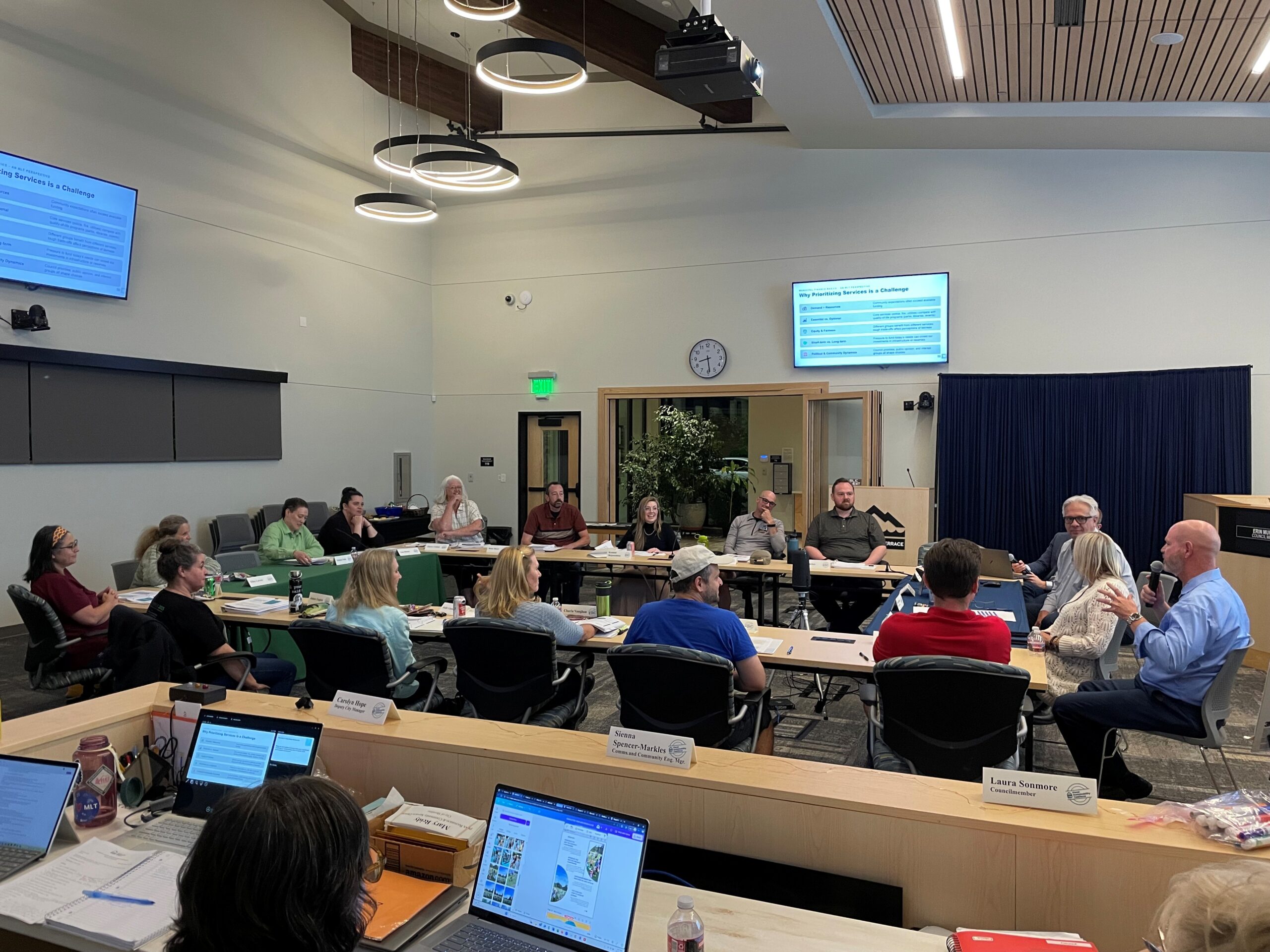
Niten was clear about who he wanted: young, old, renter, homeowner, financially comfortable, financially less comfortable. He wanted a true reflection of the community. Whatever decisions were made about cuts or taxes would be felt by everyone. Every demographic had to have a seat at the table. Every participant had to care about Mountlake Terrace too.
That’s how it started in July 2025. This story is about what happened next.
(MyMLTNews wrote about the outcomes here, but how the task force came to be and what happened in the last six months is a good story and an idea more governments should know about.)
What is a financial sustainability task force?
A financial sustainability task force isn’t new, but few cities use it. Niten brought in Baker Tilly, a national consulting firm that helps local governments solve intractable financial problems with good governance at the forefront to guide the process.
Baker Tilly supported the cities of Kenmore and Sammamish with their budget issues. The consulting firm charged Mountlake Terrace $107,000.
The concept seems simple.
- Tap into employees who are closest to the work. Ask them to generate a list of cost-saving ideas.
- Find a cross section of residents who are prepared to commit their time, expertise and care for the community to help solve these financial challenges.
Twenty-five people applied for the job. Niten and the team chose 15.
Brent Meyer (IT manager), Clark Morgan (software design), Daniel Luoma (software engineer), Ellen Lavoie (UW scientist), Eric Nodtvedt (corporate finance), Gina Ruelas (corporate finance), Ian Tucker (fleet coordinator), Jaimee English (government project/program manager), Jeannie Kee (child welfare consultant), Jodie Gunderson (administrative supervisor), Kendehl Rojanasthien (branding consultant), Kerem Onat (government auditor), Charla Vaughan (unavailable), Thesvy Cashen (former travel executive), Tshilaba Verite (CPA)
These 15 people attended five meetings, nearly three hours each over a six-month period. They learned about city finances (general fund, service fees, grants), financial levers (cuts, public vote, councilmanic choices) and the impact of those options.
The hard work begins
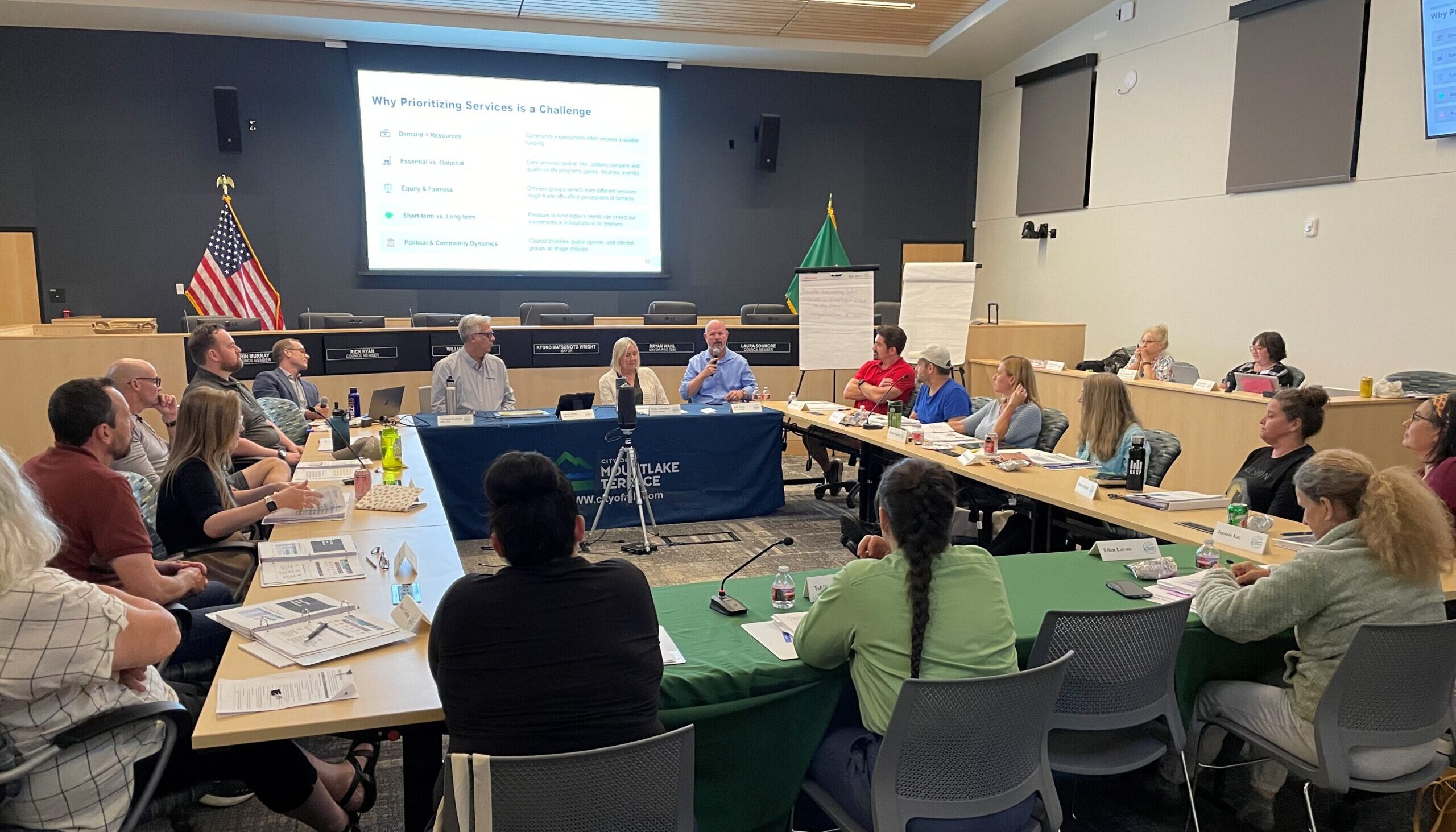
“None of us knew it as well as we thought,” said Eric Nodtvedt, whose day job is managing budgets and balance sheets for infrastructure projects. “It was interesting to learn. Less fun was trying to figure out the downstream impacts… government is different from the private sector.”
City staff submitted their 30 cost-saving ideas. Task force members, newly schooled in city processes, developed 16 of their own for a total of 46 ideas.
Task force member Ian Tucker’s idea was so good, Niten didn’t wait for the process to be complete. He reworked the way the city insured vehicles for an annual cost savings of $83,000. Tucker’s day job includes managing the Port of Seattle’s vehicle fleet.
Task force members spent the next several months asking questions, looking at impacts.
“I thought that it was a really smart thing that Jeff and his team picked people from, like, all walks of life,” Nodtvedt said. “Emotionally exhausting” (but good) is how he described really listening and thinking about everyone in the community.
“Well, if we did that, then this thing would happen, and that would be really hard [for another task force member or their family],” he added. “Just because it’s not the way it is for me [Nodtvedt]. And so, you know, it was a really smart choice.” The objective was easier said than done. “Help people the most, hurt people the least.”
“Empathy” is the single word that Brent Meter, IT manager for Snohomish County’s 911 system, used.
As a group, they had to decide their values.
Everything was on the table. That made for really hard discussions and decisions.
“It’s for the good of your entire community, so you can walk away both tired but satisfied at the same time,” Nodtvedt said.
When asked to describe these discussions, Gina Ruelas, who works in corporate asset management, said, “Passionate” – with a look that made it clear that was an understatement. No councilmembers were present at these meetings. “We wanted to keep it free of influence,” Councilmember William Paige Jr. said.
Nodtvedt said Niten and his team had to teach “government” to task force members but also stayed 100% hands-off on the decision-making process.
“They can educate but they can’t advise, right?” Nodtvedt said. “God, that’s really hard. That’s one of the hardest things.”
With the help from consultants and many spreadsheets, task force members plugged in real numbers – a combination of this tax and that cut — to get to $4.3 million in savings annually from 2026-2030 and $5.2 million from 2030-2035. They organized ideas into yes, no and maybe. They listed pros and cons. They listed impacts. They had more “passionate” discussions
They watched the target number come (slowly) into view. That math would put the city on solid long-term financial footing.
They came up with two budget packages to send to Mountlake Terrace City Council. A preferred budget and an alternative. Both budgets addressed the target gap. A sense of relief for the task force. But there was still more to do.
Task force explains work to the public.
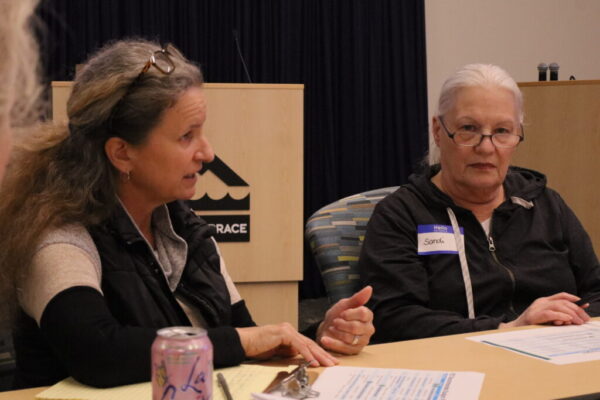
In mid-January, the City and the task force hosted two community engagement sessions. The City explained the process as a whole, then task force members scattered to small break-out tables to explain and answer questions from the public.
“So much of this is over my head,” one resident said in a candid moment. Task force members were patient and eager to share their knowledge and thought process. “I really wish more people were here,” said another resident who came to learn about the process.
The task force does not have legal authority. In late February, this package will be presented to the council for adoption. The council can accept it or not.
What task force members learned
Task force participants found the process invaluable. They said they learned a lot, and developed empathy for community members who may have been invisible to them. They learned that $20 is a lot when you are living on the edge.
“The best analogy I could think of was more like team sports and less like reality TV,” Nodtvedt said.
“In sports you’re a team that’s all working together,” he said. “There might be a little bit of competition inside the team, as each player has, like, ‘this is the thing that’s best for me’. But in the end, you’re all going in the same direction for one goal… collaborating toward a certain end. And in reality TV, it’s just conflict.”
Nodtvedt said another surprise was the city’s long-range forecasting model.
“The city has to think ‘What’s going to happen in 10 years’? They bake a recession into their model every 10 years. Historically, there’s a recession about every 10 years. When you’re really talking about [is] money coming in, money coming out. It’s going to happen at some point.”
Core memory
The final night of discussion still stays with Nodtvedt.
It was, quite literally, a dark and stormy night, the middle of that historic December windstorm. Only a handful of members were present. Travel was too difficult. The clock had run out. They made key decisions to close the final gap.
“It was just kind of silent for a second, and I said something to the effect of, like, ’I think the fact that nobody seems happy is probably a sign that we’re on the right track.’”
“And it got a little bit of a chuckle. And then somebody reiterated, like, yeah, that’s actually probably about right. And it was just like the whole room sort of relaxed, because we realized we had sort of gotten there, and we had gotten there through compromise.”
It’s a hard, but satisfying, process. It seems to be working.
When asked if he’d use this concept for other decision-making, Niten laughed. “No, hopefully, now that we have this budget issue addressed, we’re done for a while!”


Real first and last names — as well as city of residence — are required for all commenters.
This is so we can verify your identity before approving your comment.
By commenting here you agree to abide by our Code of Conduct. Please read our code at the bottom of this page before commenting.