
Will you chip in to support our nonprofit newsroom with a donation today?
Yes, I want to support My MLTnews!
My Neighborhood News Group (MNNG) is publishing a series of stories on how local governments are funded and the financial challenges facing both elected officials and residents. You can read Part 1: Introduction here. Part 2: Where’s the money here. Part 3: Property taxes here.
“The article said Washington state residents are one of 9 states nationwide that do not tax individual wages and salary. BUT we have the highest tax on gasoline and sales tax, taxes on homes… Our legislators have blinders on and can only see how to tax and spend tax and tax spend in an unending cycle. They need to be replaced.” Nov. 11, 2025 My Lynnwood News comment section
Fees and taxes
To make up for the funding gaps created by I-695 and I-747, cities are increasingly turning to fees, fines and specialty taxes or new types of revenue generators like red-light cameras or paid parking.
Some special taxes for public safety, road repairs, and arts and culture must go to a community vote. These funds go toward special projects or programs. Others are “councilmanic,” which means the council can do it without a vote of the people. Councilmanic taxes can only fund operations and are limited.
For example, many local governments have a transportation benefit district (TBD). Money generated through a TBD can only go to road projects. The state allows local governments to add up to $50 per car registration and up to 0.3% sales tax for road projects.
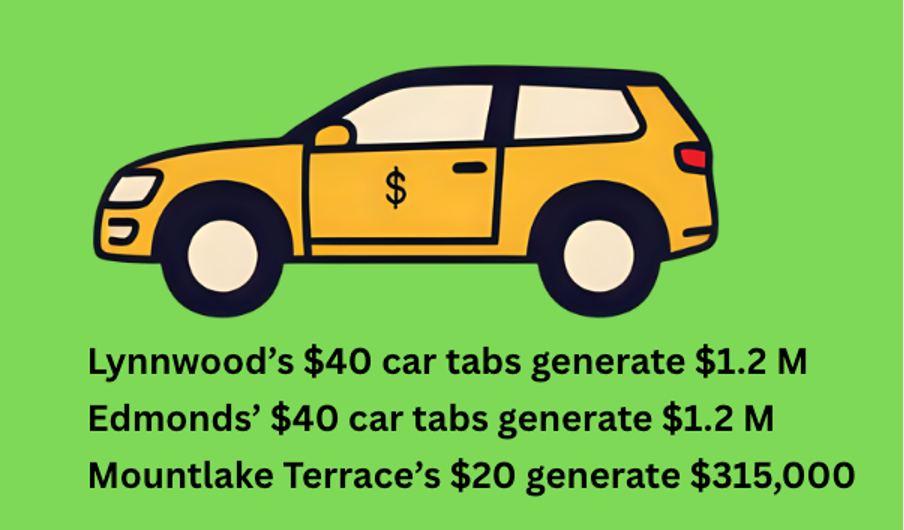
It’s important to note that most of these fees are restricted to specific projects, programs or services with little to no flexibility and almost no overhead for staff, the people who administer programs, projects and services.
These nickels and dimes — and there are a lot of them – add up for local government funding. They add up for residents, too, and hit those on the low end of the wealth gap even harder.
There are permitting fees and licensing fees for businesses and builders. These fees support infrastructure systems associated with more or different structures or systems. For example, if a new apartment building is constructed and adds 100 more residents, how will the wastewater system handle that? This expert analysis, which is needed and required, costs money.
Business owners can also be subject to a business and occupation (B&O) tax. Those taxes go toward the general fund and city services like parks and public works because coming to a business includes the experience of driving on roads and maybe enjoying open space after.
For small businesses operating on a slim margin, these nickels and dimes add up. Sometimes, they are a business killer.
Local governments tax utilities like wastewater, garbage, fiber lines and cellular communications systems. The goal is to cover the utility-related costs to help governments manage infrastructure impacts and system repairs for a growing and more complex population in an urban environment.
Those systems have infrastructure problems of their own right now, as we reported recently in My MLT News.
Fees and taxes are more complex to manage and do not provide a consistent, stable and predictable revenue stream for creating long-range financial forecasts. Taxes can have end dates. Fees fluctuate with development. Businesses go out of business.
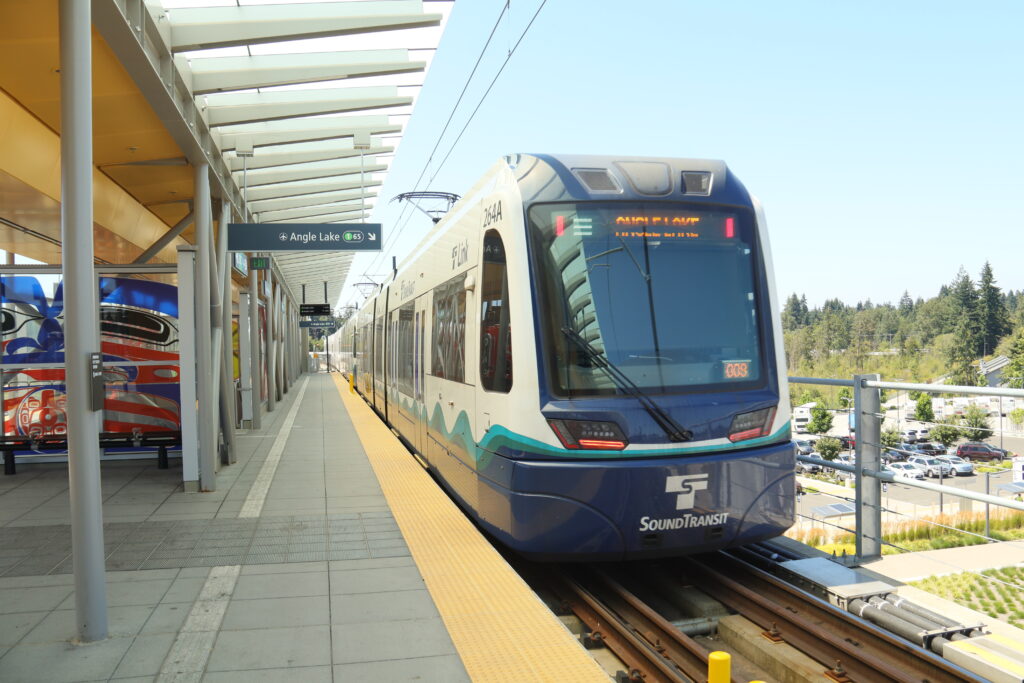
Lynnwood anticipated a building boom with the opening of the new light rail station in 2024. That didn’t materialize as expected in 2025. Fees associated with the anticipated increased building didn’t materialize either, creating an unexpected hole in the budget.
“Many planned projects have been put on hold due to the national economy,” said a City of Lynnwood spokesperson.
Mountlake Terrace also expected a light rail-related construction boom and a couple of other solid development projects.

“Development fees fluctuate with the economy. This year, there has been a significant slowdown,” Mountlake Terrace City Manager Jeff Niten said.
“Two large projects that were ready to go are now on hold. This delays impact fees and construction-related sales tax revenues. Real estate sales are also slow this year, causing decreased collection of real estate excise tax,” Niten added.
This is a national issue. When an economy goes soft, builders pause and that anticipated money disappears from the budget – until sometime (hopefully?) in the future. And it’s not just permitting fees.
Other revenue-generating ideas that don’t pan out as expected
Red-light cameras were touted as a big revenue generator for cities, outsourcing the technology while taking in quick revenue. But that revenue isn’t always predictable. Here’s a snapshot from the City of Lynnwood budget update in early November regarding anticipated red-light camera revenue.
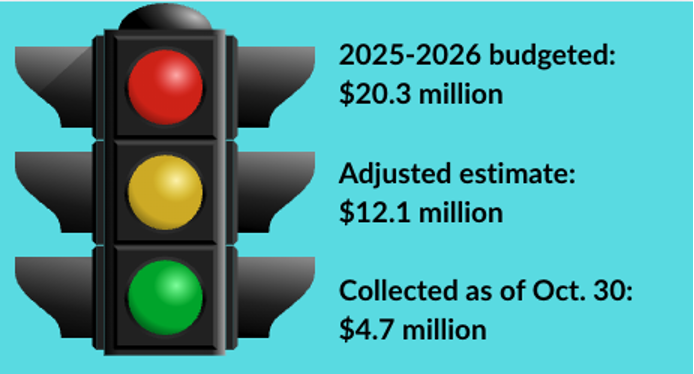
Local governments count on these as they build budgets. When the solution doesn’t materialize as planned, there’s a new problem to be urgently fixed.
These are examples of inconsistent and unreliable revenues that replaced those reliable, consistent, predictable property taxes and road funds.
Back to our personal economy analogy: Just to live, you have multiple jobs. You have a full-time job that paid all the bills in 2020. Then your employer said no more overtime. Things got more expensive in 2021 so you picked up a side job as a dog walker. That wasn’t enough in 2022, so you got a third job as a sports referee on the weekends. That wasn’t enough in 2023, so you decided to rent out a room in your house. Now you can pay all the bills.
Then one dog moved away and you couldn’t find another dog to walk. And your renter who worked at Amazon and was a solid bet, got laid off and now can’t pay rent. And that small bonus you were planning on for mid-December just got clawed back because the company didn’t do as well as they thought they’d do by the fourth quarter.
It can all fall apart really quickly and is hard to manage. You are one small problem away from a financial disaster. Like all of us, this is what cities are doing. It’s complex and ever changing and really hard to plan for the long term.
Next: State and federal grants — surely those can help…

Inslee increased spending 40% in his last 4 years. The tax payers voted to repeal the gas taxes and like a good Dem Ferguson went judge shopping and found one to say the initiative was no good. Simple answer is to vote GOP.