
Will you chip in to support our nonprofit newsroom with a donation today?
Yes, I want to support My MLTnews!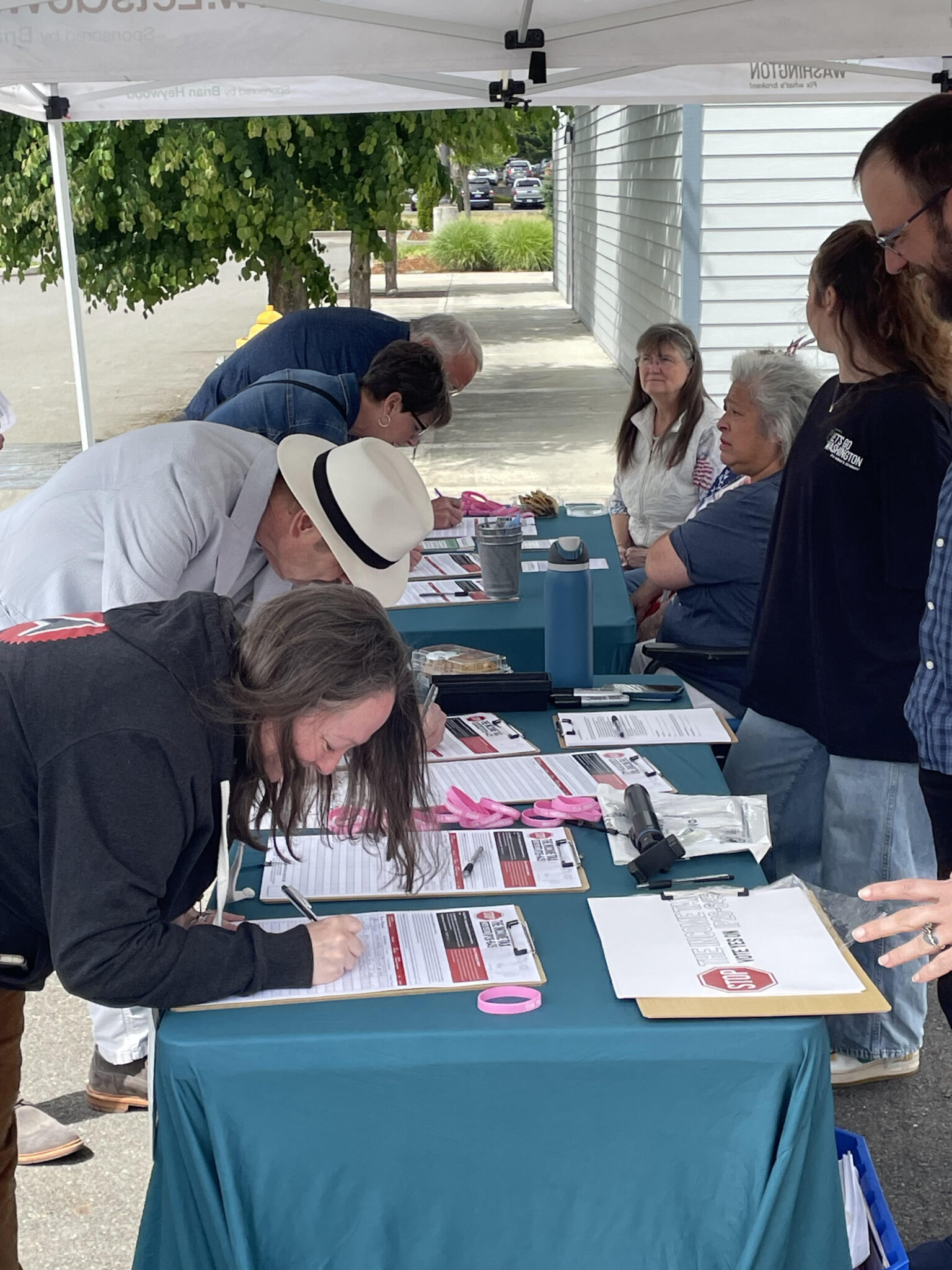
Democratic lawmakers in Washington paired their new income tax on high earners with a pledge to use billions of dollars from the annual proceeds to help small businesses compete and lower-income families get by.
They committed to remove sales tax on diapers, grooming products and some over-the-counter drugs and repeal recently added sales taxes on services. There is also a more generous tax break for small firms and a massive expansion of a tax credit for working families.
Opponents of the income tax are now circulating an initiative that would keep those promises but erase the tax.
“We’re taking out the parts that drive people away from the state and we’re keeping the parts that allow them to be successful,” said Hallie Herzberg, spokesperson for Let’s Go Washington, the conservative political committee gathering signatures for the measure, IP26-645.
To qualify for the November ballot, the group must turn in at least 309,000 valid signatures of registered voters by July 2. They had 317,000 on Tuesday, Herzberg said.
If the measure were to win approval, the state would lose around $3 billion a year in estimated revenue, as it gains $570 million in annual expenses, with those costs rising annually.
This would force the Democratic-led Legislature and Gov. Bob Ferguson, a Democrat, to find a way in the 2027 legislative session to pay for their commitments, or abandon them.
“Lawmakers think that the only way to provide those things is to tax people. We think the money is there in the budget,” Herzberg said.
Backers of the tax say initiative sponsors are misleading the public about the financial havoc that would be caused by preserving those tax savings and credits while eliminating the means of paying for them.
Sen. June Robinson, D-Everett, chair of the Senate Ways and Means Committee, called the measure “deeply irresponsible fiscal policy.”
She said Brian Heywood, the Let’s Go Washington founder and leader, “pretends he can give voters something for nothing. If the initiative passes, it would create a massive budget gap for the Legislature to grapple with. It would make it impossible to write a balanced budget without very damaging reductions in other programs and services.”
Even with the tax in place, lawmakers are preparing to confront a sizable budget gap next year.
How we got here
On March 30, Ferguson signed Senate Bill 6346, creating a new 9.9% income tax with a standard deduction of $1 million per household. It would take effect Jan. 1, 2028, with payments due the following year. The threshold would be adjusted for inflation every two years.
Overall, all Republican legislators and 11 Democrats — three in the Senate and eight in the House — opposed the bill.
Almost immediately after it was signed, a lawsuit was filed challenging the tax and the initiative effort to overturn it was launched.
Only a few paragraphs in the 110-page piece of legislation concern the income tax, which will affect an estimated 21,000 filers. Most of the text covers items Democrats and Ferguson included to help families and businesses.
A portion will go to the state’s Working Families Tax Credit, expanding it to cover people at least 18 years old and boosting the income levels for eligibility. It is estimated the credits, which range from $50 to $1,330 a year, would be available to 810,000 lower-income households, up from the current 350,000.
Sales tax for diapers, personal care products, like shampoo and deodorant, and many over-the-counter drugs will be eliminated on Jan. 1, 2029. So too would most of the retail sales taxes lawmakers adopted last year on services. A tax on advertising services that drew a lawsuit from cable giant Comcast will remain in place.
And a greater number of companies will be exempt from paying the state’s main business tax.
Breaking down the numbers
The state Department of Revenue estimates the income tax will generate $2.7 billion for the fiscal year that starts July 1, 2028. In the same period, it estimates the cost of the new tax breaks and spending obligations will be roughly $570 million.
To capture the full size of the budget hole the initiative would create, its critics say you need to add those two numbers together for a total of $3.27 billion. That’s because the state would lose out on tax dollars the Legislature counted on and rack up the new expenses.
Ferguson and lawmakers would be cornered into deciding between spending cuts, modifying tax reductions and credits, new revenue sources, or a combination of those approaches.
And, critics contend, the picture will become more challenging in future years as the costs rise without any of the anticipated revenue.
If the initiative qualifies, the Office of Financial Management will prepare a detailed statement of its potential fiscal impacts. And ballots would contain a 15-word disclosure of public investment impacts.
State Treasurer Mike Pellicciotti, a Democrat, is trying to keep clear of campaign salvos. He is concerned that the initiative, as crafted, would knock the state’s structurally balanced budget out of alignment and hurt the state’s credit rating.
A downgraded rating can increase borrowing costs by making the state pay higher interest rates on bonds it issues to pay for public projects.
Washington has a top rating today. But credit rating firms have recently signaled concern with the state’s reliance on reserves and one-time maneuvers to balance the budget. They’ve also noted the legal challenge to the income tax.
“The policy question for the public is, do they want to vote for an initiative that has identified impacts on long-term budget stability and threatens our credit rating,” he said. “I generally have confidence in the voter. What’s important is that they get good information.”
Washington State Standard is part of States Newsroom, a nonprofit news network supported by grants and a coalition of donors as a 501c(3) public charity. Washington State Standard maintains editorial independence. Contact Editor Bill Lucia for questions: [email protected].


Real first and last names — as well as city of residence — are required for all commenters.
This is so we can verify your identity before approving your comment.
By commenting here you agree to abide by our Code of Conduct. Please read our code at the bottom of this page before commenting.