
Will you chip in to support our nonprofit newsroom with a donation today?
Yes, I want to support My MLTnews!
Key takeaways:
- Council seeks more data on short-term rentals; not likely to support short-term rental caps.
- Council formally receives recommendations from community Fiscal Sustainability Taskforce but takes no action.
- Community Academy program begins Wednesday.
- City receives record 48 applicants for Terrace Summer Nights events.
- MLT resident shares his big idea for a musical transit center.
Mountlake Terrace is not a hotbed for short-term rentals like Airbnb and Vrbo, but the City currently has no separate rules, regulations or formal count of how many exist in the City.
At the City Council’s Thursday, Feb. 26 work session, City staff asked the Council for policy direction to get ahead of the potential tax and regulation issues raised during the current Washington state legislative session and questions from residents.
The state gives short-term rental regulation to local cities through local zoning laws. However, taxing these rentals could come through both the state and local governments. A short-term rental is defined as a rental lasting fewer than 30 consecutive days in exchange for compensation.
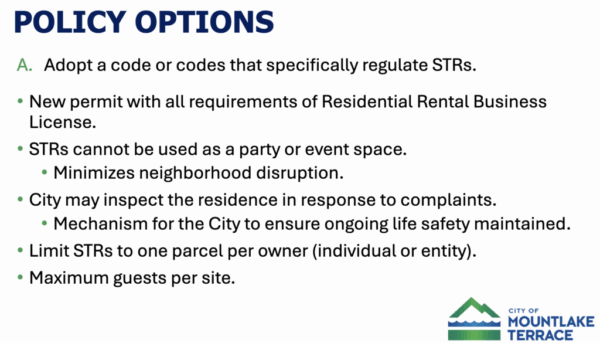
Four policy concepts are on the table, said Community Development Department Code Compliance Officer Laura Stevenson.
- Adopt a code or codes that specifically regulate these short-term rentals.
- Cap the number of short-term rentals allowed in the City.
- Make no changes and continue to treat short-term rentals like long-term rentals, which require a business license, registration with the State Department of Revenue and making the rental available for safety and health inspections by the City or County Department of Health.
- Prohibit short-term rentals.
Stevenson’s best guess at the current number of short-term rentals in Mountlake Terrace is 28.
From the Community Development Department’s perspective, the issue is about policy and safety and compliance. Stevenson said it is difficult to address chronic violations, complaints or safety issues when the legally responsible owner is hard to identify and then track down, and occupant turnover is high.
Third-party ownership is popular in the short-term rental industry, and day-to-day operations are frequently managed through a separate company that is not responsible for the physical property.
Some councilmembers said they see the value of short-term rentals for families.
“If they [families] have to rent a hotel, they have to rent several rooms and if they have little kids, they have to have a place for them to play,” said Councilmember Kyoko Matsumoto-Wright.
Councilmembers Bryan Wahl, William Paige Jr. and Laura Sonmore asked about potential tax revenues for the city. Stevenson said there is no process outlined for that yet, even at the state level. Currently, a residential permit is less than $100, and the cost is associated with the current rental code.
There was no council support for prohibiting short-term rentals.
Because there are so few rentals, there was little interest in limiting the number of short-term rental units. The Mountlake Terrace City Attorney also recommended against caps because it is challenging to find a system that works well.
Cities across Washington and the nation have a mixed bag of rules from short-term rental caps of 1% to 10% of total housing capacity to no short-term rentals at all.
Councilmembers agreed they needed more data and information about how to regulate these rentals through the local code.
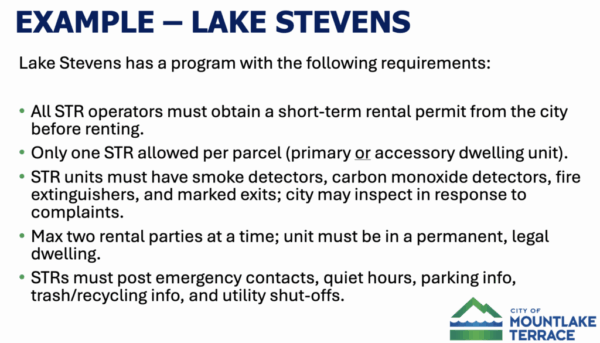
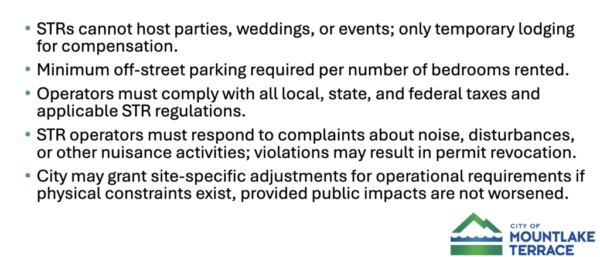
Stevenson outlined possible City code changes for the short-term rentals and shared existing rules in cities like Lake Stevens and Everett.
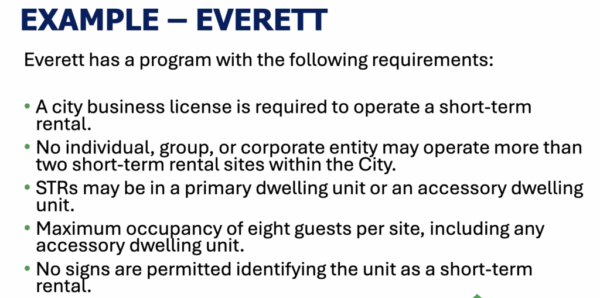
Mayor Steve Woodard asked Stevenson to contact other cities who have caps and regulations and ask how it is actually working and return to brief the Council. He also requested a social media campaign to get current rental owners in compliance with correct residential permits.
Fiscal Sustainability Taskforce
The community-led Fiscal Sustainability Taskforce (FST) formally presented its recommendations to get the City back on solid financial footing and address the long-term general fund revenue gap.
Many task force members were in Council chambers. All Councilmembers and Mountlake Terrace’s Baker Tilly consultants praised Taskforce members for their commitment, compassion and hard work.
“Something that really characterized this whole process and stood out for me was how sincere and respectful they were in articulating their perspectives and also in hearing the perspectives of the other task force members,” Michael Perkins of Baker Tilly said. “How thoughtful and respectful they were in getting to a point of consensus around the ultimate recommended set of budget strategies.”
My MLT News wrote about the task force in February.
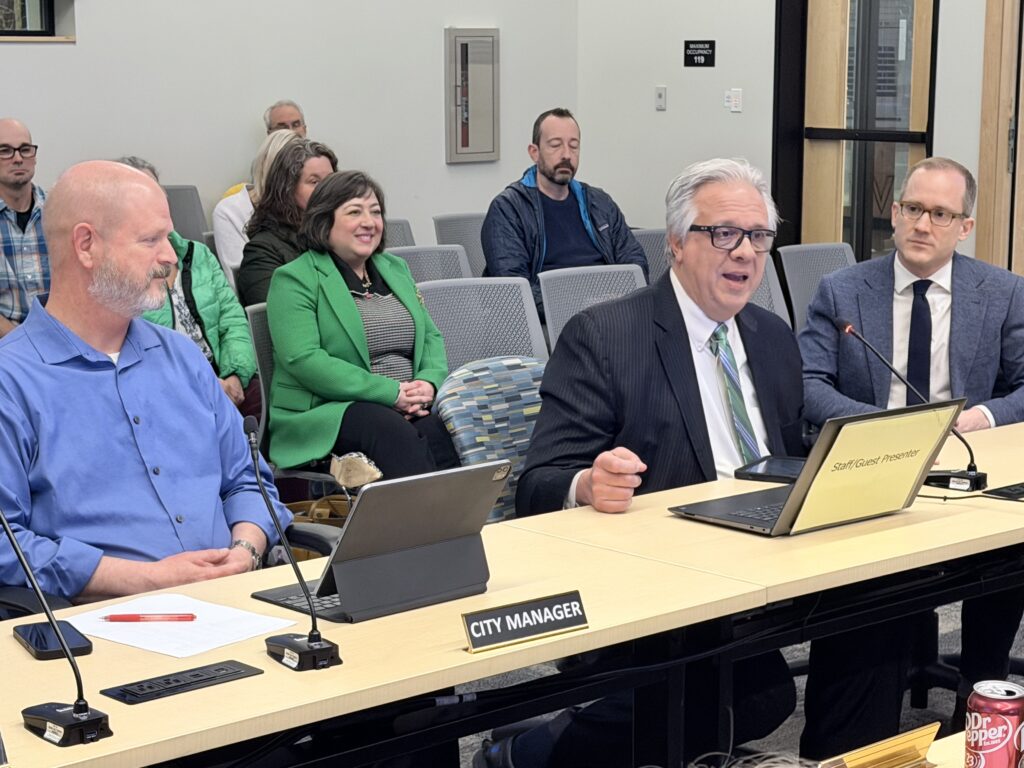
City Manager Jeff Niten recapped the process laying out the problem the task force had to solve – bridge the $4.2 million annual gap between the City’s general fund revenues and expenditures from 2026-30, and the $5.4 million annual gap from 2031-35.
Baker Tilly consultant Steve Toler described the process and work sessions that began in August 2025.
My MLT News wrote a detailed story about the outcomes here.
Task force members presented the two packages.
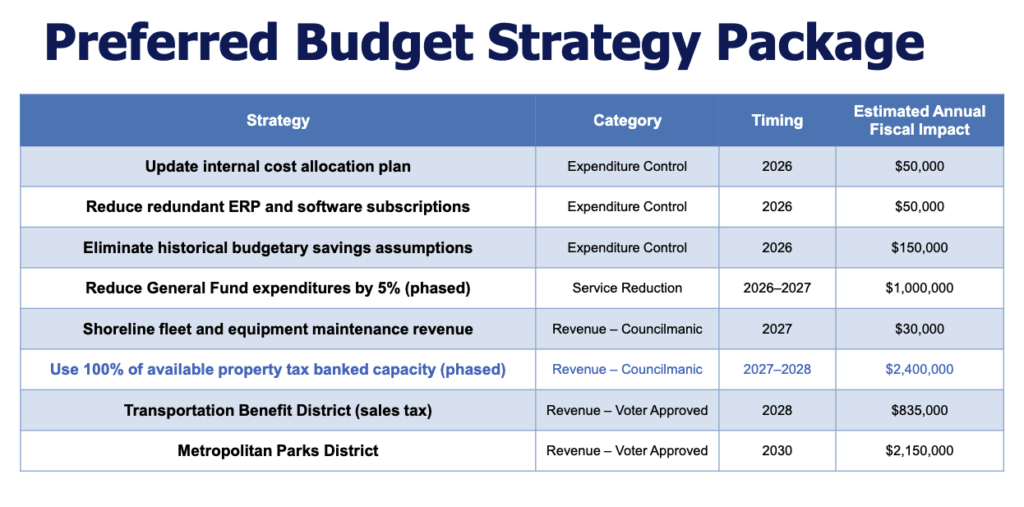
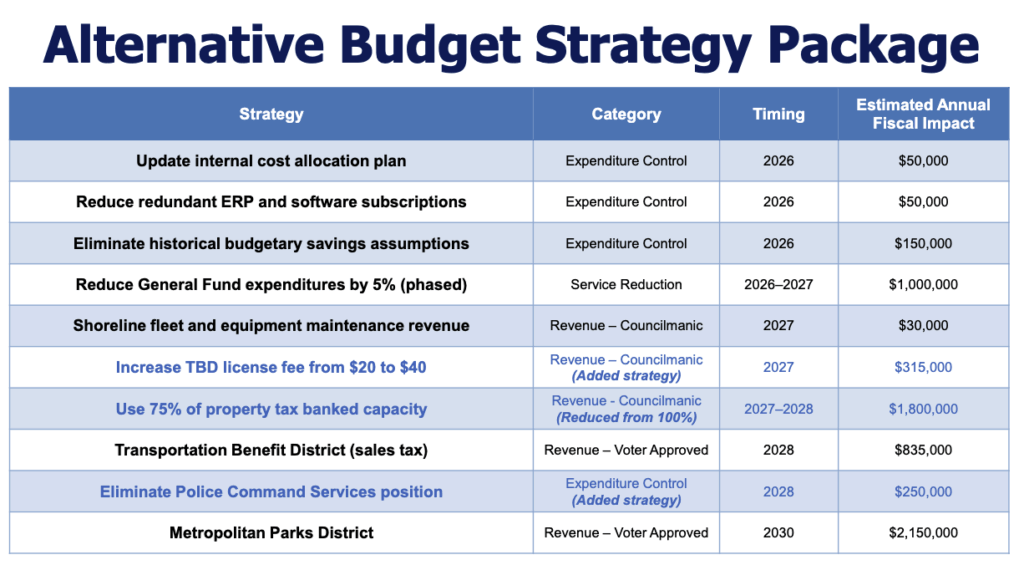
Task force members Danny Luoma, Ellen Lavoie, Eric Nodtvedt and Ian Tucker shared their thinking, how they developed the list of cuts and revenue enhancements and feedback they received from the community after they developed the preferred budget packages.
In the preferred plan, the City uses 100% of its banked capacity. Banked capacity is money the Council has authorized to be collected at an unspecified later time.. It is tied to property tax. Taskforce member Nodtvedt said the group felt this was not as regressive as other options and also generated the largest amount ($2.5 million) to close the $4.2 million gap.
However, it also depletes the banked capacity option if the other levers of the task force’s balanced budget plan fails. For this reason, the alternative plan uses 75% of banked capacity to generate $1.8 million.
The second hard discussion was a .03% sales task versus a $20 increase in car tab fees. The task force agreed to sales tax because, while it generated more money than car tabs, not everything had sales tax. Some food, for example, doesn’t carry sales tax.
Councilmembers asked about the elimination of the police commander. City Manager Niten said it could lead to accreditation issues because it increases the span of control – how many officers one commander supervises. The City will continue to look into this.
Task force members said the City still has work to do. Residents have questions about “banked capacity” and what it is, and also want more information about the potential Metropolitan Parks District (MPD) levy in 2030. The potential MDP levy addresses the general fund shortfall by moving park maintenance out of the general fund and creating a new fund just for that work.
The MPD does not pay for a new Mountlake Terrace pool or Recreation Pavilion.
“It was a very big part of the discussion,” Lavoie said. “Moving forward, that will be a very important separate discussion to have… because no one wants to spend more money. But everyone I talked to wants the Pavilion and the pool.”
The City needs to have more meetings with communities going forward and “reaching out to those who don’t normally show up at City Hall. That’s really, really, really super important,” Lavoie said.
Councilmembers can accept either the preferred or alternative package or develop one of their own. They did not lay out a timeline of when that might happen.
Deputy City Manager Carolyn Hope shared hard deadlines that are budget- and decision- dependent.
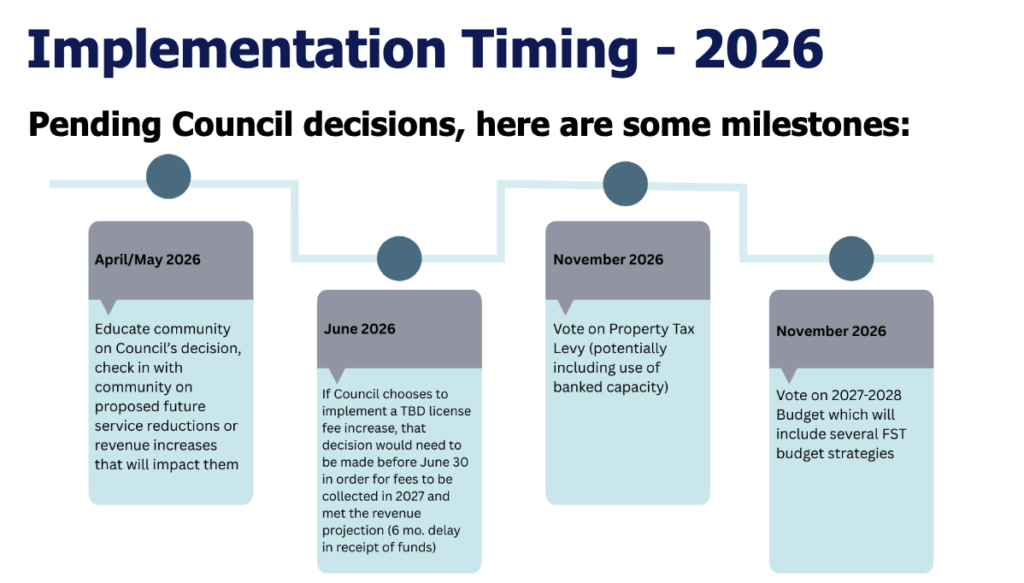
Councilmember William Paige Jr. looked at the entire process as a reflection of people and community.
“You showed our city what community engagement really looks like. I think that your presence and what you all came together to do, I believe, helped open the doors for our community wanting to be community ambassadors,” he said.
Other news
Niten said the next cohort of Mountlake Terrace Community Academy members have their first session Wednesday, March 4.
In addition, the City received a record 48 applicants for performers at Terrace Summer Nights, which runs the last two weeks of July at the Mountlake Terrace Civic Campus.
Finally….
Mountlake Terrace resident and University of Washington’s Urban Planning program student Danny Vega Garcia Alderete shared his big idea to create a musical interlude that plays when riders pull into the Mountlake Terrace Link Light Rail station.
He pitched the idea during public comment.
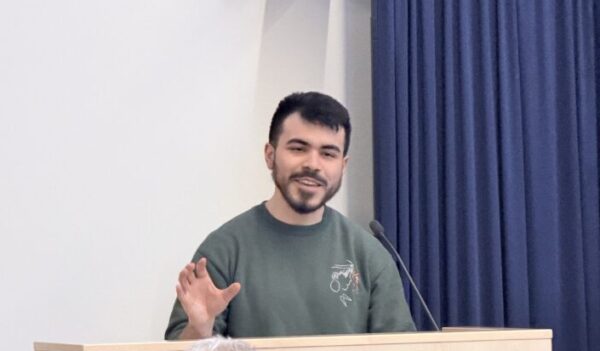
He wants local residents to weigh in on which seven-second melody sounds like “Mountlake Terrace.” Choices include rock and roll, jazz, a traditional Japanese sound or none of the above.
He modeled his idea of “Eki-Melo” after Japan’s train station melodies. Scan this QR code to take his survey and choose the sound you think reflects Mountlake Terrace.



Real first and last names — as well as city of residence — are required for all commenters.
This is so we can verify your identity before approving your comment.
By commenting here you agree to abide by our Code of Conduct. Please read our code at the bottom of this page before commenting.