
Will you chip in to support our nonprofit newsroom with a donation today?
Yes, I want to support My MLTnews!
During his first three months as mayor of Mountlake Terrace, Steve Woodard worked with Councilmembers and staff to tackle the City’s $4.2 million budget gap while connecting with local communities and addressing walkability and public surveillance issues.
Woodard also talked about his role as the City’s first African American mayor, and being part of a council that includes two other African American members and is also mainly female.
Woodard has been on the Council since 2019, when he was appointed to fill the position 2 seat following the death of longtime Councilmember and Mayor Jerry Smith. He is also the Vice President of Community Engagement for Volunteers of America Western Washington (VOAWW).
In this Q&A with My MLT News, the mayor discusses how his background and work experience shapes his leadership, what’s ahead for the city budget and his vision for a more connected Mountlake Terrace.
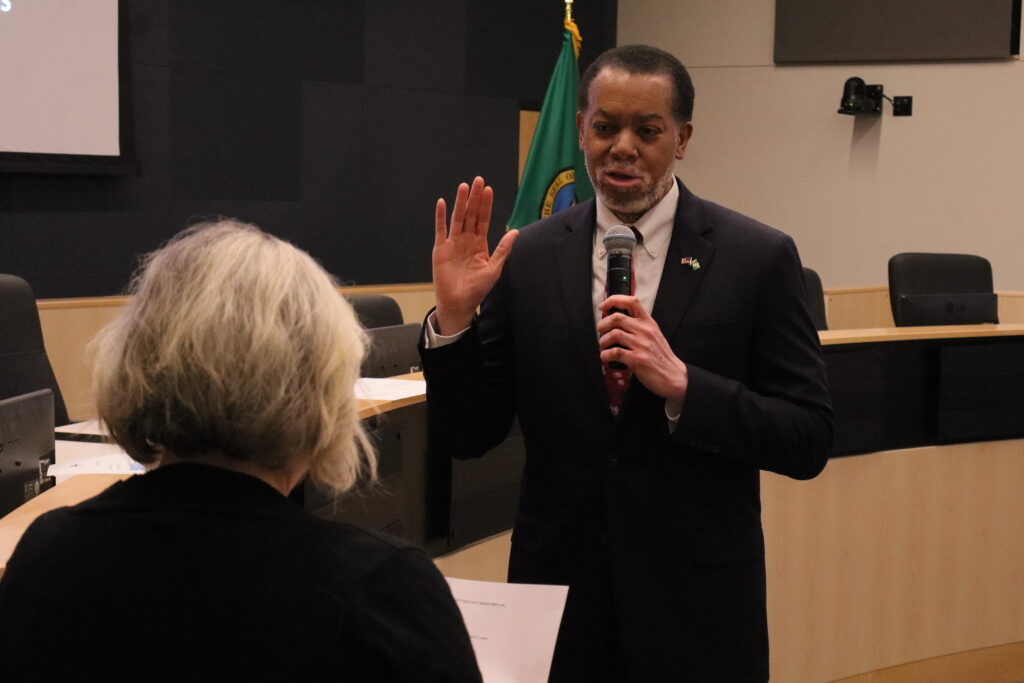
My MLT News: As a first-time mayor of Mountlake Terrace, was there anything that surprised you about the role?
Woodard: You know, not necessarily surprised me. I had great leadership. I had the honor of literally watching Mayor Matsumoto Wright for almost seven solid years doing this work. And before that, the Honorable Jerry Smith was in charge for a number of years. So the few times that I had entered the Council, I kind of saw how he managed the Council.
And I will say that for me, my expectation was my major role on Thursdays…is really to manage the flow of conversation and how we’re dialoguing with each other, and that’s held true so far. So in my regard, it’s been a wonderful transition and an expectation of what I was, you know, my own expectations met.
MMN: Have family and friends treated you differently since you became mayor?
Woodard: Yes and no. Family, surprisingly, no different treatment, as you would expect. Love that kind of humility [that] is always in the home. I definitely have been in newer circles to me or [a different] platform [to be] standing on, which has caused people, I think, to look at me slightly different.
For folks who have never met me, I think once you start to interact with me, you realize, “This guy’s genuine and down to earth. He’s gonna be all right, you know?” Some are like “Oh, my gosh!” Although that still happens, it’s flattering and embarrassing at the same time.
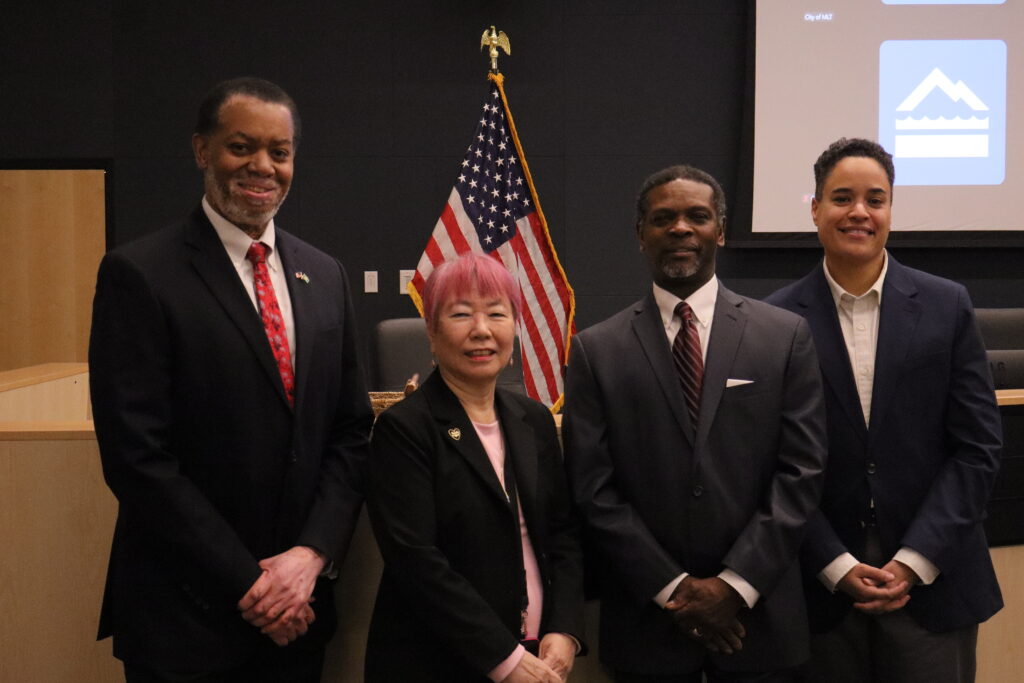
MMN: Since you mentioned during Black History Month that this is the first time that Mountlake Terrace has three councilmembers who are African Americans, why is that significant?
Woodard: It’s an indication of growth, especially growth-mindedness, if you will. The reality is your background and cultural heritage. Have you seen the world differently and interacting in the world, especially with capitalism – when you mix in racism and all the other -isms? That kind of dictates how we interact with each other. You just have a different perspective.
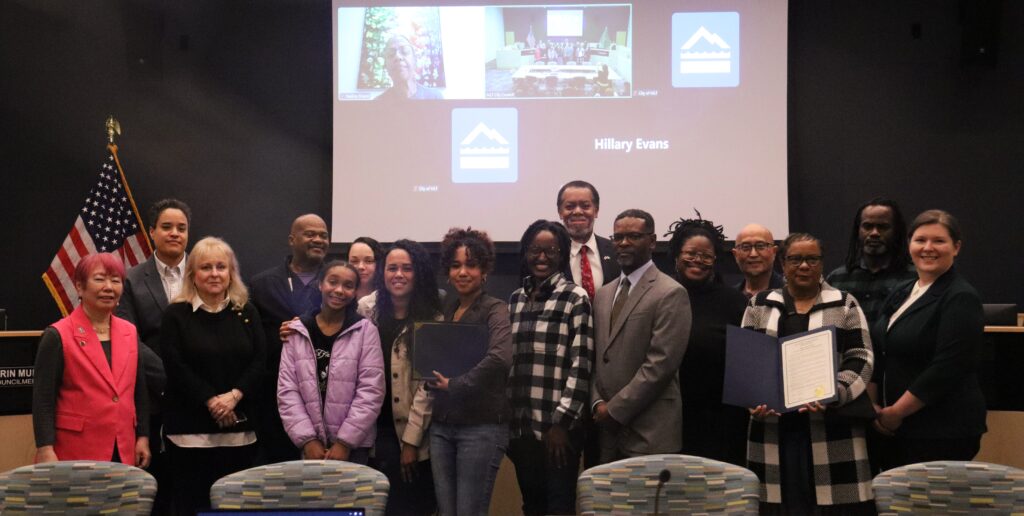
So to have that trust in leadership, I think it’s a significant stride for all communities. In this case, we’re talking African Americans, but really across the spectrum of just having your real community represented across your dais. I think that’s a higher expectation of folks that this is not something that’s inaccessible. In fact, it’s something you should be pursuing.
I’m also hoping it’s impacting the youth who are looking up and seeing themselves reflected here. We are actually a primarily female-led Council, which is awesome. I think to myself, “Okay, you know, you’re disrupting a lot of narratives right there alone.” We are now primarily led by people of color. The more perspectives in the City’s vision, the more vibrant I think that city is just going to be.
MNN: I remember what you said at Mountlake Terrace Plaza about your military background as well as your work with VOAWW. How has your previous career experience helped you or shaped your role as a mayor?
Woodard: Education and human services are kind of my crossroads…just trying to get people [to] recognize [or] envision what human services can be. It’s making sure your needs are met so you can have that ability to dream and get bigger and stronger. How do you have a city thrive?
It’s not individuals, but it’s actually a city as an organism. And so, how do you make sure everybody is being uplifted? That’s the lens that I bring. So as budget decisions are being made, as policies are coming down, [my] angle is always thinking about what’s the impact on real, lived lives.
I have my own lived experience…I’m more invested in other people’s stories than my own advancing, but I’m not going to leave my story out. I’m looking for connections to make sure you’re not left out of that.
MMN: What steps do you have for this year and next year that you and the Council are doing to address the City’s $4.2 million budget gap?
Woodard: First and foremost, being as transparent as possible. By creating a Fiscal Sustainability Taskforce, residents come in and look at [where] we are. Here is what’s coming. How are we going to get there, and what are we bringing forward with us in that process? How is this going to impact you?
They [the task force] presented their recommendations to us. All of this is accessible in digital format. But moving forward, we have an entire timeline that’s mapped out, and we’re not going to move fast. In fact, we had [at our] last Thursday meeting [a discussion that] we have to make some pretty tough decisions here and [during the] next two or three years. And the reality is we weren’t ready. So we’re asking for more information, all of which throughout this process is done out in the public so the public can see what we’re seeing and can give their input on what we’re saying, so that their say is in there as well.
I encourage people to go back to that [My MLT News Government and You series] because it walks you through. This is what a city budget is, what a state budget is.
MMN: What is the City doing to improve walkability and traffic safety?
Woodard: Our goal is to be a walkable city. We’ve been documented as such [in] different polls. Residents themselves have given us that feedback. So really improving our streets, widening our sidewalks. We have an entire Main Street project, phase one is done, and you’re genuinely seeing people love it.
We now have the funding for phase two and are going to start that process. Whenever we are doing road projects, we’re looking for ways to maximize the opportunity. So right here down the street, across from Veterans Park, there’s a lot of work that was being done in the park. In fact, the ribbon cutting is going to be very soon here, but that work blended out into the street as well because that intersection needed to be worked on.
And we still have visions for making that street more accessible: Blinking lights for pedestrian traffic. [We’re] trying to make it easier for developers to understand, well, you have your property that you’re developing, but your property also comes up to the right of way. And we have designs that we envision that are going to make this more walkable city, a more inviting city, a more welcoming space, so stuff like that.
We’re looking at policy and trying not to rush, but to think about, well, how do you make this something more accessible? With light rail opening up, we know Community Transit had a chance to re-envision their routes and how they’re doing service [with] their Zip Cars. We are very fortunate to have Councilmember Matsumoto Wright, [who] is on [the Community Transit] board now so we actually have a voice in Community Transit.We had a topic on transportation, and people that are parking at the park- and-ride [lot] and on the streets live like within a mile of the station, which is mind-blowing because a mile is really not that far. Literally, as a kid in the ‘80s, we had to run a mile in school. It was an expectation.
We might have an opportunity to get them [Community Transit] to expand their Zip Car practice over here. I mean, there’s different ways to think about what resources can help people stay in their place, have a gathering spot, get to the light rail in it, not add an additional 30 minutes because I do know that time is one of the most underestimated commodities. When it comes to public transportation, you can get anywhere if you have the time.
MNN: Regarding public safety, what are the top three issues that you hear about from residents?
Woodard: Generally speaking, I think we have an amazing police force and system in place, but the reality is, you need a succession plan, and that’s something they’ve been actively working on. It’s harder to hire police officers than we give them [the police department] credit [for]. Making sure that we’re planning for the growth that we have while we still bring in quality officers is definitely on our mind.
I just read another article about ICE behavior here in Snohomish County. That [there] is actually [an] uptick, which is having its impact on communities in a lot of different ways. Police officers are caught in the middle of not being able to legally do anything, but also wanting to keep everyone safe. I mean, it’s a horrible situation. Obviously that’s definitely been pressing on people’s minds.

And with us having gone through the Flock conversation so publicly, that conversation hasn’t gone away. It’s just made people that much aware of all the ways in which we’re tracked. How does that play out in the long run? A number of people are pleased that we did not continue with Flock.
MNN: You said you and your family lived in Spain for about 18 months in the early 2010s. Has that experience influenced how you think about Mountlake Terrace’s infrastructure?
Woodard: We giggled a little bit because when we were there, we let our 11-year-old use the [transit] system. It felt like that level of safety and community. It was amazing. When we got back here, it’s like I won’t let him walk to the corner store.
So if everybody’s out walking, it should be as safe as possible. A lot of things are done in isolation. Bad things happen in isolation. But if you got an entire community engaged, then it’s less likely for that to happen.
The distances that we walked [in Spain] became a little bit harder here [Mountlake Terrace], and it was more about what the traffic is. We’re definitely more traffic-oriented than foot traffic-oriented, and that makes a world of difference.
To make intersections safer, we’re looking at actual speed limits versus posted speed limits. So our city engineer right now is going through that process where you have what’s posted, but then you can also see what people are actually doing and try to align them. So we’re not going to change the speed limit, per se, as much as it’s just kind of recognizing, well, this is an area where we need to think about traffic mitigation. We’re thinking about how it makes things safer and more friendly.

Real first and last names — as well as city of residence — are required for all commenters.
This is so we can verify your identity before approving your comment.
By commenting here you agree to abide by our Code of Conduct. Please read our code at the bottom of this page before commenting.