
Will you chip in to support our nonprofit newsroom with a donation today?
Yes, I want to support My MLTnews!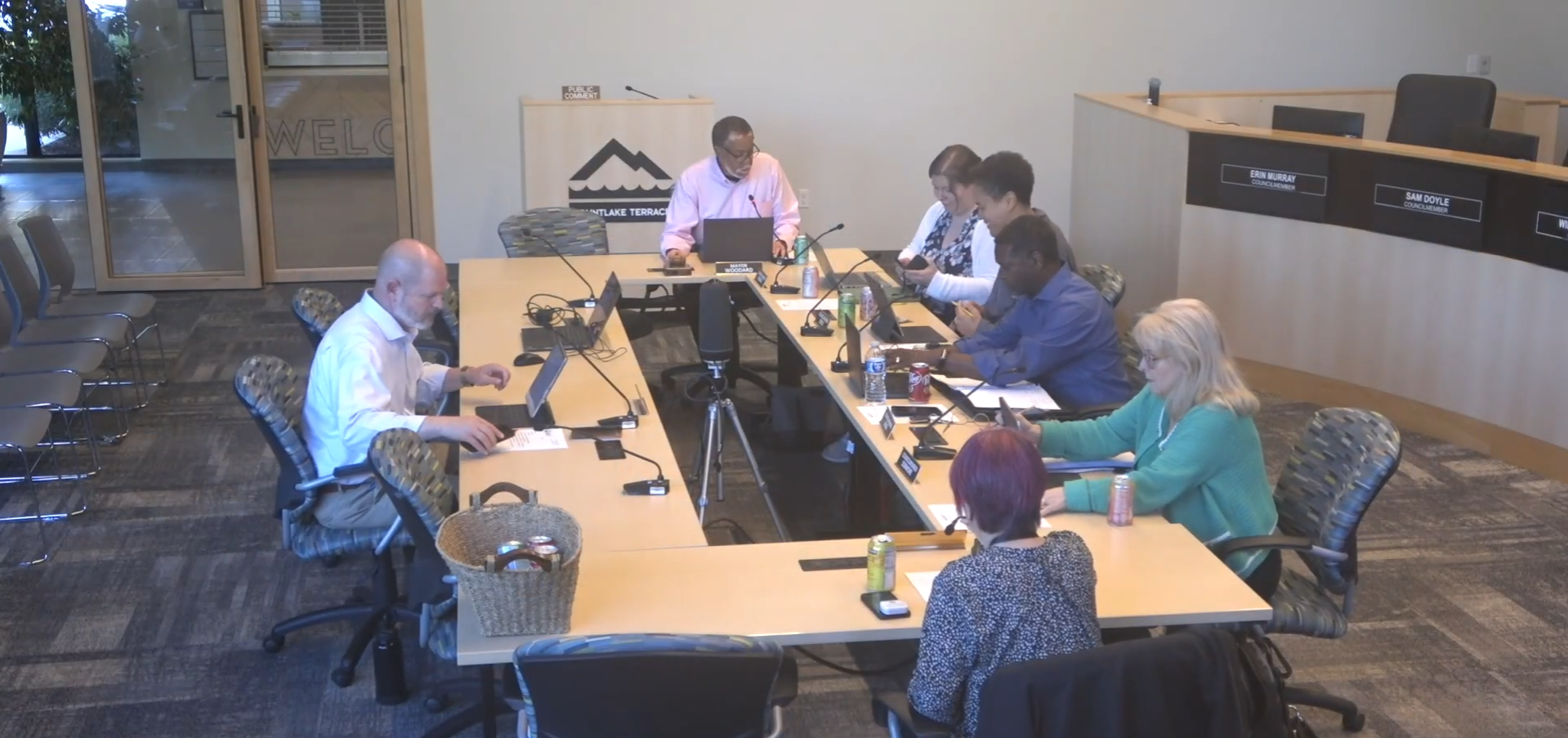
Key takeaways:
- Mountlake Terrace City Councilmembers heard about an interlocal agreement in which the City will reimburse Snohomish County PUD about $950,000 to underground utilities on Main Street.
- The Council also heard an update on the cost and funding of the Main Street Phase II project, residential building codes, permit processing, and how to standardize street addresses.
- The city manager proposed repealing obsolete Title 2 chapters and creating a unified framework for advisory boards and commissions.
The Mountlake Terrace City Council’s Thursday meeting was centered around the Main Street Phase II project, which will bring pedestrian, bicycle and utility improvements to 56th Avenue West between 232nd and 236th Streets Southwest. The project is part of the City’s Comprehensive Plan to boost multimodal access to the light rail transit center and spur development in the Town Center. It is funded through a mix of state and federal grants and City funds, with construction bidding expected in the third quarter of 2026 and work set to begin by year’s end.
Public Works Director Gary Schimek said an interlocal agreement with Snohomish County PUD will move power lines underground as part of the Main Street Phase II project. While the total cost of moving PUD’s existing overhead system underground is about $1.5 million, Schimek said state law requires the City to pay only the difference between full undergrounding and a hypothetical “overhead to overhead” move. Therefore, the City will reimburse PUD about $950,000 after a $500,000 credit
Schimek said that this expense has been “included from the get‑go” in the project budget and that staff have also built in money for similar work with Ziply.
“We knew this was coming from day one because of the work previously on Main Street Phase I,” Schimek said.
Councilmember Laura Sonmore asked why the City pays when telecommunications companies “use our poles.” Schimek said state law treats utilities differently: Telecommunications and cable firms generally pay to move their own facilities, but an 1897-era state agreement for Ziply’s predecessor appears to “grandfather” that company’s rights, meaning the City must fund its full conversion, similar to PUD.
Sonmore also asked whether the City could avoid some undergrounding expenses by using “special telecommunication towers” or rooftop devices instead of burying all facilities. Schimek said he has not explored that alternative but would confer with the project manager,
“If there’s a way we can make a lower cost for the City, I’m all for that,” he said.
Public Works Deputy Director Aparna Khanal said the Main Street Phase II project is under review by the Washington State Department of Transportation and is “getting ready to go out to bid.” Bidding is targeted for the third quarter of 2026, and construction starts in the fourth quarter of this year.
She said work will be phased, with contractors building the west side of the street first and then shifting to the east side, which should be completed by late 2027,
Khanal reported the City has secured three external grants – about $2.5 million from the Department of Commerce, $5 million from the Transportation Improvement Board and $850,000 in federal directed spending – toward a $14.12 million construction budget that also covers contingency and construction management. She added that the Department of Commerce funds must be spent by June 2027, but she said the City expects the main roadway work to be finished in 2027,
In response to Councilmembers Sonmore and Kyoko Matsumoto Wright’s questions on community outreach, Khanal and City Traffic Engineer John Marek said Phase II planning will include communication with residents, schools, emergency services and solid‑waste providers, along with phasing intended to keep two‑way traffic open and improve pedestrian and school‑bus safety during construction.
Building codes, addresses, permits
Community Development Director Brooke Eidem walked the Council through a package of residential zoning and procedural code cleanups, adding that they are meant to clarify existing rules and comply with new state housing and permit laws rather than increase density. In the residential districts update, Eidem said changes tighten up definitions, group multiplex types together, clarify how standards apply to oversized lots and exempt parking areas from floor‑area ratio calculations. They also fixed the ambiguous accessory-dwelling unit (ADU) definition so lots with wetlands or other critical areas are still eligible for an ADU as long as the unit stays outside critical areas and their buffer.
Sonmore repeatedly asked whether the edits would “appear to increase development and flexibility and density,” increase traffic and parking impacts or weaken tree retention. Eidem and City Manager Jeff Niten said that lot sizes, unit types and the number of units that could be built on a lot are not changing.
Regarding permitting procedures, Eidem described a broad reorganization of permit rules to implement 2023’s Senate Bill 5290, consolidate scattered process language, repeal duplicative or outdated chapters, and clearly spell out how comprehensive plan amendments, annual docketing and development agreements work.
Niten said that city codes often become fragmented over time as amendments are added to different sections of the municipal code over many years. As a result, provisions in one chapter can end up conflicting with those in another.
“If we’re going to fix it, fix all of it at once instead of trying to fix each little section as they come about,” he said. “Look at it comprehensively and holistically, make sure it makes sense and that it’s clear.”
Councilmember William Paige, Jr. asked whether this rewrite would prevent future contradictions and whether there would be a digital cross‑reference system. Niten said the responsibility lies with administrators to “make it clear” and “simple,” adding that city staff should consider how people in 20 years look at what the City did.
Eidem then presented a new city addressing policy that standardizes how street names, suffixes and unit numbers – including attached and detached ADUs and middle‑housing units – are assigned to align with the United States Postal Service and emergency services.
She said the City, not developers, will assign names, clarifying that detached ADUs would typically use a lettered unit, such as “Unit A, Unit B” under the main street address.
City code cleanup
City Manager Jeff Niten outlined a cleanup of Mountlake Terrace Municipal Code Title 2, which defines how the City conducts its operations and manages its personnel and advisory bodies. Niten proposed repealing obsolete chapters, including the long‑unused Historical Commission, police reserves, an old firemen’s pension fund and an early 2000s economic feasibility study. He suggested creating a new Chapter 2.30 that standardizes rules for boards and commissions, such as residency requirements, student members and common procedures.
For example, the updates would align the Planning Commission and Lodging Tax Advisory Committee with state law, which moves lodging tax appointments to June starting in 2027; and the Diversity, Equity, and Inclusion Commission would have a student representative who is a voting member. Every other board and commission has the ability to appoint a student member, Niten added.
Paige pushed for all advisory meetings to be publicly published online and later backed adding alternate members so strong applicants who aren’t appointed “don’t disappear.”
Murray pointed out potentially conflicting language over who controls bylaws and rules of procedure. “I’m trying to understand the intent and the difference between what we would be giving commissions the flexibility to make determinations around on their own and what would be coming back to council for approval,” she said.
Niten agreed the Title 2 package would be delayed past June 18 so staff can clarify those sections and incorporate Council feedback. He also thanked City Clerk Jennifer Joki for the “tremendous amount of work” she did with City Attorney Hillary Evans.
All the agenda items will be voted under the consent agenda at the June 18 meeting.
At the end of the meeting, Niten said that the City’s Pride event drew about 1,000 attendees and more than 20,000 views on Instagram.
The meeting can be viewed on the City’s YouTube channel.


Real first and last names — as well as city of residence — are required for all commenters.
This is so we can verify your identity before approving your comment.
By commenting here you agree to abide by our Code of Conduct. Please read our code at the bottom of this page before commenting.