
Will you chip in to support our nonprofit newsroom with a donation today?
Yes, I want to support My MLTnews!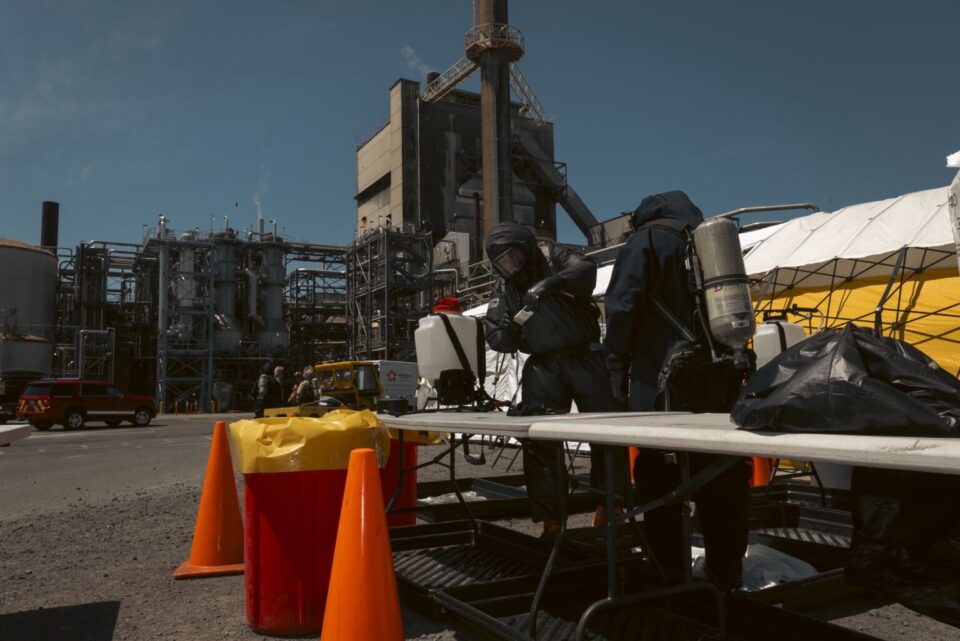
No state agency was responsible for inspecting the 900,000-gallon chemical storage tank that burst at a mill in southwest Washington this week, leaving 11 people dead.
Unlike underground storage tanks that are inspected at least every three years by the Department of Ecology due to groundwater contamination risks, ensuring the safety of above-ground tanks is largely left to site operators.
“There’s no one agency or regulatory body that would be responsible for inspecting any single (above-ground) tank,” said Marissa Baker, industrial hygiene program director at the University of Washington.
“Ultimately, the responsibility falls on the mill owner and operator,” Baker said. “Part of maintaining a safe and healthy work site is ensuring the structural integrity of their tanks that store extremely hazardous chemicals.”
The tank at the Nippon Dynawave Packaging plant in Longview contained a caustic substance known as white liquor. The chemical, used in paper manufacturing, is highly corrosive and can cause severe burns upon contact with skin.
During a press conference Saturday, officials announced that the two remaining victims who went missing have been recovered, raising the confirmed death toll to 11.
“I hope today will give the families so affected by this incident the closure needed to begin the long process of healing,” Longview Fire Chief Brad Hannig said.
The victims who died at the Nippon Dynawave Packaging facility are: Gilbert Bernal, 52; brothers Tyler Covington and Brad Covington, 29 and 27; Robert Wilson, 48; Dale Miller, 54; Jared Ammons, 35; Braydon Finkas, 38; Clinton, or CJ, Doran, 26; John Forsberg, 51; Norman Barlow, 58 and Dillon Miller, whose age was not identified in the press conference.
All recovered individuals have been matched with identifying features, according to Dana Tucker, Cowlitz County coroner.
Seven other employees and a firefighter were injured. Two of those injured remained hospitalized at the Legacy Oregon Burn Center.
Why the tank failed remains unclear. The federal Chemical Safety and Hazard Investigation Board is investigating.
At the state level, Washington’s Department of Ecology oversees the Nippon Dynawave’s water and air quality permits as well as hazardous waste, but those permits do not cover the integrity of storage tanks like the one that failed, said Anna Izenman, Ecology spokesperson.
And, the Department of Labor and Industries has the authority to make sure the company is assessing on-site hazards but doesn’t conduct storage tank inspections, said Matt Ross, public affairs manager for the agency.
Nippon Dynawave did not respond to a request for comment.
An unknown amount of the white liquor spilled outside the facility and authorities have said some of it went into the nearby Columbia River. It also flowed into a local diking system.
Since Tuesday, 23 dead fish, including carp, redfish and bluegill, have been collected near the mill by the Department of Ecology, said Courtney Serad, lead spill responder with the agency.
“As we continue to flush the ditches, we do anticipate that some of the dead fish that we cannot recover will be discharged” into the Columbia River, Serad said, advising the public not to touch or collect them.
Longview’s drinking water remains safe, said Chris Collins, the city’s public works director.
Residents may notice what smells like rotten eggs near ditches, but it is “not a cause for alarm,” Collins said. “This is an indication that our flushing and pumping is working.”
Washington State Standard is part of States Newsroom, a nonprofit news network supported by grants and a coalition of donors as a 501c(3) public charity. Washington State Standard maintains editorial independence. Contact Editor Bill Lucia for questions: [email protected].


Real first and last names — as well as city of residence — are required for all commenters.
This is so we can verify your identity before approving your comment.
By commenting here you agree to abide by our Code of Conduct. Please read our code at the bottom of this page before commenting.